Components of a force. When do I use cos or sin?

Click For Summary
SUMMARY

The discussion focuses on determining the components of a vector A using trigonometric functions, specifically when to apply cosine versus sine. The vector A is defined as (-10 cos70 sin30, 10 cos70 cos30, 10 sin70). The confusion arises from understanding the projection of the vector in relation to its angles, particularly in a polar coordinate system. The explanation provided clarifies that the angle of 30 degrees corresponds to 120 degrees from the x-axis, leading to the use of cosine and sine in calculating the vector's components.

PREREQUISITES
  • Understanding of vector components in three-dimensional space
  • Knowledge of trigonometric functions: sine and cosine
  • Familiarity with polar coordinates and their application in vector analysis
  • Basic principles of vector projection
NEXT STEPS
  • Study vector decomposition in three dimensions using trigonometric identities
  • Learn about polar coordinates and their conversion to Cartesian coordinates
  • Explore vector projection techniques in physics and engineering contexts
  • Practice problems involving trigonometric functions in vector calculations
USEFUL FOR

Students in physics or engineering, educators teaching vector analysis, and anyone seeking to improve their understanding of trigonometric applications in vector decomposition.

Vinny_S
Messages
1
Reaction score
0
Member warned that the homework template is required
Here is an example of a problem I am having trouble with. I need to find the i, j, k of A. I have no issues with finding the components for B, but A I just can't wrap my head around when to use cos or sin. Especially here with double projection.
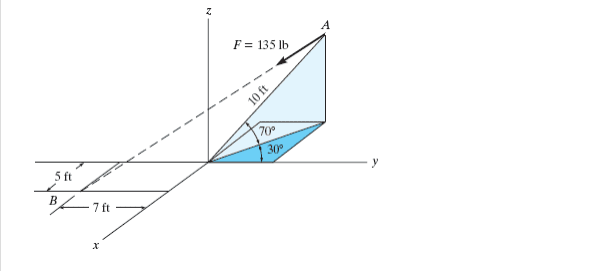
media%2Fed8%2Fed8d3315-6495-41e1-afcf-5b9dccfa364a%2FphpPuMTKo.png


I know that A is :
(-10 cos70 sin30, 10 cos70 cos30, 10 sin70)

Any kind of an explanation regarding why I would do cos vs sin and vice versa would be greatly appreciated. I feel like I am missing something really obvious with this. Thank you.
 
Last edited by a moderator:
Physics news on Phys.org
Since you are new here you may not be aware that bold facing is frowned on.

<Mark44: fixed>

Vinny_S said:
Here is an example of a problem I am having trouble with. I need to find the i, j, k of A. I have no issues with finding the components for B, but A I just can't wrap my head around when to use cos or sin. Especially here with double projection.

media%2Fed8%2Fed8d3315-6495-41e1-afcf-5b9dccfa364a%2FphpPuMTKo.png


I know that A is :
(-10 cos70 sin30, 10 cos70 cos30, 10 sin70)

When you say you "know" that do you mean you understand it or that that is what the answer book says?
If you use standard polar coordinates in the xy plane, the angle you have as 30 degrees would be labelled as ##120^\circ## from the x axis. The shadow of the 10 foot length on the xy plane would be ##10\cos70##, so the x coordinate of A would be ##10\cos(70)\cos(120)##. But ##\cos 120 = -\sin 30##, so that is where your x coordinate comes from. Can you take it from there?
 

Similar threads

  • · Replies 1 ·
Replies
1
Views
4K
Replies
12
Views
7K
  • · Replies 21 ·
Replies
21
Views
6K
  • · Replies 6 ·
Replies
6
Views
2K
  • · Replies 9 ·
Replies
9
Views
2K
Replies
12
Views
3K
  • · Replies 6 ·
Replies
6
Views
3K
  • · Replies 6 ·
Replies
6
Views
4K
Replies
3
Views
2K
  • · Replies 1 ·
Replies
1
Views
2K