Computational General Relativity

Click For Summary
The discussion centers on a user seeking feedback on a Python program designed to compute the Einstein Tensor, specifically the Ricci Tensor, for vacuum solutions of the Einstein Field Equations. The program has successfully derived the Schwarzschild solution, but the user is open to suggestions for improvement and better forum engagement. Other participants recommend using Maxima for handling complex algebraic expressions and suggest testing the software with the Minkowski space metric. Concerns are raised about the reliability of software distribution from SourceForge, and comparisons are made between Maxima and Mathematica regarding their capabilities and pricing. Overall, the thread emphasizes the importance of effective computational tools in general relativity research.
dylanreynolds1
Messages
2
Reaction score
2
Hello all, first post.

I have come here to get second opinions on the program I have written to compute the Einstein Tensor (the Riemann Tensor and Ricci Tensor). I enjoy looking for solutions to the Einstein Field Equations, however computing them by hand is not realistic. I decided to write a program, but I am by no means a programmer.

The program takes in a particular form of the metric, and outputs the Ricci Tensor. Since I am mostly interested in vacuum solutions at the moment, this is all I need. I have copied in the Python code below, however I am sure there is a better way to display it.

Any ideas about how to make the program better, or how to make a better post on this forum are greatly appreciated, however my main goal is to hear form people who know more about GR than me.
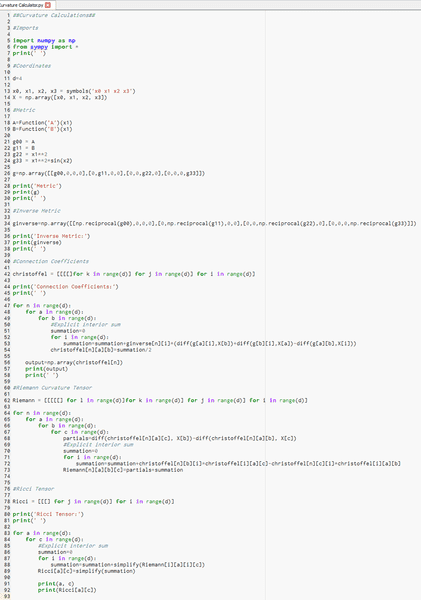
basic1.png

This code has helped me derive the Schwarzschild solution, so it must be at least somewhat accurate. However there may be some small detail that I have missed.

Any help would be much appreciated.
 
Last edited:
  • Like
Likes member 657093 and bcrowell
Physics news on Phys.org
dylanreynolds1 said:
Hello all, first post.

I have come here to get second opinions on the program I have written to compute the Einstein Tensor (the Riemann Tensor and Ricci Tensor). I enjoy looking for solutions to the Einstein Field Equations, however computing them by hand is not realistic. I decided to write a program, but I am by no means a programmer.

The program takes in a particular form of the metric, and outputs the Ricci Tensor. Since I am mostly interested in vacuum solutions at the moment, this is all I need. I have copied in the Python code below, however I am sure there is a better way to display it.

Any ideas about how to make the program better, or how to make a better post on this forum are greatly appreciated, however my main goal is to hear form people who know more about GR than me.

This code has helped me derive the Schwarzschild solution, so it must be at least somewhat accurate. However there may be some small detail that I have missed.

Any help would be much appreciated.
That is all very good but you'll soon run into trouble if you have complicated algebraic expressions that need simplification.

I use Maxima with the windows interface wxMaxima with great success. For free software it is extraordinary. If you can write Python like that you will be able to write scripts that find geodesics, Killing vectors, kinematic decomposition and so on. It also outputs expressions as Latex on demand.

It is available at sourceforge.
 
Last edited:
Have you seen/used Maxima with its ctensor stuff?
 
Cool little project! Although I also would have used maxima and ctensor for this, I'm sure you got some real educational benefit from writing it, which is great. If you want to test whether your software is working correctly, one way to do it would be to write down the Minkowski space metric and then transform into some random, unusual coordinates, then input the metric into your code in that form. It should give zero for the Riemann tensor.

BTW, I hadn't realized that windows versions of maxima were distributed through sourceforge. That's unfortunate, because sourceforge, which was formerly a respected resource in the open-source community, has now degenerated to the point where it has been bundling malware with the binaries it distributes. For linux, maxima is available from more reliable sources, e.g., apt-get for debian and ubuntu.
 
  • Like
Likes PeterDonis
I use Mathematica, because indeed to evaluate the Ricci or Einstein tensor is cumbersome even for simple cases as the spherical symmetric spacetime, leading to the Schwarzschild solution. I was not aware of the free CA maxima. How powerful is that in comparison to Mathematica?
 
vanhees71 said:
I use Mathematica, because indeed to evaluate the Ricci or Einstein tensor is cumbersome even for simple cases as the spherical symmetric spacetime, leading to the Schwarzschild solution. I was not aware of the free CA maxima. How powerful is that in comparison to Mathematica?
I respectfully request to all that future recommendations for Mathematica/Maple be accompanied by pricing information.
 
  • Like
Likes bcrowell
In an inertial frame of reference (IFR), there are two fixed points, A and B, which share an entangled state $$ \frac{1}{\sqrt{2}}(|0>_A|1>_B+|1>_A|0>_B) $$ At point A, a measurement is made. The state then collapses to $$ |a>_A|b>_B, \{a,b\}=\{0,1\} $$ We assume that A has the state ##|a>_A## and B has ##|b>_B## simultaneously, i.e., when their synchronized clocks both read time T However, in other inertial frames, due to the relativity of simultaneity, the moment when B has ##|b>_B##...

Similar threads

  • · Replies 20 ·
Replies
20
Views
2K
  • · Replies 15 ·
Replies
15
Views
3K
  • · Replies 8 ·
Replies
8
Views
1K
  • · Replies 4 ·
Replies
4
Views
2K
  • · Replies 6 ·
Replies
6
Views
2K
  • · Replies 33 ·
2
Replies
33
Views
4K
  • · Replies 9 ·
Replies
9
Views
2K
  • · Replies 186 ·
7
Replies
186
Views
11K
  • · Replies 14 ·
Replies
14
Views
2K
  • · Replies 10 ·
Replies
10
Views
2K