boris16
- 46
- 0
hiya
I'm having some problems understanding concave mirrors and their reproduction of actual object.
1)
Can you show me some proof as to why all rays of light from the object converge at the same point ( image point )?
2)
I'm having hard time understanding how person looking at real image of an object ( created by concave mirror ) will perceive this image?
Will person have the feeling as if real image ( aka reproduction of an actual object ) is located in front of a concave mirror?
*To explain myself further: plane mirrors create virtual images --> images which are formed in locations where light does not actually reach, even though it appears to an observer as though the light were coming from position somewhere behind the mirror. So an image of an object is actually
" created on the surface of a mirror " --> mirror in a way acts as monitor screen.
But with concave mirrors, it sounds to me as if image of an object is created away from the mirror, thus unlike with plane mirrors ( which have image of an object created on its surface, even if it appears to observer as if image is located behind the mirror ), concave mirrors don't have an image of object created on its surface?
3)
BTW-How does one perceive something as being closer or further away? Does it have to do with size of an object ( meaning if object appears bigger than it is closer ) or is there more to it?
thank you
I'm having some problems understanding concave mirrors and their reproduction of actual object.
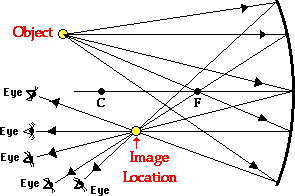
Suppose that a light bulb is placed in front of a concave mirror at a location somewhere behind the center of curvature (C). The light bulb will emit light in a variety of directions, some of which will strike the mirror. Each individual ray of light which strikes the mirror will reflect according to the law of reflection. Upon reflecting, the light will converge at a point. At the point where the light from the object converges, a replica or reproduction of the actual object is created; this replica is known as the image. Once the reflected light rays reach the image location, they begin to diverge . The point where all the reflected light rays converge is known as the image point. Not only is it the point where light rays converge, it is also the point where reflected light rays appear to an observer to be diverging from. Regardless of the observer's location, the observer will see a ray of light passing through the real image location. To view the image, the observer must line her sight up with the image location in order to see the image via the reflected light ray. The diagram below depicts several rays from the object reflecting from the mirror and converging at the image location.
[/size]
1)
Can you show me some proof as to why all rays of light from the object converge at the same point ( image point )?
2)
Not only is it the point where light rays converge, it is also the point where reflected light rays appear to an observer to be diverging from.
[/size]
I'm having hard time understanding how person looking at real image of an object ( created by concave mirror ) will perceive this image?
Will person have the feeling as if real image ( aka reproduction of an actual object ) is located in front of a concave mirror?
*To explain myself further: plane mirrors create virtual images --> images which are formed in locations where light does not actually reach, even though it appears to an observer as though the light were coming from position somewhere behind the mirror. So an image of an object is actually
" created on the surface of a mirror " --> mirror in a way acts as monitor screen.
But with concave mirrors, it sounds to me as if image of an object is created away from the mirror, thus unlike with plane mirrors ( which have image of an object created on its surface, even if it appears to observer as if image is located behind the mirror ), concave mirrors don't have an image of object created on its surface?
3)
BTW-How does one perceive something as being closer or further away? Does it have to do with size of an object ( meaning if object appears bigger than it is closer ) or is there more to it?
thank you