SUMMARY
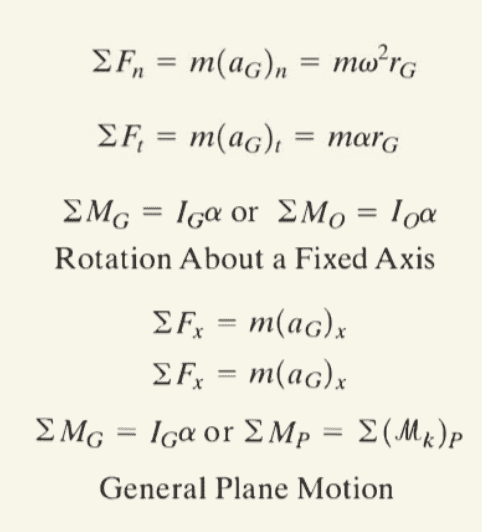
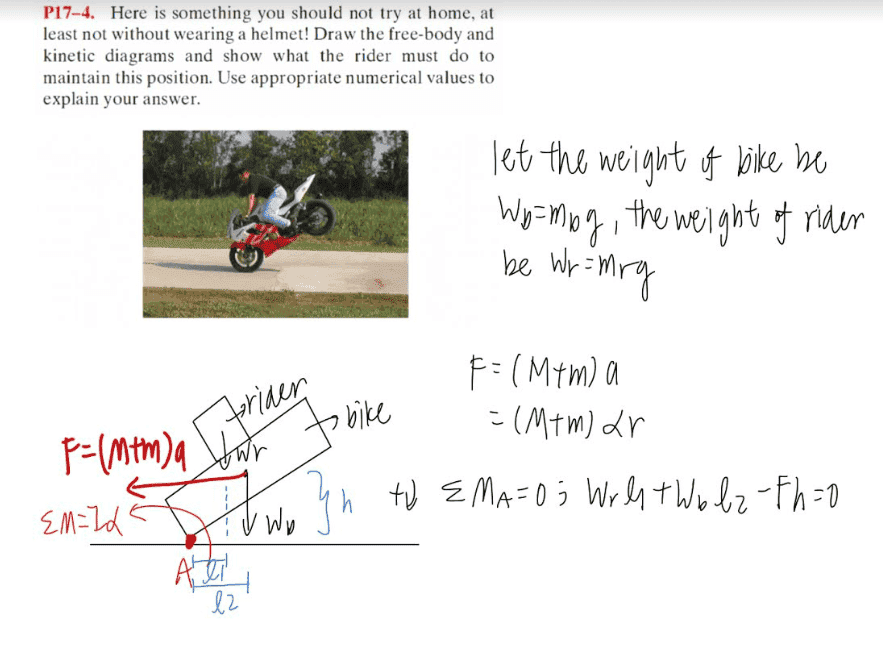
This discussion focuses on maintaining the position of a bike and rider during deceleration, utilizing the principles of planar kinetics. The combined center of mass (CM) is identified as being located near the rider's knees, with the front tire's contact patch acting as a fulcrum. The analysis includes the effects of horizontal friction forces at the contact patch and the balance of moments, specifically addressing the clockwise moment induced by weight and the counter-clockwise moment. The role of friction force in this scenario is debated, emphasizing its significance in the overall dynamics.
PREREQUISITES
- Understanding of planar kinetics and dynamics
- Familiarity with concepts of center of mass (CM)
- Knowledge of friction forces and their effects on motion
- Basic grasp of moment equilibrium in physics
NEXT STEPS
- Research the role of friction in dynamic systems
- Study the principles of moment equilibrium in planar motion
- Explore the effects of combined center of mass in multi-body systems
- Learn about the equations of motion for decelerating vehicles
USEFUL FOR
This discussion is beneficial for mechanical engineers, physics students, and cycling enthusiasts interested in the dynamics of bike handling and stability during braking maneuvers.