Conceptual Question- Hydrostatic Pressure

Click For Summary
SUMMARY

The discussion centers on the comparison of hydrostatic pressure at two points, A and B, located at equal depths in water. It is established that while the pressures at equal depths are generally equal, the presence of a ship above point A complicates this scenario. The weight of the ship and the volume of water it displaces must be considered, as they can increase the pressure at point A compared to point B. Therefore, the pressure at A can be greater than that at B if the displaced water's weight exceeds the ship's weight.

PREREQUISITES
  • Understanding of hydrostatic pressure principles
  • Knowledge of Pascal's principle
  • Familiarity with concepts of buoyancy and displacement
  • Basic physics equations related to pressure and force
NEXT STEPS
  • Study the principles of hydrostatics in fluid mechanics
  • Learn about Pascal's law and its applications
  • Explore the concept of buoyancy and Archimedes' principle
  • Investigate the effects of submerged objects on fluid pressure
USEFUL FOR

Students studying physics, particularly those focusing on fluid mechanics, as well as educators and anyone interested in understanding hydrostatic pressure and its applications in real-world scenarios.

bcjochim07
Messages
366
Reaction score
0
b]1. Homework Statement [/b]
In the figure, is pressure at A larger than, smaller than, or equal to the pressure at B?
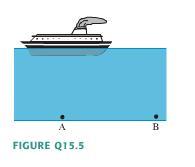
aship.jpg
[

Homework Equations


The Attempt at a Solution


My first instinct is that they are equal because they are at equal heights, but then again, isn't the pressure at the surface above A greater than the surface above B because of the force, mg, of the boat exerted over the surface area in addition to the pressure exerted by the atmosphere? Could someone please explain this to me? Thanks.
 
Physics news on Phys.org
You have mentioned equal heights -- height above what? I hope you meant depth from the surface of the water. Then the pressures must be equal, since the depths are equal.

But there's a ship above A. Your concern is will that change the pressure at A? (You can safely neglect atmospheric pressure, since that is acting everywhere.)

The ship exerts some pressure on the water surrounding it due to its weight. It also displaces a certain volume of water, which is the volume of the submerged portion of the ship.

Suppose you take out the ship and replace the volume of the submerged portion of the ship by water, so that the water level becomes same everywhere. How much does this volume of water weigh? If it weighs, say, more than the ship, then the pressure on A will definitely be more than that at B.

What does your instinct say? And Physics?
 

Similar threads

  • · Replies 6 ·
Replies
6
Views
3K
  • · Replies 3 ·
Replies
3
Views
1K
  • · Replies 1 ·
Replies
1
Views
2K
  • · Replies 11 ·
Replies
11
Views
3K
  • · Replies 5 ·
Replies
5
Views
10K
  • · Replies 10 ·
Replies
10
Views
3K
  • · Replies 1 ·
Replies
1
Views
3K
  • · Replies 3 ·
Replies
3
Views
1K
  • · Replies 6 ·
Replies
6
Views
1K
  • · Replies 6 ·
Replies
6
Views
2K