Conformability elastic material compressed on a wavy surface

Click For Summary
SUMMARY

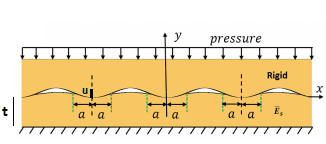
This discussion focuses on determining conformability parameters for a finite elastic material, specifically EPDM, when compressed on a rigid, slightly wavy surface. The user seeks to optimize the thickness of the elastic material concerning indentation depth, contact area, and pressure. Key variables include indentation depth (u), thickness (t), pressure (P), and elastic modulus (E). The suggested approach involves using finite element analysis, particularly when the undulation depth is significant relative to the material thickness.

PREREQUISITES
  • Understanding of finite element analysis (FEA)
  • Knowledge of elastic materials, specifically EPDM properties
  • Familiarity with contact mechanics principles
  • Basic equations relating pressure, thickness, and elastic modulus
NEXT STEPS
  • Research finite element modeling techniques for elastic materials
  • Study contact mechanics and its application to wavy surfaces
  • Explore optimization methods for material thickness in engineering applications
  • Learn about the properties and applications of EPDM in engineering contexts
USEFUL FOR

Engineers, material scientists, and researchers involved in the design and optimization of elastic materials in contact with complex surfaces.

SolMech
Messages
5
Reaction score
0
Hey there,

I'm struggling in finding the useful equations to determine some conformability parameters for a finite elastic material (EPDM) compressed on a rigid slightly wavy surface. I would like to optimize the thickness of the elastic material in terms of indentation depth and thus contact area and pressure. To describe the situation I've added the following picture.
upload_2016-6-1_9-17-9.png


I would like to determine indentation depth u in terms of thickness t, pressure P and elastic modulus E. Could you assist me in finding the solution.
 
Engineering news on Phys.org
My inclination would be to solve this using finite element, particularly if the depth of the undulations is significant (compared to the thickness of the elastic material). You can use a "unit cell" consisting of half the wave laterally. I can't think of a simple "strength of materials" approximation that would work on this.
 

Similar threads

Replies
1
Views
3K
  • · Replies 2 ·
Replies
2
Views
3K
  • · Replies 9 ·
Replies
9
Views
7K
  • · Replies 1 ·
Replies
1
Views
4K
Replies
2
Views
649
  • · Replies 35 ·
2
Replies
35
Views
29K
  • · Replies 264 ·
9
Replies
264
Views
32K
  • · Replies 1 ·
Replies
1
Views
2K
  • · Replies 6 ·
Replies
6
Views
11K
  • · Replies 2 ·
Replies
2
Views
4K