Confused about force and work in 3 Dimensions. Line integrals.

Click For Summary

Discussion Overview

The discussion revolves around the role of force in calculating work using line integrals in three-dimensional space. Participants explore the implications of defining work in the context of a continuous force field and its relationship to the motion of a particle along a specified curve.

Discussion Character

  • Exploratory
  • Debate/contested
  • Technical explanation

Main Points Raised

  • One participant expresses confusion about how a force field can move an object from point A to point B, questioning the implications of the position function r(t) and its relationship to the force field.
  • Another participant suggests that the force field does not need to move the object directly, proposing an analogy of an object on rails with an external device providing the necessary force.
  • There is a discussion about whether the particle's motion is independent of the force field, with one participant asserting that the particle must act independently to reach point B.
  • Some participants challenge the notion that the force field is solely responsible for initiating motion, suggesting that the particle's movement can be considered independently of the force field.
  • Concerns are raised about scenarios where the force field opposes the motion of the particle, leading to negative work and potential implications for reaching point B.

Areas of Agreement / Disagreement

Participants do not reach a consensus on the relationship between the force field and the motion of the particle. Multiple competing views remain regarding the independence of the particle's motion and the role of the force field in dictating the path.

Contextual Notes

There are unresolved assumptions regarding the nature of the force field and its interaction with the particle's motion, as well as the implications of defining r(t) strictly as a position function versus a more general curve.

PhysicsKid0123
Messages
95
Reaction score
1
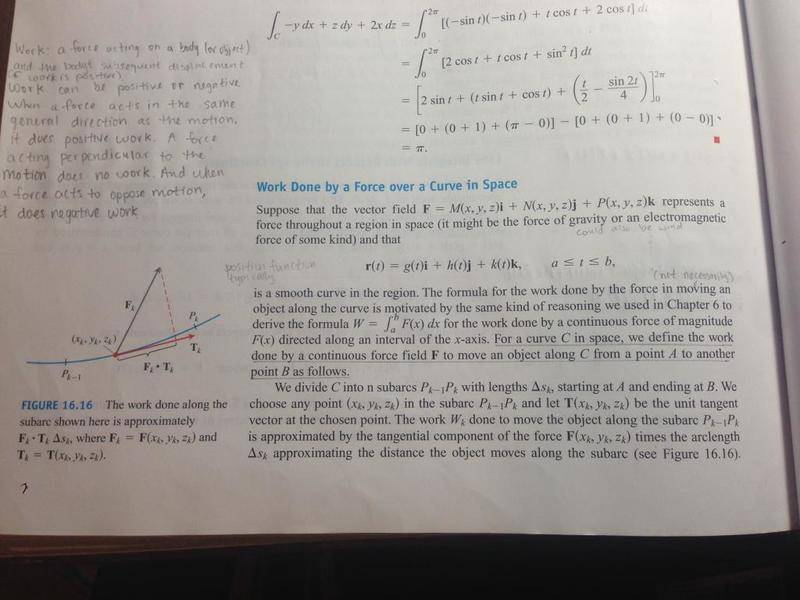
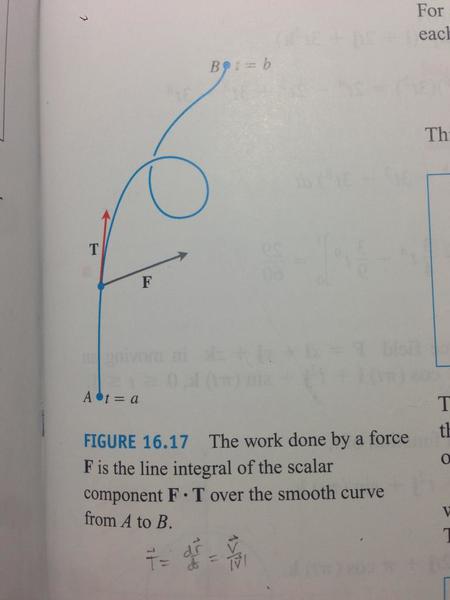
So I am kind of confused about the role of force when calculating work. Specifically, when defining work using a line integral. There is a paragraph in my calculus book that is really throwing me off and its really bugging me so much I can't continue reading unless I fully understand what's going on. It is the part where it talks about how "For a curve C in space, we define the work done by a continuous force field F to move an object along C from a point A to another point B as follows." Here, the curve C is defined by r(t) = g(t)i + h(t)j + k(t)k. I'll link a picture of what it says. My problem is how can such a force field specifically move an object from point A to a point B. Isn't this only true when the magnitudes of the i components in both r and F are greater than the magnitudes of the j and k components. I am aware that when a force is applied perpendicularly to motion, there is zero work. When force is opposed to motion work is negative. When force is in the direction of motion work is positive. Force can initiate motion when an objecting is "stationary," and so this object moves in the direction of the force. To better understand my question, r(t) defines the definite position function of a particle (kind of like a train following the train tracks), but if r(t) is completely opposed to the force field for all of time t, how does it move it from a point A at t = 0 to a point B at t = t* where t* >0. Doesn't the position function r(t) imply that it has it's own velocity and acceleration vectors (from derivatives) which is what gives rise to motion and thus the ability to travel through the curve from A to B, separate from the influence of the force field. Furthermore, isn't the force field that acts on such a particle that is moving on it's definite fixed path or curve C merely just changing the speed at which the particle travels? For example, in one of the pictures there is a curve that has a loop. In the part of the loop where the particle travels against the force(when the velocity vector and force vector at that point in space are parallel and opposing), it slows down, but when it turns back around in the opposite direction it accelerates again. If the force field is the only thing to initiate motion and perpetually "move an object along C from a point A to another point B" it will not always be able to move it to point B. For example, if the particle has a path in the direction of the force field then takes a 180 degree turn shortly after and follows a very long path opposing the field before turning back around to approach the point B again, it will not have gained the momentum or velocity to do so since the force would have slowed it down and perhaps sent it back to A. The paragraph is implying that the force is dictating the position function r(t). Meaning that r(t) does not have a fixed position function and is free to move along the force field F.
What kind of other implications could arise if we solely define r(t) to be simply a curve C not necessarily a position function, or is it always going to describe a position function of some sort? (I always think of a particle's position, which may not always be true and perhaps be applied to other things.)
48D2D039-F5DD-4E22-9E8A-80AB40DB4193.jpg


95757895-D6A4-4A2F-AC34-FCE2EC4B4FC6.jpg
 
Last edited:
Physics news on Phys.org
PhysicsKid0123 said:
My problem is how can such a force field specifically move an object from point A to a point B.
It cannot, and it does not have to. Imagine the object being on rails with some other device/force (like a motor) delivering the necessary force to move it along. What is the energy this device needs for the path due to the force you consider?

The velocity of the particle is not relevant here.
 
I'm not sure I understand the question you are posing.
 
Okay, the position function r(t) implies that the particle moves on its own accord, like a rocket ship in space. Correct?

If this is not the case, then the motion is initiated by and thus comes from the force field which subsequently moves the particle and therefore work has been put into moving it. But if the path were to encounter a 180 degree turnaround the force field would then oppose the motion after the turn around and work in this case would be negative until it stops completely due to the force which would then move it back toward the turn around producing positive work. And eventually reaching a stable equilibrium at the turn around. So the particle cannot get to point B unless it acts independently of the force field.

mfb said:
It cannot, and it does not have to. Imagine the object being on rails with some other device/force (like a motor) delivering the necessary force to move it along. What is the energy this device needs for the path due to the force you consider?

The velocity of the particle is not relevant here.
 
Last edited:
PhysicsKid0123 said:
Okay, the position function r(t) implies that the particle moves on its own accord, like a rocket ship in space. Correct?
It can move, but we can also just consider "what happens if it moves (for whatever reason)?".

then the motion is initiated by and thus comes from the force field which subsequently moves the particle
No. Forget that concept. The particle moves, we don't know why and we do not have to care.
 

Similar threads

Replies
5
Views
2K
Replies
6
Views
2K
  • · Replies 23 ·
Replies
23
Views
3K
  • · Replies 9 ·
Replies
9
Views
3K
  • · Replies 6 ·
Replies
6
Views
1K
  • · Replies 9 ·
Replies
9
Views
3K
  • · Replies 2 ·
Replies
2
Views
2K
  • · Replies 4 ·
Replies
4
Views
2K
  • · Replies 31 ·
2
Replies
31
Views
4K
  • · Replies 8 ·
Replies
8
Views
2K