Confused by basic hydropower concepts

  • Thread starter Thread starter Micmic85
  • Start date Start date
  • Tags Tags
    Concepts Confused
Click For Summary

Discussion Overview

The discussion revolves around basic concepts of hydropower, specifically the mechanics of water flow through a penstock and its implications for turbine operation. Participants explore the effects of removing a nozzle and valve from the system, questioning how this impacts the generation of power by the turbine.

Discussion Character

  • Exploratory
  • Technical explanation
  • Debate/contested

Main Points Raised

  • One participant questions the assertion that power generated by the turbine would be zero without a nozzle, arguing that water exiting the pipe has velocity and kinetic energy that could potentially be harnessed.
  • Another participant explains that without the nozzle, the hydrostatic pressure is lost, resulting in insufficient velocity at the turbine input to generate power.
  • A different perspective compares the situation to a garden hose, suggesting that while velocity exists without a nozzle, it is not sufficient to effectively power a turbine.
  • One participant mentions that real-life turbines operate on a combination of impulse and reaction principles, indicating that design choices depend on specific flow and head conditions.
  • Another participant suggests that an old-fashioned paddlewheel could extract some energy at low speeds, contrasting it with modern turbine designs that operate at higher speeds.
  • Concerns are raised about the design of the nozzle and its role in converting potential energy to kinetic energy, with speculation that pressure energy may be lost as heat without proper design.
  • Several participants note that the basic scenario assumes zero velocities in both the reservoir and tailings pond, leading to the conclusion that without flow velocity, the turbine cannot spin.
  • One participant suggests that the problem may be mis-stated, indicating that without nonzero values, there is nothing to solve.

Areas of Agreement / Disagreement

Participants express a mix of agreement and disagreement regarding the implications of removing the nozzle. While some agree on the minimal velocity without the nozzle, others challenge the initial claim about power generation, leading to an unresolved discussion on the mechanics involved.

Contextual Notes

Limitations include assumptions about flow velocities and pressure conditions that may not be fully articulated in the initial problem statement. The discussion highlights potential gaps in the provided information from the textbook referenced.

Micmic85
Hi everybody,

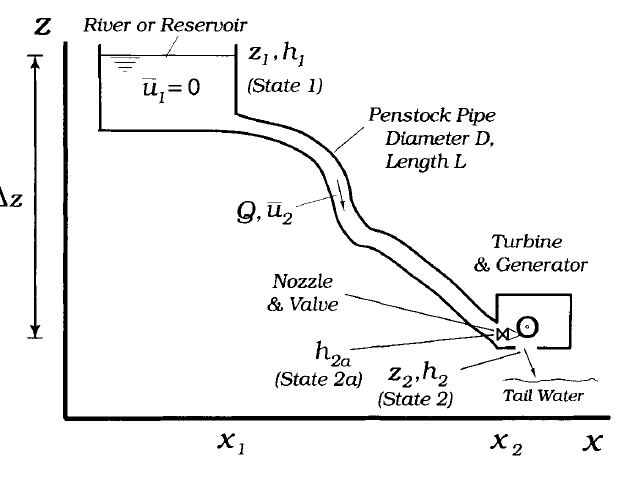
Consider the situation illustrated in the attached figure . A large water tank at elevation z1 is connected to a penstock with diameter D and outlet at elevation z2. The flow in the penstock is Q. The outlet of the pipe is connected to a valve and nozzle that direct a jet of water to an impulse turbine. Yes, the most basic stuff...
tank_zpsqd840mua.png


Let's assume that we remove the nozzle and valve at the outlet of the pipe. Q is in that case the natural flow in the pipe, i.e. the maximum flow that a pipe of a given diameter can carry under the sole action of gravity. From the book of Jones, Gravity Driven Water Flows in Networks, the power generated by the turbine in that case would be 0...I cannot understand this as the water coming out of the pipe has some velocity and carries then kinetic energy that could be used to rotate the turbine. Can someone clarify?

Thanks
 
Engineering news on Phys.org
Welcome to PF.

The natural flow will be limited when the hydrostatic pressure of the water is lost as the water flows down the penstock. There will be no pressure available at the turbine input. The nozzle is needed to speed up the water velocity and narrow the jet to match the impulse turbine dimensions. Without the jet, the turbine will be flooded with low velocity water that has insufficient speed to spin the turbine fast enough to generate power.
 
Forger the hydropower and just think of a garden hose with a nozzle. The stream in the air has no more pressure, but it does have velocity. The nozzle gives it more velocity but less flow, until the nozzles opens far enough that flow is limited by friction in the hose. After that, opening the nozzle more has no effect.

Any real life turbine has a some fraction of impulse (velocity change) and reaction (pressure change). But the ratios vary dramatically in different situations.

Condider the pelton wheel turbine, the Francis turbine, and the propeller turbine. That is only three designs, but there are an infinite number of combinations of head and flow rates. So most real life cases would be optimum with a compromise design combining all three.
 
I agree with you there's minimal velocity. So an old fashioned paddlewheel turning slowly could extract some energy.

But a hydro plant turbine is not a low speed paddlewheel
and if we constrain it to operation near synchronous speed
i expect its blades would be moving faster than the water
so it would deliver power to the water instead of the other way round, just churning like an eggbeater .

If the author is a hydro-power guy he may simply have forgotten that once upon a time he didn't know that, so neglected to explain it.
Haste makes waste. That's the price of "Publish or Perish" mentality in academia

Make any sense ?

old jim
 
With a nozzle at the bottom: All potential energy of water becomes kinetic energy of water.

With no nozzle at the bottom: Well, same as above, I guess.

At the place where the pipe starts, there's a 'nozzle', above the 'nozzle' there's the pressure caused by the water above, below the 'nozzle' there's the under pressure caused by the water in the pipe.

I would guess a nozzle must be carefully designed, which the top 'nozzle' is not. So maybe the pressure energy is converted mostly to heat energy of the water at that point?
 
jim hardy said:
I agree with you there's minimal velocity.
Specifically, the basic scenario assumes the velocities in the reservoir and tailings pond to both be zero. No flow velocity, no spinning turbine. There are some other assumption in there that are hidden, but might be visible in the context in the textbook we aren't seeing.
 
russ_watters said:
Specifically, the basic scenario assumes the velocities in the reservoir and tailings pond to both be zero. No flow velocity, no spinning turbine. There are some other assumption in there that are hidden, but might be visible in the context in the textbook we aren't seeing.

I agree, the problem must be mis-stated. Unless there is something nonzero somewhere in the problem, there's nothing to solve.
 
  • Like
Likes   Reactions: russ_watters

Similar threads

  • · Replies 8 ·
Replies
8
Views
2K
  • · Replies 20 ·
Replies
20
Views
11K
  • · Replies 4 ·
Replies
4
Views
5K
Replies
21
Views
9K
  • · Replies 5 ·
Replies
5
Views
2K
Replies
3
Views
3K
  • · Replies 2 ·
Replies
2
Views
8K
Replies
18
Views
5K
  • · Replies 1 ·
Replies
1
Views
3K
Replies
2
Views
2K