Confused by Integration in Polar Coordinates: Why Use This Unfamiliar Method?

  • Context: Undergrad 
  • Thread starter Thread starter Abdul.119
  • Start date Start date
  • Tags Tags
    Confused Integration
Join the discussion
Registration is free. Ask a follow-up in this thread, or start your own.
5 replies · 2K views
Abdul.119
Messages
73
Reaction score
2
So I was reading a solution of a problem that has to do with integration in polar coordinates, and in one of the steps it did this
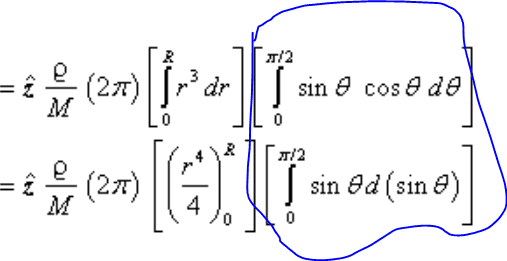
2yukcw1.png

How did these terms (circled in blue) change like that? I've never seen a step like that before..
 
Physics news on Phys.org
Abdul.119 said:
So I was reading a solution of a problem that has to do with integration in polar coordinates, and in one of the steps it did this

2yukcw1.png

How did these terms (circled in blue) change like that? I've never seen a step like that before..
What is the differential of ##\sin \theta##?

If y = f(x), the differential of y is defined as dy = f'(x) dx
 
The substitution rule says
##\int f(x) \, \frac{du}{dx} \, dx = \int f(u(x)) \, du(x)##
Hence, ##\theta = x##, ##\frac{du}{dx} = \cos\theta## and ##u = \sin \theta## gives
##\int f(\theta) \, cos(\theta) \, d\theta = \int f(\theta) \, d(\sin(\theta))##
 
pwsnafu said:
The substitution rule says
##\int f(x) \, \frac{du}{dx} \, dx = \int f(u(x)) \, du(x)##
Hence, ##\theta = x##, ##\frac{du}{dx} = \cos\theta## and ##u = \sin \theta## gives
##\int f(\theta) \, cos(\theta) \, d\theta = \int f(\theta) \, d(\sin(\theta))##

Why didn't they use the regular u-substitution, where u = cos(θ) , and du = -sin(θ) dθ ?
 
Abdul.119 said:
Why didn't they use the regular u-substitution, where u = cos(θ) , and du = -sin(θ) dθ ?
I'm not sure why you call that "the regular u-substitution". To integrate something like [itex]\int sin(\theta) cos(\theta) d\theta[/itex] either [itex]u= cos(\theta)[/itex], [itex]du= -sin(\theta)d\theta[/itex] or [itex]u= sin(\theta)[/itex], [itex]du= cos(\theta)d\theta[/itex] will work. And, I suspect that most people would use the latter since, as mathman said, it avoids the negative sign.