arestes
- 84
- 4
Hello!
I was reading two things:
1) tidal locking (as explained in the Wikipedia article:https://en.wikipedia.org/wiki/Tidal_locking
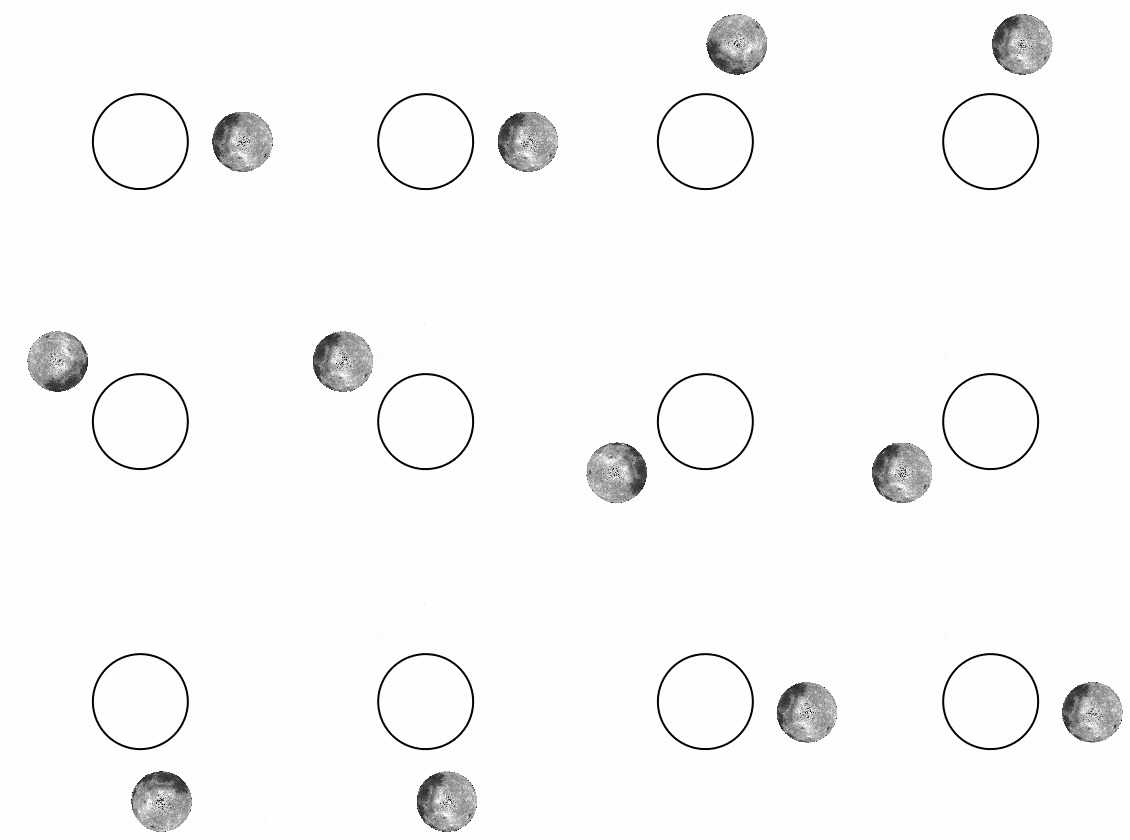
where it is stated that, because of internal friction caused by the body of water being attracted to the moon and deforming, the kinetic energy of the system Earth-Moon diminishes as time passes, giving rise to tidal locking. This explains why the left figure above has less kinetic energy and is the final state of the system after some time. This makes sense.2) Chabay and Sherwood's not-so-popular but (I believe) well thought-out book "Matter and Interactions". Here, they split Kinetic energy into Rotational and Translational. They put up two examples in which a bar (with two small spheres) is rotated about a point, by virtue of a light rod. See figures 11.81 and 11.82. Figure 11.81 shows the bar rotating in such a way that its orientation remains fixed (vertical) while rotating around the central point. The other figure shows the bar rotating around the bar's own center and while this very center rotates around the original center. The first one (11.81) is said to have less angular momentum than 11.82 because 11.81 has no "intrinsic" rotation about its own axis. I assume that this argument also shows that the first (bar with unchanging orientation) has less kinetic energy.
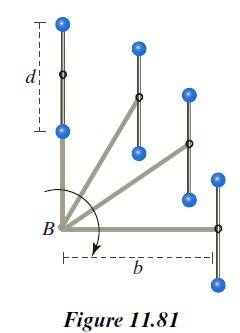
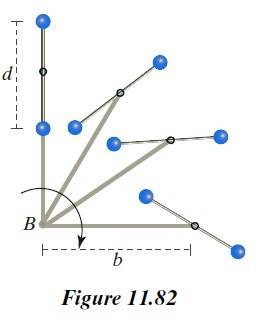
But... this contradicts the wikipedia article that requires that the rigid body rotating lose energy and starts showing the same face to the center (the Earth), which means its orientation keeps changing.
What am I getting wrong?
Any help would be appreciated.
I was reading two things:
1) tidal locking (as explained in the Wikipedia article:https://en.wikipedia.org/wiki/Tidal_locking
where it is stated that, because of internal friction caused by the body of water being attracted to the moon and deforming, the kinetic energy of the system Earth-Moon diminishes as time passes, giving rise to tidal locking. This explains why the left figure above has less kinetic energy and is the final state of the system after some time. This makes sense.2) Chabay and Sherwood's not-so-popular but (I believe) well thought-out book "Matter and Interactions". Here, they split Kinetic energy into Rotational and Translational. They put up two examples in which a bar (with two small spheres) is rotated about a point, by virtue of a light rod. See figures 11.81 and 11.82. Figure 11.81 shows the bar rotating in such a way that its orientation remains fixed (vertical) while rotating around the central point. The other figure shows the bar rotating around the bar's own center and while this very center rotates around the original center. The first one (11.81) is said to have less angular momentum than 11.82 because 11.81 has no "intrinsic" rotation about its own axis. I assume that this argument also shows that the first (bar with unchanging orientation) has less kinetic energy.
But... this contradicts the wikipedia article that requires that the rigid body rotating lose energy and starts showing the same face to the center (the Earth), which means its orientation keeps changing.
What am I getting wrong?
Any help would be appreciated.


