Confusion regarding signs in rotational motion

Click For Summary
SUMMARY

The discussion centers on the confusion regarding the signs in rotational motion, particularly the acceleration component a_x and its implications on time t and distance d_f. The participant initially calculated t using a positive a_x, leading to discrepancies in the kinematic equations. The correct interpretation involves recognizing that the friction force, represented as F_k = -μ_kN, results in a negative acceleration a_x = -μ_kg, which affects the sign of both t and d_f. The importance of consistent sign conventions in equations related to rolling motion is emphasized.

PREREQUISITES
  • Understanding of Newton's second law (F = ma)
  • Familiarity with kinematic equations in physics
  • Knowledge of angular momentum and torque relationships
  • Ability to apply sign conventions in vector equations
NEXT STEPS
  • Study the implications of friction in rotational dynamics
  • Learn about the rolling without slipping condition in detail
  • Explore the derivation and application of kinematic equations in rotational motion
  • Investigate the use of vector notation in physics to avoid sign errors
USEFUL FOR

Physics students, educators, and anyone involved in mechanics or engineering who seeks to clarify the complexities of rotational motion and sign conventions.

Eggue
Messages
13
Reaction score
2
Homework Statement
A solid cylinder with mass M and radius R, rotating with angular speed about an axis through its center, is set on a horizontal surface for which the kinetic friction coefficient is (a) Draw a free-body diagram for the cylinder on the surface. Think carefully about the direction of the kinetic friction force on the cylinder. Calculate the accelerations of the center of mass and of rotation about the center of mass. (b) The cylinder is initially slipping completely, so initially but Rolling without slipping sets in when Calculate the distance the cylinder rolls before slipping stops
Relevant Equations
Kinematic equations
I'm not sure as to why my working is incorrect. When the sign on a_x is positive, i get t = \frac{R\omega_0}{3\mu_kg} which would give the correct value for distance if plugged into the kinematic equation. However, I'm not sure why a_x would be positive though since the friction force is pointing in the direction of -x

Working:
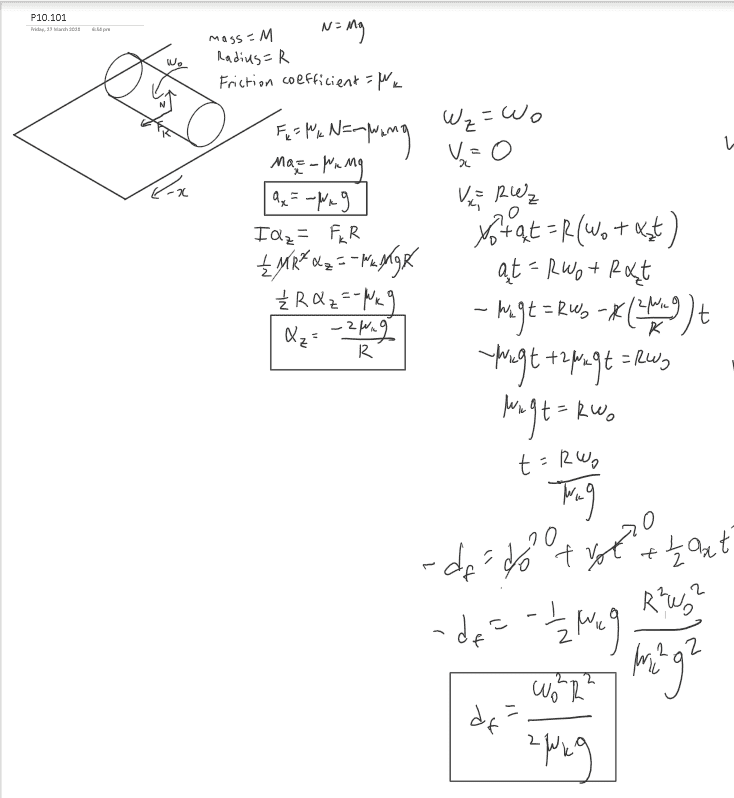
Capture.PNG
 
Physics news on Phys.org
Eggue said:
I'm not sure as to why my working is incorrect. When the sign on a_x is positive, i get t = \frac{R\omega_0}{3\mu_kg} which would give the correct value for distance if plugged into the kinematic equation. However, I'm not sure why a_x would be positive though since the friction force is pointing in the direction of -x
In your hand-drawn solving, you write an equation:$$-d_f=d_0 + v_0t + \frac{1}{2}a_xt^2$$Can you justify that equation? Why the minus sign on ##d_f##?
 
There is a top secret method of how never get confused with signs. First write equations in vector form then expand them in coordinate frame
 
  • Informative
Likes   Reactions: etotheipi
jbriggs444 said:
In your hand-drawn solving, you write an equation:$$-d_f=d_0 + v_0t + \frac{1}{2}a_xt^2$$Can you justify that equation? Why the minus sign on ##d_f##?
Oh that was a mistake that i corrected later, but that shouldn't affect anything right?
 
Eggue said:
Oh that was a mistake that i corrected later, but that shouldn't affect anything right?
It affects the sign of ##d_f## surely. I thought that was what you were asking about -- the sign on the value for ##d_f##.
 
jbriggs444 said:
It affects the sign of ##d_f## surely. I thought that was what you were asking about -- the sign on ##d_f##.
No what i meant was the sign on a_x changes the value of t and i do not know why the sign should be positive even though friction is pointing in the -x direction.
 
Well, let us review how you are calculating t. It seems that we will have to decode some chicken-scratchings.

You start with$$F_k=\mu_kN=-\mu_kmg$$At this point you have inserted a sign into the formula because the relative motion of the ground beneath the cylinder is leftward -- in the direction of negative x. I agree. Because the only force acting is ##F_k##, you invoke Newton's second law (##F=ma##) and assert that$$ma_x=-\mu_kmg$$. A straightforward inference. I agree. You divide out the m to obtain$$a_x=-\mu_kg$$You now shift to angular momentum and assert that equate the rate of change of angular momentum with the applied torque:$$I\alpha_z=F_kR$$Here you are implicitly adopting a sign convention such that ##\alpha_z## is positive counter-clockwise. You proceed to substitute in for the moment of inertia ##I=\frac{1}{2}MR^2## and ##F_k=-\mu_kmg## to obtain$$\frac{1}{2}mR^2\alpha_z=-\mu_kmgR$$You are a bit sloppy with the case on the M versus m, but you cancel it anyway along with one factor of R to obtain$$\frac{1}{2}R\alpha_z=-\mu_kmg$$You proceed to solve for ##\alpha_z## obtaining$$\alpha_z=\frac{-2\mu_kg}{R}$$I agree with this and agree that the sign on the resulting angular acceleration will be negative (i.e. clockwise).

You now do some stuff with variable names, but since you never actually use any of the following variable names, it turns out not to matter.

You introduce ##\omega_z## equal to the starting rotation rate.

You introduce ##v_x## equal to zero.

You introduce ##v_{x_1}## equal to the rim speed relative to the center of the cylinder.

The equation that matters is $$v_0+a_xt =R(\omega_0+\alpha_zt)$$This is supposed to be the rolling without slipping equation. But let us examine it for sign convention agreement. On the left hand side we have the velocity of the cylinder with a sign convention of right = positive. On the right hand side we have the rim speed of the cylinder with a sign convention of counter-clockwise positive. But that does not fit. A positive (rightward) velocity without slipping means a negative (clockwise) roll rate.

There's your sign error.
 
  • Like
Likes   Reactions: Lnewqban and Eggue
jbriggs444 said:
Well, let us review how you are calculating t. It seems that we will have to decode some chicken-scratchings.

You start with$$F_k=\mu_kN=-\mu_kmg$$At this point you have inserted a sign into the formula because the relative motion of the ground beneath the cylinder is leftward -- in the direction of negative x. I agree. Because the only force acting is ##F_k##, you invoke Newton's second law (##F=ma##) and assert that$$ma_x=-\mu_kmg$$. A straightforward inference. I agree. You divide out the m to obtain$$a_x=-\mu_kg$$You now shift to angular momentum and assert that equate the rate of change of angular momentum with the applied torque:$$I\alpha_z=F_kR$$Here you are implicitly adopting a sign convention such that ##\alpha_z## is positive counter-clockwise. You proceed to substitute in for the moment of inertia ##I=\frac{1}{2}MR^2## and ##F_k=-\mu_kmg## to obtain$$\frac{1}{2}mR^2\alpha_z=-\mu_kmgR$$You are a bit sloppy with the case on the M versus m, but you cancel it anyway along with one factor of R to obtain$$\frac{1}{2}R\alpha_z=-\mu_kmg$$You proceed to solve for ##\alpha_z## obtaining$$\alpha_z=\frac{-2\mu_kg}{R}$$I agree with this and agree that the sign on the resulting angular acceleration will be negative (i.e. clockwise).

You now do some stuff with variable names, but since you never actually use any of the following variable names, it turns out not to matter.

You introduce ##\omega_z## equal to the starting rotation rate.

You introduce ##v_x## equal to zero.

You introduce ##v_{x_1}## equal to the rim speed relative to the center of the cylinder.

The equation that matters is $$v_0+a_xt =R(\omega_0+\alpha_zt)$$This is supposed to be the rolling without slipping equation. But let us examine it for sign convention agreement. On the left hand side we have the velocity of the cylinder with a sign convention of right = positive. On the right hand side we have the rim speed of the cylinder with a sign convention of counter-clockwise positive. But that does not fit. A positive (rightward) velocity without slipping means a negative (clockwise) roll rate.

There's your sign error.
Ah i understand now. Thank you
 
  • Like
Likes   Reactions: Lnewqban

Similar threads

Replies
4
Views
2K
  • · Replies 9 ·
Replies
9
Views
2K
Replies
10
Views
2K
  • · Replies 11 ·
Replies
11
Views
2K
  • · Replies 17 ·
Replies
17
Views
1K
  • · Replies 5 ·
Replies
5
Views
2K
Replies
67
Views
4K
Replies
26
Views
1K
  • · Replies 9 ·
Replies
9
Views
2K
  • · Replies 10 ·
Replies
10
Views
2K