Confusion regarding Standing Waves and Reflection resulting in Phase Change

Click For Summary
SUMMARY

The discussion centers on the behavior of standing waves and their reflection characteristics, specifically addressing phase changes. When a standing wave reflects off a barrier, it undergoes a 180-degree phase change, leading to constructive interference at certain points and destructive interference at others. In transverse waves, such as those on a string, this phase change results in a node at the barrier. For longitudinal waves in open-closed or open-open systems, the phase change occurs at the open ends, affecting the wave's behavior differently. The confusion arises from the interpretation of standing wave diagrams, which depict the interaction of incident and reflected waves at various points along the medium.

PREREQUISITES
  • Understanding of standing waves and harmonic frequencies
  • Knowledge of wave reflection and phase change concepts
  • Familiarity with transverse and longitudinal wave behaviors
  • Basic principles of constructive and destructive interference
NEXT STEPS
  • Study the principles of wave reflection and phase shifts in detail
  • Explore the mathematical representation of standing waves
  • Learn about the differences between transverse and longitudinal waves
  • Investigate the concept of nodes and antinodes in wave mechanics
USEFUL FOR

Students of physics, educators teaching wave mechanics, and anyone interested in the principles of wave behavior and interference patterns.

Hereformore
Messages
61
Reaction score
0
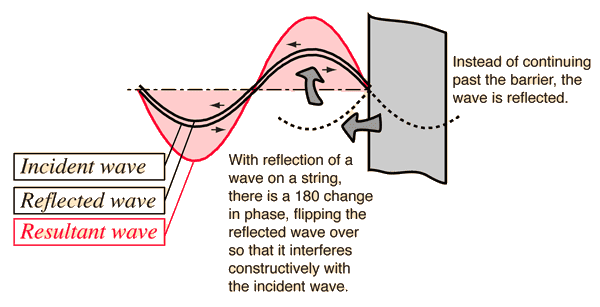
So a standing wave is one which looks to be standing still at certain harmonic frequencies. At these frequencies, when the wave reflects off the end, it will undergo a phase change of 180 degrees. This creates constructive interference as shown below:
upload_2014-10-26_17-21-53.png


In the case of a wave on a string, since that would constitute a transverse wave, when the wave hits a barrier, much like with thin film interference, the reflected wave is shifted by 180 degrees.

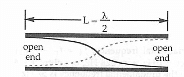
in the case of a longitudinal wave, such as with an open-closed or open open air pressure system, the phase change occurs at the open end(s) but not at the closed ends.

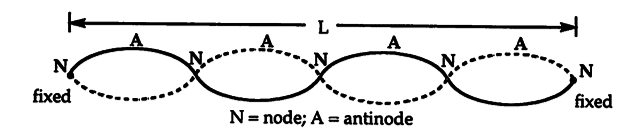
What I don't understand is, if the reflected wave is constructive, and in phase with the incident wave, then why are standing wave diagrams always drawn with the reflected wave out of phase/having destructive interference? Am i misinterpreting the diagrams?

See below for standing waves:
upload_2014-10-26_17-25-25.png

See below for Longitudinal waves:
upload_2014-10-26_17-19-42.png
(Open Open = phase change at both ends)
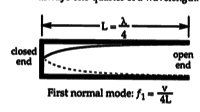
upload_2014-10-26_17-26-3.png
Open Closed = Phase change only at open end.

Also otherwise, is my understanding of what's going on (with the reflections and phase changes) accurate? Thanks guys!
 
Science news on Phys.org
Hereformore said:
So a standing wave is one which looks to be standing still at certain harmonic frequencies. At these frequencies, when the wave reflects off the end, it will undergo a phase change of 180 degrees. This creates constructive interference as shown below:

View attachment 74816

180 degrees phase change results in destructive interference, that is, why there is a node at the barrier.
 
ehild said:
180 degrees phase change results in destructive interference, that is, why there is a node at the barrier.
but then how does the standing wave occur if the reflection always causes destructive interference?

OH Is it that at each point in between nodes the incident and reflected/incoming wave interact differently to different degrees of constructive and destructive, such that at the antinode its total constructive and at the node its total descrtuctive and in between its a gradient?
 

Similar threads

  • · Replies 3 ·
Replies
3
Views
2K
  • · Replies 3 ·
Replies
3
Views
2K
  • · Replies 11 ·
Replies
11
Views
2K
  • · Replies 16 ·
Replies
16
Views
2K
  • · Replies 2 ·
Replies
2
Views
3K
  • · Replies 1 ·
Replies
1
Views
1K
  • · Replies 1 ·
Replies
1
Views
7K
Replies
3
Views
1K
  • · Replies 21 ·
Replies
21
Views
2K
  • · Replies 11 ·
Replies
11
Views
1K