Discussion Overview
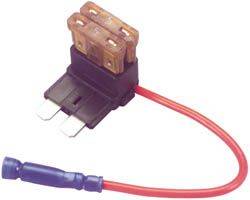
The discussion revolves around the practical aspects of soldering and connecting wires to an "add-a-circuit" device for automotive applications. Participants explore the types of connectors, the reliability of connections, and the appropriate sizing of fuses in relation to wire gauge and current draw.
Discussion Character
- Technical explanation
- Debate/contested
- Experimental/applied
Main Points Raised
- One participant seeks clarification on the type of connector used in an "add-a-circuit" and how to reliably connect two wires to it.
- Another participant describes the connector as a crimp-on type and explains its intended use for adding a fused circuit to an existing auto fuse block.
- Concerns are raised about the current draw of the two wires connected to the same fuse and the potential for nuisance fuse blowing.
- Participants discuss whether to twist the two wires together before crimping or to keep them parallel when inserting them into the connector.
- There is mention of the appropriate fuse size in relation to the wire gauge, with specific reference to 24 AWG wire being rated for 3.5 amps.
- One participant expresses uncertainty about the load they plan to draw and the implications of using a 10 amp fuse with 24 AWG wire.
- Another participant suggests that the fuse size should not exceed the ampacity of the wire to prevent overheating.
- Clarification is sought on whether the fuse size should be based on wire size rather than the actual load of the gauge.
Areas of Agreement / Disagreement
Participants express varying opinions on the best practices for connecting wires and sizing fuses, indicating that multiple competing views remain. There is no consensus on the ideal method for connecting two wires or the appropriate fuse size for the given wire gauge.
Contextual Notes
Participants reference specific wire gauges and their current ratings, but there is uncertainty about the exact load requirements for the circuit in question. The discussion includes assumptions about the reliability of connections and the implications of using crimp connectors for multiple wires.
Who May Find This Useful
This discussion may be useful for automotive enthusiasts, DIYers working on vehicle electrical systems, and individuals seeking guidance on wiring practices and safety considerations in automotive applications.
 Thanks in advance!