Conservation laws from Lagrange's equation

Click For Summary

Discussion Overview

The discussion revolves around deriving conservation laws, specifically momentum and energy, from Lagrange's equations as presented in Taylor's "Classical Mechanics." Participants explore the implications of displacing particle positions and the mathematical properties of the Lagrangian function.

Discussion Character

  • Technical explanation
  • Mathematical reasoning
  • Conceptual clarification
  • Debate/contested

Main Points Raised

  • One participant questions how to derive the equation $$\delta\mathcal{L}= \epsilon \frac{\partial \mathcal{L}}{\partial x_{1}}+\epsilon \frac{\partial \mathcal{L}}{\partial x_{2}}+...=0$$ and expresses uncertainty about the implications of displacing all particles by the same amount $$\vec{\epsilon}$$.
  • Another participant attempts to apply the chain rule to express changes in the Lagrangian, suggesting that $$d \mathcal{L}$$ could be simplified, but struggles to proceed further.
  • Some participants clarify that the transformation $$\vec{x} \rightarrow \vec{x} + \vec{\epsilon}$$ is a mathematical exploration rather than a physical displacement of particles, emphasizing the use of Taylor series expansion for the Lagrangian.
  • There is a discussion about the conditions under which $$\delta \mathcal{L} = 0$$, with one participant noting that this is not universally true for all Lagrangians, but holds if the Lagrangian does not depend on the coordinates.
  • One participant introduces a thought experiment about an infinite space where displacing particles does not change the system's energy, suggesting a conceptual perspective on the transformation.
  • There is a query regarding the constant $$a$$ in the context of the Taylor series, with participants discussing its implications and whether it must be a constant or can also be a variable.

Areas of Agreement / Disagreement

Participants express varying interpretations of the mathematical implications of the Lagrangian transformations and the conditions under which conservation laws apply. There is no consensus on the derivation of the initial equation or the implications of displacing particles uniformly.

Contextual Notes

The discussion highlights limitations in understanding the assumptions behind the transformations and the conditions necessary for $$\delta \mathcal{L} = 0$$. Participants acknowledge that the mathematical treatment may not fully capture physical realities.

Phylosopher
Messages
139
Reaction score
26
My question is related to the book: Classical Mechanics by Taylor. Section 7.8

So, In the book Taylor is trying to derive the conservation of momentum and energy from Lagrange's equation. I understood everything, but I am struggling with the concept and the following equation:

$$\delta\mathcal{L}= \epsilon \frac{\partial \mathcal{L}}{\partial x_{1}}+\epsilon \frac{\partial \mathcal{L}}{\partial x_{2}}+...=0$$

He derived this by saying that in theory, displacing the position of all N particles from ##\vec{r_{i}} \rightarrow \vec{r_{i}}+\vec{\epsilon}## will make ##\delta \mathcal{L}=0## "Unchanged". Which I understand.

Also this means that:

$$\mathcal{L}(\vec{r_{1}},...) = \mathcal{L}(\vec{r_{1}}+\vec{\epsilon},...)$$

Then from this he derived the equation that I am confused by, by letting ##\vec{\epsilon}## be in the direction of ##x## only.

I am not sure how to derive the first equation. It seems to be just the chain rule! But I didn't succeed with it.

In short I have two questions:

1- How to derive the first equation.
2- Why should all particles be moved by ##\vec{\epsilon}##. I know that this is mathematically useful to have ##\delta \mathcal{L}=0##. If each is displaced differently then there is an energy from outside the system. But what if all were displaced by an energy from outside the system exactly by the same amount ##\vec{\epsilon}## that he assumes, how can I be sure that ##\delta \mathcal{L}=0##.
 
Physics news on Phys.org
For the chain rule I did the following:

$$d \mathcal{L}= \frac{\partial \mathcal{L}}{\partial(x_{1}+\epsilon)} d(x_{1}+\epsilon)+... $$

I couldn't modify more. But I was considering something like maybe this:

$$d(x_{1}+\epsilon)=\frac{d(x_{1}+\epsilon)}{dx_{1}}dx_{1}= dx_{1}$$

Which makes sese. ##d## is just ##\Delta##, and ##\epsilon## is just a constant.
 
In talking about a transformation such as ##\vec{x} \rightarrow \vec{x} + \vec{\epsilon}##, we're just studying the mathematical properties of the lagrangian. Nobody's really talking about moving everything over by an amount ##\vec{\epsilon}##.

So you have an initial function: ##\mathcal{L}(x_1, x_2, ..., x_n, \dot{x}_1, \dot{x}_2 ...)## (where ##\dot{}## means time derivative). We're just treating it as a mathematical function. Functions can be expanded in a Taylor series. So

##\mathcal{L}(x_1 + \delta x_1, x_2 ..., x_n, \dot{x}_1, \dot{x}_2 ...) \approx \mathcal{L}(x_1, x_2 ..., x_n, \dot{x}_1, \dot{x}_2 ...) + \frac{\partial \mathcal{L}}{\partial x_1} \delta x_1 + ## higher-order terms. So the change in ##\mathcal{L}## is:

##\delta \mathcal{L} = \frac{\partial \mathcal{L}}{\partial x_1} \delta x_1 + ## higher order terms

But the Euler-Lagrange equations tell us that:

##\frac{d}{dt} \frac{\partial \mathcal{L}}{\partial \dot{x}_1} = \frac{\partial \mathcal{L}}{\partial x_1}##

So we can write:

##\delta \mathcal{L} = (\frac{d}{dt} \frac{\partial \mathcal{L}}{\partial \dot{x}_1}) \delta x_1 + ...##

At this point, we're saying that if ##\delta \mathcal{L} = 0##, then it follows that:

##(\frac{d}{dt} \frac{\partial \mathcal{L}}{\partial \dot{x_1}}) \delta x_1 = 0##

So ##\frac{\partial \mathcal{L}}{\partial \dot{x_1}} = ## a constant.

It's not true for all Lagrangians that ##\delta \mathcal{L} = 0## when you shift the coordinates. But if the Lagrangian doesn't depend on the coordinates, then ##\delta \mathcal{L} = 0##, and so the momentum ##p_1 \equiv \frac{\partial \mathcal{L}}{\partial \dot{x_1}}## will be constant.
 
  • Like
Likes   Reactions: Phylosopher
stevendaryl said:
In talking about a transformation such as →x→→x+→ϵ\vec{x} \rightarrow \vec{x} + \vec{\epsilon}, we're just studying the mathematical properties of the lagrangian. Nobody's really talking about moving everything over by an amount →ϵ\vec{\epsilon}.

I was thinking like (gedanken): If you have an infinite space where no background is available and you only see particles floating in space (So you cannot really relate the position of the particles but to there own). By displacing all the particles the same way by ##\epsilon##, the system in the observer perspective did not change its energy(Nothing actually changed).

Which I think is a cool idea. Not just mathematically. I hope you get my point.

stevendaryl said:
L(x1+δx1,x2...,xn,˙x1,˙x2...)≈L(x1,x2...,xn,˙x1,˙x2...)+∂L∂x1δx1+\mathcal{L}(x_1 + \delta x_1, x_2 ..., x_n, \dot{x}_1, \dot{x}_2 ...) \approx \mathcal{L}(x_1, x_2 ..., x_n, \dot{x}_1, \dot{x}_2 ...) + \frac{\partial \mathcal{L}}{\partial x_1} \delta x_1 + higher-order terms. So the change in L\mathcal{L} is:

δL=∂L∂x1δx1+\delta \mathcal{L} = \frac{\partial \mathcal{L}}{\partial x_1} \delta x_1 + higher order terms

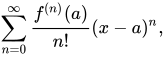
Fantastic, I get it. But for the Taylor series we are using, what would be the constant ##a##?

b43af001b691a52034c46ff67dd15b4133285961


We have ##x+\delta x##, ##(x+\delta x-a)^{n}##. I would guess that ##a## is ##x##, but it must be a constant.

stevendaryl said:
It's not true for all Lagrangians that δL=0\delta \mathcal{L} = 0 when you shift the coordinates. But if the Lagrangian doesn't depend on the coordinates

You are correct. I should have added that to the thread, when I was asking.
 
Phylosopher said:
Fantastic, I get it. But for the Taylor series we are using, what would be the constant ##a##?

b43af001b691a52034c46ff67dd15b4133285961


We have ##x+\delta x##, ##(x+\delta x-a)^{n}##. I would guess that ##a## is ##x##, but it must be a constant.

Well, it's also true when ##a## is a variable:

##f(y) = \sum_{n=0}^{\infty} \frac{f^{(n)}(x)}{n!} (y-x)^n##

or letting ##y - x = \delta x##,

##f(x+\delta x) = \sum_{n=0}^{\infty} \frac{f^{(n)}(x)}{n!} (\delta x)^n##
 
  • Like
Likes   Reactions: Phylosopher

Similar threads

Replies
6
Views
2K
  • · Replies 0 ·
Replies
0
Views
562
  • · Replies 11 ·
Replies
11
Views
3K
  • · Replies 1 ·
Replies
1
Views
1K
  • · Replies 3 ·
Replies
3
Views
2K
  • · Replies 1 ·
Replies
1
Views
2K
Replies
6
Views
2K
  • · Replies 5 ·
Replies
5
Views
2K
  • · Replies 2 ·
Replies
2
Views
1K
  • · Replies 5 ·
Replies
5
Views
2K