Conservation of momentum in antennas

Click For Summary

Discussion Overview

The discussion revolves around the conservation of momentum in the context of RF antennas and their interaction with signals, particularly focusing on the momentum transfer during photon-electron interactions. Participants explore concepts related to radiation pressure, scattering, and the complexities of electron behavior in metals.

Discussion Character

  • Exploratory
  • Debate/contested
  • Technical explanation

Main Points Raised

  • One participant suggests that when an RF antenna absorbs a signal, momentum is transferred through quantized photon-electron interactions, questioning the source of perpendicular momentum.
  • Another participant argues that a radiometer demonstration does not illustrate radiation pressure but rather the momentum difference imparted to air molecules by varying surface temperatures.
  • Some participants propose that scattering could be a useful mental model for understanding momentum transfer, noting that electrons may scatter at various angles, complicating the picture if they are bound to atoms.
  • There is a mention that classical electromagnetic theory can explain radiation pressure without invoking quantum mechanics, suggesting that the internal motion of electrons within the metal is more relevant than photoemission.

Areas of Agreement / Disagreement

Participants express differing views on the mechanisms of momentum transfer and the relevance of quantum mechanics versus classical theories. The discussion remains unresolved with multiple competing perspectives on the topic.

Contextual Notes

Some limitations include the dependence on definitions of momentum in different contexts, the complexity of electron behavior in metals, and the unresolved nature of the interactions being discussed.

jaydnul
Messages
558
Reaction score
15
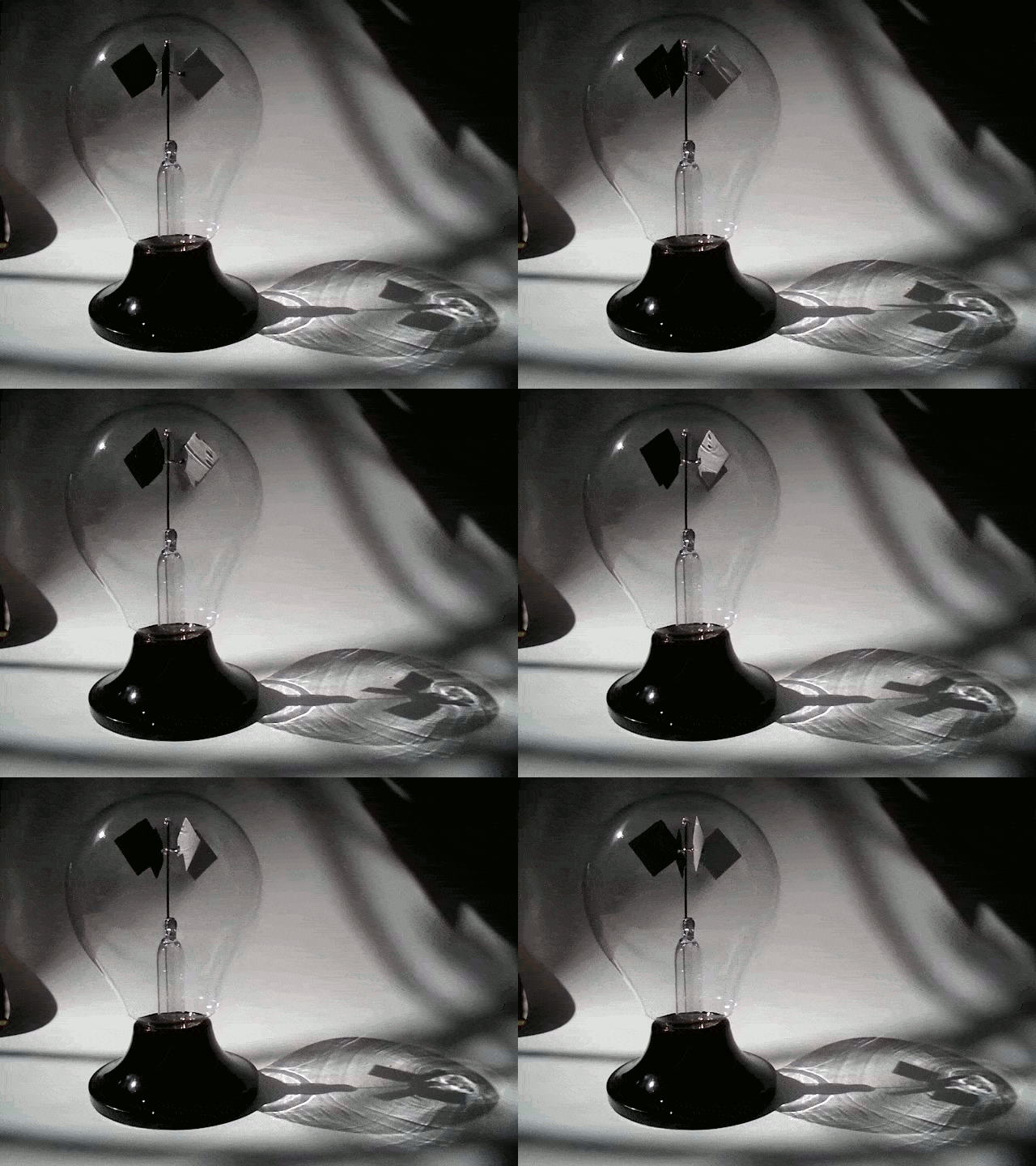
When an RF antenna absorbs a signal, the momentum is transferred in quantized photon-electron interactions. The electrons in the metal will be given both perpendicular momentum (the actual signal information) and momentum in the direction of propagation (shown below):
p?image=http%3A%2F%2Fupload.wikimedia.org%2Fwikipedia%2Fcommons%2F2%2F28%2FRadiometer_9965_Nevit.gif


The momentum in the direction of propagation is a conservation of the photon's linear momentum, but what about the perpendicular momentum? Where does that come from? The photon's angular momentum/spin?
 
Physics news on Phys.org
Unfortunately, that movie of a cheap and cheerful radiometer is not demonstrating radiation pressure. It is showing the difference in momentum imparted to air molecules by a hot and cooler surface. The dark surface gets a slightly higher equilibrium temperature than the shiny surface. But there are parallels where momentum is concerned. The normal force on the surface produces the turning effect whilst the lateral forces cancel out - whether it's photons or bouncing air molecules. To eliminate the air molecule effect, you need to drop the ambient pressure well below what you get in a 'Science Shop' version of the radiometer.​
 
Are you visualizing a cloud of free electrons? It sounds like scattering is a good mental model. Things scatter at many angles, not just linear and perpendicular. I say go look up the statistics of scattering.

If the electrons are bound to atoms, the whole picture is more complex.

If you want to analyze just the quantum states of a photon electron system, it is more of a QM question.
 
anorlunda said:
Are you visualizing a cloud of free electrons? It sounds like scattering is a good mental model. Things scatter at many angles, not just linear and perpendicular. I say go look up the statistics of scattering.

If the electrons are bound to atoms, the whole picture is more complex.

If you want to analyze just the quantum states of a photon electron system, it is more of a QM question.
Wow, that's an interesting take on things. I'm sure the OP doesn't include the idea of photoemission of electrons. It's surely to do with the idea of internal motion of electrons within the metal. There's no way that incident radiation (except perhaps UV and higher) can do more than warm up the surface or be reflected. (the vanes are not made of potassium or any other group 1 metal.)
Remember, you don't need QM to explain Radiation Pressure; it can be explained with classical EM theory. Yet again, photons can cloud the issue when they're introduced where not needed.
 
sophiecentaur said:
Unfortunately, that movie of a cheap and cheerful radiometer is not demonstrating radiation pressure. It is showing the difference in momentum imparted to air molecules by a hot and cooler surface. The dark surface gets a slightly higher equilibrium temperature than the shiny surface. But there are parallels where momentum is concerned. The normal force on the surface produces the turning effect whilst the lateral forces cancel out - whether it's photons or bouncing air molecules. To eliminate the air molecule effect, you need to drop the ambient pressure well below what you get in a 'Science Shop' version of the radiometer.​

Wow I'm a moron.

I will look into scattering a little more. Thanks!
 
  • Like
Likes   Reactions: sophiecentaur

Similar threads

  • · Replies 10 ·
Replies
10
Views
2K
  • · Replies 4 ·
Replies
4
Views
2K
  • · Replies 3 ·
Replies
3
Views
3K
  • · Replies 3 ·
Replies
3
Views
2K
  • · Replies 2 ·
Replies
2
Views
3K
  • · Replies 13 ·
Replies
13
Views
3K
  • · Replies 36 ·
2
Replies
36
Views
16K
  • · Replies 30 ·
2
Replies
30
Views
5K
Replies
2
Views
1K
  • · Replies 1 ·
Replies
1
Views
2K