Constant intensity maxima in double-slit interference ?

Click For Summary

Discussion Overview

The discussion revolves around the differences in light intensity patterns observed in double-slit interference and single-slit diffraction experiments. Participants explore the implications of these patterns on energy conservation and the nature of wave interference, considering both theoretical and practical aspects of the setups.

Discussion Character

  • Exploratory
  • Technical explanation
  • Debate/contested

Main Points Raised

  • One participant questions why the intensity maxima in double-slit interference appear constant while those in single-slit diffraction decrease, suggesting that the assumption of a short distance to the center of the screen may play a role.
  • Another participant notes that in a real double-slit experiment, both interference patterns are present simultaneously, with the double-slit pattern being narrower than the single-slit pattern.
  • A participant explains that in an ideal double-slit setup, two pointlike sources create waves that interfere at different phases, leading to a regular pattern of maxima and minima on the screen.
  • Concerns are raised about the implications of infinite light intensity in the idealized double-slit scenario, with a participant asserting that light intensity must eventually vanish, questioning the source of energy for constant maxima.
  • Another participant clarifies that there is a finite number of maxima in the double-slit experiment, determined by slit separation and wavelength, and that these maxima are not evenly spaced on a planar screen.
  • Further discussion includes the approximation of parallel rays in introductory treatments, which may limit the validity of derived equations beyond a certain point.

Areas of Agreement / Disagreement

Participants generally agree on the differences in setups and interference patterns between the two experiments, but there is contention regarding the implications of these patterns on energy conservation and the nature of intensity maxima. The discussion remains unresolved on whether intensity maxima can repeat indefinitely.

Contextual Notes

Limitations include assumptions about the distance to the screen, the nature of the slits, and the conditions under which the derived equations are valid. The discussion also touches on the transition from Fraunhofer to Fresnel diffraction without resolving the implications of these transitions.

DoobleD
Messages
259
Reaction score
20
Third question about wave optics in two days, hope it's not too much.

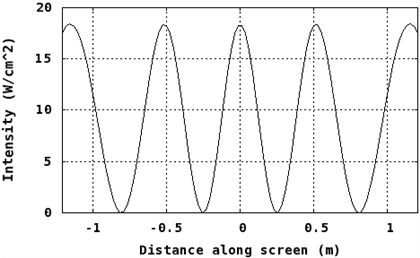
When we look at the intensity of light on the screen in a double-slit interference experiment (assuming negligible diffraction), we find something like this :
aea6d2b9_7346_4aee_aaf1_a207e483c9fc.png


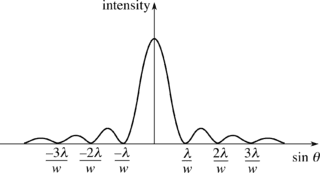
When we look at the intensity of light on screen in a single-slit diffraction experiment, we find something like :
phys10_2f_2.png
In the first case, the intensity maxima is constant. In the second case, it decreases. Why this difference ?

My best guess would be that when dealing with the double-slit interference in textbooks, we always assume a short distance to the center of the screen, thus having maxima pretty much the same. While with diffraction even at those short distances maxima falls rapidly. Would that be correct ?

I also wonder if a forever constant maxima wouldn't violate conservation of energy ? Light can only be emitted for a finite period of time, so, the amount of energy reaching the screen must be finite. Therefore, light intensity on the screen must vanishes at some point right ? Even with the double-slit interference without diffraction. Is this reasoning correct ?
 
Science news on Phys.org
DoobleD said:
Why this difference ?
A double-slit is not a single slit.

In a real double-slit experiment, you have both patterns together (multiplied). As the typical slit distance is much larger than the slit width, the double-slit pattern is narrower, so the full first picture fits into the main maximum of the second picture. With a good double-slit setup, you can see both patterns at the same time.
 
In the ideal two-slit setup, with a negligible slit width, there are two pointlike sources of waves. At each point on the screen we add two waves with different phases. As you move outwards from the center of the screen, these two waves are first in phase (reinforcing each other), then out of phase (cancelling), then in phase again, then out of phase again, etc., in a regular fashion.

In a single-slit setup, with a non-negligible slit width, each point across the width of the slit acts as a source. At each point on the screen we add (integrate) an infinite number of waves. They all have the same phase only at the center of the screen. At other locations, the waves have a range of phases that can at best partially reinforce when you add them all together.
 
Thanks for the answers.

While I understand that the setup of both experiments, and thus the interferences, are different, I still find surprising that light intensity seems infinite in the idealized double-slit interference experiment. Infinite light intensity means infinite energy, which is not possible.

Any way I look at it, I must conclude that, in an idealized double-slit interference (two pointlike sources of waves only), at some point along the screen sides, light intensity MUST vanishes. Either maxima simply stops abruptly, or they decrease slowly. The equation describing intensity must be valid only under certain conditions where maxima are constant.

How could it be different ? How could intensity maxima repeat themselves forever ? Where would the energy come from ?
 
There is a finite number of maxima in the double-slit experiment, given by slit separation and wavelength.
They are evenly spaced in sin(theta) where theta is the angle relative to the central maximum, and the sine is limited by +-1. They are not evenly spaced with a planar screen. This is a reasonable approximation close to the central maximum, but doesn't work further outside.
 
  • Like
Likes   Reactions: DoobleD
Question answered, thanks !
 
mfb said:
This is a reasonable approximation close to the central maximum

This is of course the approximation that we almost always assume in introductory treatments.

Also, introductory treatments assume the screen is very far from the slits compared to the width and spacing of the slits, so that we can consider the light rays from the slit(s) to a given point on the screen as if they were parallel. This is called Fraunhofer diffraction. Relaxing this condition leads to Fresnel diffraction, which can produce interesting intensity patterns, including (for a circular aperture) the famous Poisson spot.
 
I suspected that the parallel rays approximation could be a reason why the derived equations in those introductory treatments would be only valid up to a certain point. Thanks for the clarification.
 
jtbell said:
including (for a circular aperture) the famous Poisson spot.

Correction: "(for a circular obstacle)". :oops:
 

Similar threads

  • · Replies 4 ·
Replies
4
Views
2K
  • · Replies 4 ·
Replies
4
Views
3K
  • · Replies 1 ·
Replies
1
Views
3K
  • · Replies 8 ·
Replies
8
Views
21K
  • · Replies 3 ·
Replies
3
Views
3K
  • · Replies 23 ·
Replies
23
Views
3K
  • · Replies 6 ·
Replies
6
Views
3K
  • · Replies 17 ·
Replies
17
Views
3K
  • · Replies 7 ·
Replies
7
Views
3K
  • · Replies 7 ·
Replies
7
Views
2K