Constraint Equations: Atwoods Machine

Click For Summary
SUMMARY

The discussion focuses on the application of constraint equations in Atwood's Machine and the implications of choosing different reference frames. Users explore the concept of selecting a reference point in the middle of the string rather than at the fixed pulley, questioning the impact on acceleration and velocity signs. The conversation highlights that the pulleys are massless and frictionless, and the strings are inextensible, which are critical assumptions in analyzing the system. The negative sign in the velocity equation vB=−đxB/đt is a point of confusion that participants seek to clarify.

PREREQUISITES
  • Understanding of Newtonian mechanics and constraint equations
  • Familiarity with Atwood's Machine and its dynamics
  • Knowledge of reference frames in physics
  • Basic calculus for interpreting velocity and acceleration equations
NEXT STEPS
  • Study the derivation of constraint equations in Atwood's Machine
  • Learn about the effects of different reference frames on motion analysis
  • Investigate the implications of massless and frictionless assumptions in pulley systems
  • Explore the concept of negative velocity in the context of direction and reference points
USEFUL FOR

Physics students, educators, and anyone interested in classical mechanics, particularly those studying pulley systems and constraint dynamics.

sid95
Messages
2
Reaction score
0
Can questions like the one given in the following pic be solved by taking the reference frame answhere in the middle of the string and not on the fixed pulley?(http://cnx.org/content/m14731/latest/pq8.gif)
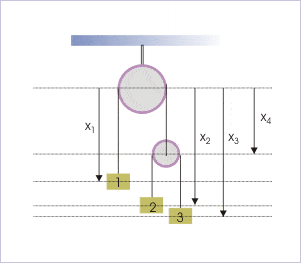
pq8.gif


A somewhat similar method has been given in http://cnx.org/content/m14783/latest/" ( Search for Horizontal pulley system ) I'm unable to comprehend the following line:

"There is an important subtle point here. The positions of blocks are on either side of the reference point (not on the same side as usually is the case). If positive direction of reference x-direction is towards right as shown in the figure, then velocities of two blocks are : "

Why does acceleration get -ve? pl help.
 
Last edited by a moderator:
Physics news on Phys.org
I don't understand what you are meaning. Why should you make a reference frame with respect to "a middle of (some) string"??
Choice of reference frame is an arbitrary matter, but I don't see why it would help you to choose some middle of some string.

By the way, are your pulleys massless?
Do the ropes pass without friction over the pulleys, or do the pulleys rotate, with the strings not moving relative to the pulleys?
 
Yes the pulleys are massless, frictionless with the strings being inextinsible.

My basic question is the one given in http://cnx.org/content/m14783/latest/ ( Search for Horizontal pulley system ) wherein vB=−đxB đt . I can't understand the -ve sign.
 

Similar threads

  • · Replies 8 ·
Replies
8
Views
4K
  • · Replies 2 ·
Replies
2
Views
8K
  • · Replies 4 ·
Replies
4
Views
3K
  • · Replies 8 ·
Replies
8
Views
12K
  • · Replies 7 ·
Replies
7
Views
4K
Replies
17
Views
9K
  • · Replies 3 ·
Replies
3
Views
6K
Replies
13
Views
3K
  • · Replies 117 ·
4
Replies
117
Views
10K
  • · Replies 13 ·
Replies
13
Views
4K