Why is one Tension Negative and the Other Positive - Atwood Machines

Click For Summary

Discussion Overview

The discussion revolves around understanding the tension forces in Atwood machines, specifically addressing why one tension is considered negative while the other is positive. Participants explore the implications of coordinate systems and the direction of acceleration for two masses in the system.

Discussion Character

  • Technical explanation
  • Conceptual clarification
  • Debate/contested

Main Points Raised

  • One participant questions why tension for mass 2 is negative despite being directed upwards in a force diagram, while gravity is considered positive.
  • Another participant suggests that different coordinate systems are used for each mass, which can lead to different signs in the equations of motion.
  • A participant seeks clarification on why the equation T - m2g = -m2a is structured this way, particularly why m2a is negative when mass 1's acceleration is positive.
  • It is noted that mass 2 accelerates downwards, which contributes to the negative component in its acceleration if upwards is defined as positive.
  • There is a discussion about the necessity of defining a consistent coordinate system to avoid confusion, with one participant emphasizing that if one mass moves down, the other must move up.
  • Different approaches to solving the problem are presented, including one that assumes known directions for all quantities and another that measures everything positively in the same direction.

Areas of Agreement / Disagreement

Participants express differing views on the treatment of tension and acceleration in Atwood machines, with no consensus reached on the best approach to define the coordinate systems or the implications of the signs in the equations.

Contextual Notes

Participants highlight the importance of consistent coordinate definitions and the potential for confusion when mixing different approaches to the problem. The discussion reflects varying assumptions about the direction of forces and accelerations.

Blakeasd
Messages
11
Reaction score
0
Why is one Tension Negative and the Other Positive -- Atwood Machines

Hello,

Please consider the following:
atwd.gif


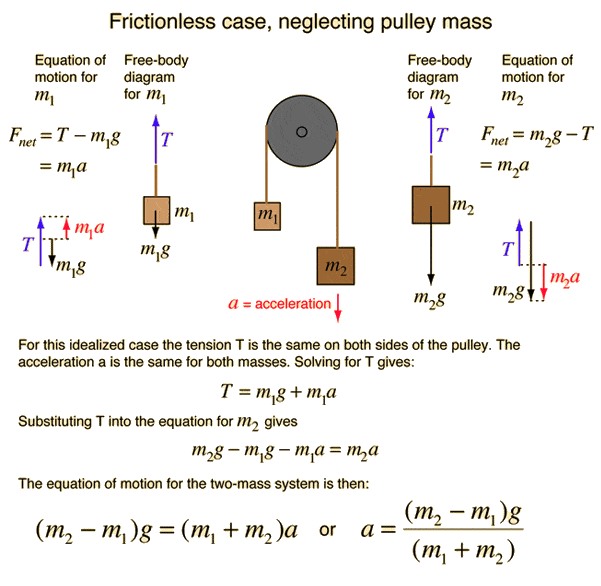
I am trying to understand how to solve for acceleration when dealing with Atwood machines. I keep getting hung up on one part: the direction of tension. In the image above, why is tension in the sum of the forces for m2 negative when if I were to draw a force diagram it is pointing up. Furthermore, why is gravity positive? Tension is pulling the masses up and gravity is pulling them down. A force diagram's directions are not different between m1 and m2, so why are they different when summing the equations.

Many Thanks.
 
Last edited by a moderator:
Physics news on Phys.org
Obviously the author is using coordinates where the positive axis point down for the mass 2. for the mass 1 they are using a different coordinate axis where the positive side points upward as usual. This is common choice designed to keep the acceleration positive for both masses. If the axis had been chosen with the positive end pointing up (as you expected), the equation would be T - m_2 g = - m_2 a. That equation is identical to the one found by the author except that the whole equation was multiplied by -1. That, of course, makes no difference at all for the solution.
 
I see, thanks. But why is T - m2g = to a negative m2a ?

What is the reasoning behind m2a being negative. If when dealing with the first mass ma is positive; what makes the difference here?
 
Blakeasd said:
I see, thanks. But why is T - m2g = to a negative m2a ?

What is the reasoning behind m2a being negative. If when dealing with the first mass ma is positive; what makes the difference here?

The difference is that the mass 2 is accelerating downwards which has a negative component in the vertical direction (If we chose upwards as positive). The acceleration, just as the forces, may have negative components. That's easy to forget. That's why it is common to chose axis such that the acceleration is positive avoiding having to deal with negative accelerations.
 
dauto said:
The difference is that the mass 2 is accelerating downwards which has a negative component in the vertical direction (If we chose upwards as positive).

Yes, but isn't mass 1 accelerating downwards as well. It also is being affected by gravity. Why then is it equal to positive ma and not negative ma. I expect it to be negative, but that is not the case. Am I missing something obvious?

Thanks!
 
Blakeasd said:
Yes, but isn't mass 1 accelerating downwards as well.
They can't both be accelerating downward. Mass 2 accelerates down while mass 1 accelerates up.
 
  • Like
Likes   Reactions: 1 person
Doc Al said:
They can't both be accelerating downward. Mass 2 accelerates down while mass 1 accelerates up.


I see!

Thank you.
 
Last edited:
Blakeasd said:
Yes, but isn't mass 1 accelerating downwards as well. It also is being affected by gravity. Why then is it equal to positive ma and not negative ma. I expect it to be negative, but that is not the case. Am I missing something obvious?

Thanks!

Yes, you're missing the obvious fact that if one mass goes down than the other mass must go up
 
  • Like
Likes   Reactions: 1 person
There are two different ways to attack this sort of problem.

The picture in the OP uses the principle that "we know which way everything moves, so let's draw a picture where all the quantities are positive."

The other way says, "We don't know what happens, because we haven't solved the problem yet. So let's measure everything positive in the same direction (e.g. upwards), and if some things turn out negative, that's not a big deal." Using this method, because the string is a fixed length, if m1 has acceleration a, m2 has acceleration -a.

You can use either method, but the mixing them up usually leads to mistakes.
 
  • Like
Likes   Reactions: 1 person

Similar threads

  • · Replies 3 ·
Replies
3
Views
3K
  • · Replies 7 ·
Replies
7
Views
5K
  • · Replies 6 ·
Replies
6
Views
3K
  • · Replies 9 ·
Replies
9
Views
6K
  • · Replies 8 ·
Replies
8
Views
4K
  • · Replies 10 ·
Replies
10
Views
4K
  • · Replies 1 ·
Replies
1
Views
1K
  • · Replies 2 ·
Replies
2
Views
3K
  • · Replies 4 ·
Replies
4
Views
4K
  • · Replies 4 ·
Replies
4
Views
3K