Continuous functions on metric spaces

  • Thread starter Thread starter Lambda96
  • Start date Start date
  • Tags Tags
    Function Proof
Join the discussion
Ask a follow-up here, or get your own question answered by working scientists, mathematicians and engineers — people, not an autocomplete.
Real named experts · corrections over time · the nuance an AI answer skips
14 replies · 2K views
Lambda96
Messages
233
Reaction score
77
Homework Statement
Show that the mapping ##\phi## is continuous
Relevant Equations
none
Hi,

I don't know if I have solved task correctly
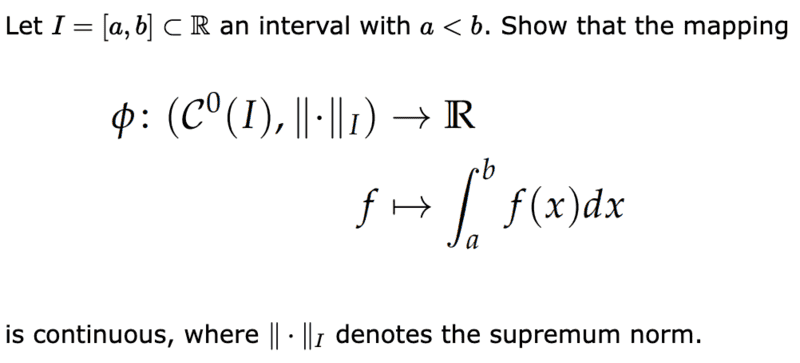
Bildschirmfoto 2024-05-17 um 13.50.12.png


I used the epsilon-delta definition for the proof, so it must hold for ##f,g \in (C^0(I), \| \cdot \|_I)## ##\sup_{x \in [a,b]} |F(x)-G(x)|< \delta \longrightarrow \quad |\int_{a}^{b} f(x)dx - \int_{a}^{b} g(x)dx |< \epsilon##

I then proceeded as follows

##|\int_{a}^{b} f(x)dx - \int_{a}^{b} g(x)dx | =|F(b)-F(a)-G(b)+G(a)|=|F(b)-G(b)+G(a)-F(a)|##

Then I used the supremum norm to estimate the above expression ##|F(b)-F(a)-G(b)+G(a)|=|F(b)-G(b)+G(a)-F(a)| \le \sup_{x \in [a,b]} |F(x)-G(x)|+\sup_{x \in [a,b]} |F(x)-G(x)|+\sup_{x \in [a,b]} |G(x)-F(x)|=2\sup_{x \in [a,b]} |F(x)-G(x)|<2\delta## it then follows that ##\delta## must be defined as follows ##\delta= \frac{\epsilon}{2} ##
 
on Phys.org
Orodruin said:
You want to find a ##\delta## such that if ##||f-g|| = \sup_{x \in I}|f(x)-g(x)| < \delta## then ##|\phi(f) - \phi(g)|< \varepsilon##. It seems to me that you have instead used the primitive function of ##f## and ##g## in the supremum norm.
How do you know the space ##C^0## has a vector space structure that allows you to subtract functions? Edit: Never mind, it's a normed space, hence a vector space.
Seems you could too, just use the open set definition and verify that the inverse image of an interval is open in ##C^0## with the given norm.
 
Reply
  • Like
Likes   Reactions: docnet and Lambda96
Thank you Orodruin, pasmith and WWGD for your help 👍👍👍

I have now used the tip from pasmith and received the following

The following must apply:
##\sup_{x \in [a,b]} |f(x)-g(x)|< \delta \longrightarrow \quad |\int_{a}^{b} f(x)dx - \int_{a}^{b} g(x)dx |< \epsilon##

Then I determined ##\delta## as follows
$$|\int_{a}^{b} f(x)dx - \int_{a}^{b} g(x)dx \le |\int_{a}^{b} |f(x)|dx - \int_{a}^{b} |g(x)|dx \le (b-a) \sup f|x|-(b-a) \sup |g(x)| = (b-a) \bigl( \sup|f(x)| - \sup|g(x)| \bigr)$$

Then ##\delta## must be ##\delta = \frac{\epsilon}{b-a}##
 
Reply
  • Like
Likes   Reactions: WWGD
Lambda96 said:
Then I determined ##\delta## as follows
$$|\int_{a}^{b} f(x)dx - \int_{a}^{b} g(x)dx \le |\int_{a}^{b} |f(x)|dx - \int_{a}^{b} |g(x)|dx \le (b-a) \sup f|x|-(b-a) \sup |g(x)| = (b-a) \bigl( \sup|f(x)| - \sup|g(x)| \bigr)$$
The first inequality is incorrect.
 
Reply
  • Like
Likes   Reactions: Lambda96
Lambda96 said:
$$|\int_{a}^{b} f(x)dx - \int_{a}^{b} g(x)dx \le |\int_{a}^{b} |f(x)|dx - \int_{a}^{b} |g(x)|dx \le (b-a) \sup f|x|-(b-a) \sup |g(x)| = (b-a) \bigl( \sup|f(x)| - \sup|g(x)| \bigr)$$
That all looks ill-conceived to me. For example, I don't think you've corrently identified the metric that is derived from the given supremum norm.

PS as pointed out in post #2.
 
Reply
  • Like
Likes   Reactions: Lambda96 and docnet
Thank you Orodruin, PeroK and pasmith for your help 👍👍👍

$$ \bigg \vert \int_{a}^{b} f(x) dx - \int_{a}^{b} g(x)dx \bigg \vert= \bigg \vert\int_{a}^{b} f(x)-g(x) dx \bigg \vert \le \int_{a}^{b} |f(x)-g(x)| dx \le (b-a) \sup|f(x)-g(x)|$$


From this follows ##\delta=\frac{\epsilon}{b-a}##
 
Lambda96 said:
Thank you Orodruin, PeroK and pasmith for your help 👍👍👍

$$ \bigg \vert \int_{a}^{b} f(x) dx - \int_{a}^{b} g(x)dx \bigg \vert= \bigg \vert\int_{a}^{b} f(x)-g(x) dx \bigg \vert \le \int_{a}^{b} |f(x)-g(x)| dx \le (b-a) \sup|f(x)-g(x)|$$


From this follows ##\delta=\frac{\epsilon}{b-a}##
That's fine as far as it goes, but you really need a sound, logical proof. All ##\epsilon-\delta## proofs, in principle, should start with "Let ##\epsilon > 0 \dots ##".
 
WWGD said:
How do you know the space ##C^0## has a vector space structure that allows you to subtract functions? Edit: Never mind, it's a normed space, hence a vector space.
Even without that, it should be pretty clear that a pointwise sum of continuous functions is a continuous function. All of the vector space axioms are clearly satisfied.

WWGD said:
Seems you could too, just use the open set definition and verify that the inverse image of an interval is open in ##C^0## with the given norm.
This is always my preferred way forward. However, the OP is most likely not aware of this definition of continuity.
 
WWGD said:
Seems you could too, just use the open set definition and verify that the inverse image of an interval is open in ##C^0## with the given norm.
Orodruin said:
This is always my preferred way forward. However, the OP is most likely not aware of this definition of continuity.
I'd like to see a simple proof in this case using that method. Or any proof, simple or otherwise, that isn't essentially just the ##\epsilon-\delta## we have already.
 
Many thanks to all of you for your help 👍👍👍👍👍


For the above problem, I had decided to use the proof for the epsilon delta definition, as my lecturer told me that I would have to know it for the exam.

According to my professor's lecture notes, if the mapping is linear, you can also use boundedness to prove continuity

Bildschirmfoto 2024-05-18 um 16.21.50.png


I have another problem where I have to show continuity, can I post it here or should I open a new thread?