Control System Doubt: Voltage Transfer Function of Resistor

Click For Summary
SUMMARY

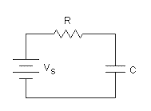
The voltage transfer function of a resistor in the given circuit with Vs=1V, R=1Ω, and C=1F is defined as Vr(s)/Vs(s)=s/(s+1). At s=∞, the transfer function equals unity, indicating that the capacitor behaves as a short circuit. However, at s=-1, the transfer function approaches infinity, which signifies an infinite gain in the circuit due to the exponential decay of current represented by I=exp(-t). The real part σ in the Laplace transform indicates the rate of exponential decay or growth in the system.

PREREQUISITES
  • Understanding of Laplace transforms and their applications in control systems
  • Familiarity with voltage transfer functions and circuit analysis
  • Knowledge of complex frequency and its significance in system behavior
  • Basic concepts of resistors and capacitors in electrical circuits
NEXT STEPS
  • Study the implications of infinite gain in control systems and its practical limitations
  • Learn about the significance of the real part σ in Laplace transforms
  • Explore the behavior of circuits with different configurations using voltage transfer functions
  • Investigate the effects of varying resistor and capacitor values on transfer functions
USEFUL FOR

Electrical engineers, control system designers, and students studying circuit analysis and Laplace transforms will benefit from this discussion.

cnh1995
Homework Helper
Gold Member
Messages
3,489
Reaction score
1,163
Consider the following circuit with Vs=1V,
R=1Ω and C=1F.
upload_2016-3-20_16-49-34.png

The voltage transfer function of the resistor can be written as
Vr(s)/Vs(s)=s/(s+1).
Now I understand s is complex frequency and at s=∞
the transfer function becomes unity since capacitor acts as a short and Vs=Vr. What I don't understand is at s=-1, the TF becomes infinity.
If s=-1 and s=σ+jω, σ=-1 gives TF=∞. What is the meaning of this? What is the general significance of σ? I know jω represents the oscillations in the system but what does the real part σ represent?
 
Engineering news on Phys.org
σ is for an exponential voltage (or current) proportional to exp(σt).
Consider the current I=exp(-t).
It gives voltages exp(-t) and -exp(-t)+const passing through the resistor and capacitor - so the sum is constant (1 in your case) which means infinite "AC" gain of your circuit.

(but of course it's only in mathematics where a current can be infinite in the past))
 
Last edited:

Similar threads

  • · Replies 31 ·
2
Replies
31
Views
12K
  • · Replies 1 ·
Replies
1
Views
2K
  • · Replies 12 ·
Replies
12
Views
4K
  • · Replies 3 ·
Replies
3
Views
1K
  • · Replies 1 ·
Replies
1
Views
4K
  • · Replies 12 ·
Replies
12
Views
8K
  • · Replies 1 ·
Replies
1
Views
1K
  • · Replies 3 ·
Replies
3
Views
3K
  • · Replies 1 ·
Replies
1
Views
2K
Replies
14
Views
3K