Undergrad Convergence .... Singh, Example 4.1.1 .... .... Another Question ....

Click For Summary
SUMMARY

The discussion centers on Example 4.1.1 from Tej Bahadur Singh's "Elements of Topology," specifically addressing the convergence of sequences in topological spaces. The complement of the set of points not equal to a limit point is established as a neighborhood of that point, leading to the conclusion that there exists an integer n0 such that the sequence becomes constant beyond that index. The conversation highlights the distinction between convergent sequences and the need for more generalized concepts like nets and filters to fully describe topological convergence.

PREREQUISITES
  • Understanding of basic topology concepts, including neighborhoods and convergence.
  • Familiarity with sequences and their properties in mathematical analysis.
  • Knowledge of the definitions and differences between topological spaces, particularly discrete and standard topologies.
  • Awareness of advanced concepts such as nets and filters in topology.
NEXT STEPS
  • Study the definitions of neighborhoods in topology as presented in "Elements of Topology" by Tej Bahadur Singh.
  • Learn about the concept of nets and how they generalize the notion of convergence in topological spaces.
  • Explore the differences between convergent sequences in standard and discrete topologies.
  • Investigate the role of filters in topology and how they relate to nets.
USEFUL FOR

Mathematicians, students of topology, and anyone interested in understanding the convergence of sequences and the foundational concepts of topological spaces.

Math Amateur
Gold Member
MHB
Messages
3,920
Reaction score
48
TL;DR
I need further help in order to fully understand an example concerning convergence in the space of real numbers with the co-countable topology ...
I am reading Tej Bahadur Singh: Elements of Topology, CRC Press, 2013 ... ... and am currently focused on Chapter 4, Section 4.1: Sequences ...

I need some further help in order to fully understand Example 4.1.1 ...Example 4.1.1 reads as follows:
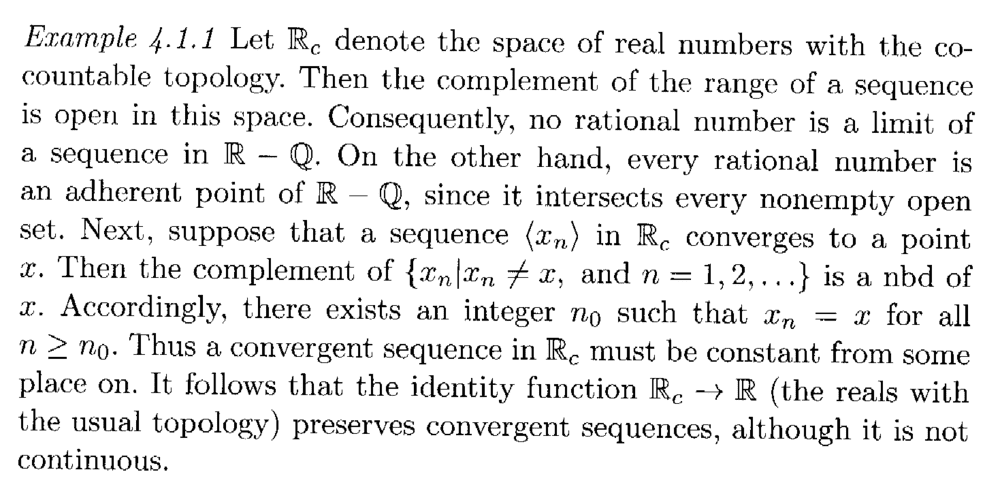
Singh - Example  4.1.1 ... .png
In the above example from Singh we read the following:

" ... ...Then the complement of ##\{ x_n \ | \ x_n \neq x \text{ and } n = 1,2, ... \}## is a nbd of ##x##. Accordingly, there exists an integer ##n_0## such that ##x_n = x## for all ##n \geq n_0##. ... ... "My question is as follows: Why, if the complement of ##\{ x_n \ | \ x_n \neq x## and ##n = 1,2, ... \}## is a nbd of ##x## does there exist an integer ##n_0## such that ##x_n = x## for all ##n \geq n_0##. ... ... ?Help will be much appreciated ... ...

Peter
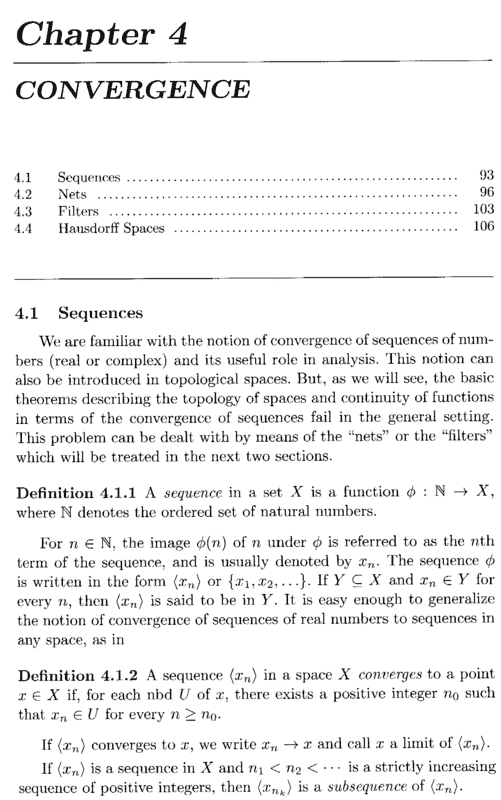
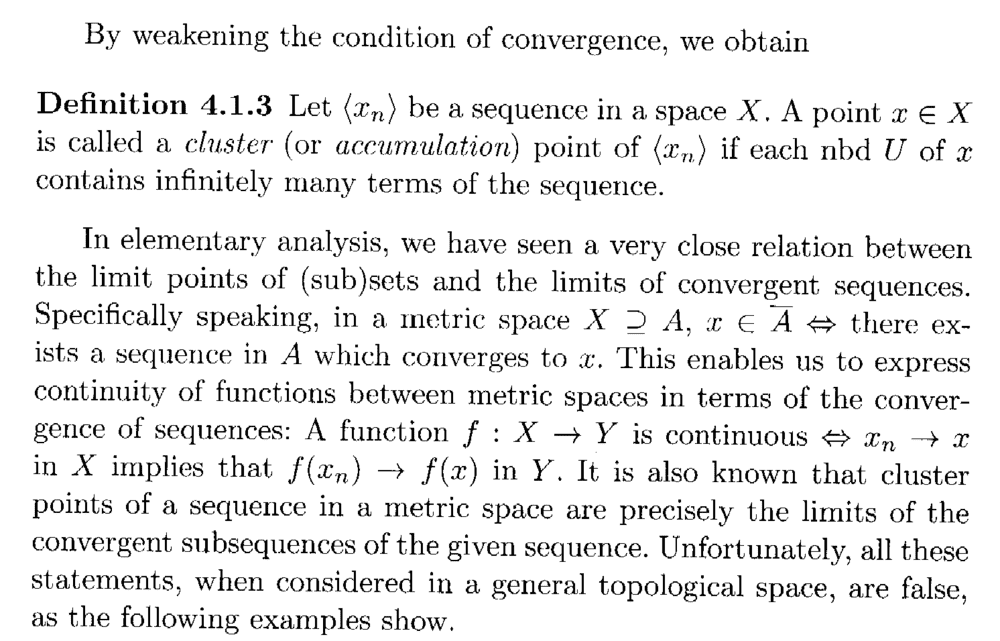
=====================================================================================It may help readers of the above post to have access to Singh's definition of a neighborhood and to the start of Chapter 4 (which gives the relevant definitions) ... so I am providing the text as follows:

Singh - Defn 1.2.5 ... ... NBD ... .png

Singh - 1 - Start of Chapter 4 ... PART 1 .png

Singh - 2 - Start of Chapter 4 ... PART 2 .png


Hope that helps ...

Peter
 
Physics news on Phys.org
##V=\mathbb{R} \setminus \{x_n: x \neq x_n, n \geq 1\}## is a neighborhood of ##x## as ##V## contains ##x## and it is the complement of a countable set, thus open.

But ##x_n \to x##, which means that for all neighborhoods ##U## of ##X##, there is ##n_0## such that ##x_n \in U## if ##n \geq n_0##.

Next, take ##U = V##. Then there is ##n_0## such that ##x_n \in V \iff x_n = x## if ##n \geq n_0##.

__________________

Addendum for the interested reader:

Note that the converse of what the author claims holds: any sequence that is eventually constant converges (to the eventually constant value). Thus in this topological space, the convergent sequences are exactly these which are eventually constant.

On ##\mathbb{R}##, we can also define the discrete topology ##\mathcal{P}(\mathbb{R})## (every subset of ##\mathbb{R}## is open). Then also a sequence in ##\mathbb{R}## is convergent if and only if it is eventually constant (easy exercise).

Thus we see that ##(\mathbb{R}, \mathcal{T}_c)## and ##(\mathbb{R}, \mathcal{P}(\mathbb{R}))## are different topological spaces with the same convergent sequences.

This means that sequences do not suffice to describe the topology (unlike for metric spaces or more generally spaces where every point has a countable neighborhood basis). The solution then is to generalise the concept of sequence and allow more general index sets than ##\mathbb{N}##. We then come to the concept of nets and these do describe the topology. But some authors use other approaches and use filters instead of net, though both concepts are equivalent and can be translated to one another.

TLDR: Sequences in topological spaces do not suffice to describe the topology, so there is the need to introduce a new kind of object to describe convergence. This will be a net or a filter.
 
Last edited by a moderator:
  • Like
Likes Math Amateur
Thanks for the help, Math_QED ...

And thanks also for a most interesting post ...

Peter
 
  • Like
Likes member 587159

Similar threads

  • · Replies 2 ·
Replies
2
Views
2K
  • · Replies 14 ·
Replies
14
Views
2K
  • · Replies 2 ·
Replies
2
Views
2K
  • · Replies 17 ·
Replies
17
Views
2K
  • · Replies 2 ·
Replies
2
Views
2K
  • · Replies 4 ·
Replies
4
Views
3K
  • · Replies 2 ·
Replies
2
Views
2K
  • · Replies 2 ·
Replies
2
Views
2K
  • · Replies 1 ·
Replies
1
Views
2K
  • · Replies 15 ·
Replies
15
Views
2K