Conversion in equal volume CSTR and PFR

  • Thread starter Thread starter Jaller1404
  • Start date Start date
  • Tags Tags
    Cstr Volume
Click For Summary
SUMMARY

The discussion focuses on determining the reaction order that results in greater conversion in a Continuous Stirred Tank Reactor (CSTR) compared to a Plug Flow Reactor (PFR), specifically when Xcstr > Xpfr. It is established that this condition occurs when the reaction order, n, is less than 1. Participants suggest equating the mass balances of both reactors and solving for Xpfr in terms of Xcstr, with specific values of n (0.5, 1, and 2) recommended for plotting. The challenge of handling the indeterminate form at n=1 is acknowledged, with a reference to the natural logarithm solution in that limit.

PREREQUISITES
  • Understanding of reaction kinetics and order
  • Familiarity with mass balance equations for CSTR and PFR
  • Basic knowledge of algebraic manipulation and graph plotting
  • Concept of limits in calculus, particularly for n=1
NEXT STEPS
  • Explore the derivation of mass balance equations for CSTR and PFR
  • Learn about reaction kinetics and the implications of different reaction orders
  • Investigate the graphical representation of conversion rates in chemical reactors
  • Study the natural logarithm and its applications in reaction order analysis
USEFUL FOR

Chemical engineers, process engineers, and students studying reaction engineering who are interested in optimizing reactor performance and understanding the dynamics between different reactor types.

Jaller1404
Messages
5
Reaction score
1
Hello
I've been working on a problem that involves finding which reaction order gives a greater conversion for a CSTR over a PFR (Xcstr>Xpfr).
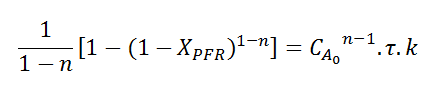
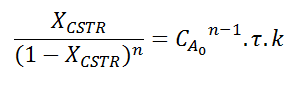
I was able to solve the mass balance for each reactor, finding:
upload_2017-12-5_1-25-15.png


and

upload_2017-12-5_1-28-13.png


Allowing us to equate them. This is where I've been stuck for a while now, how can I find an inequation that would get me which reaction order gives XCSTR>XPFR? It is known that this happen when n<1
 

Attachments

  • upload_2017-12-5_1-25-15.png
    upload_2017-12-5_1-25-15.png
    1.1 KB · Views: 1,101
  • upload_2017-12-5_1-28-13.png
    upload_2017-12-5_1-28-13.png
    1.3 KB · Views: 1,061
Engineering news on Phys.org
Set the two left hand sides equal, and then algebraically solve for Xpfr in terms of Xcstr. Then, for various values of n, plot a graph of Xpfr as a function of Xcstr. I suggest n = 0.5, 1, and 2.
 
Thanks for the tip, but wouldn't n=1 result in a 1/0 indetermination?
 
Jaller1404 said:
Thanks for the tip, but wouldn't n=1 result in a 1/0 indetermination?
For n = 1, you need to go back to the original differential equation. In the limit of n= 1, the solution approaches a natural log solution.
 
  • Like
Likes   Reactions: Jaller1404

Similar threads

  • · Replies 3 ·
Replies
3
Views
4K
  • · Replies 10 ·
Replies
10
Views
40K
Replies
4
Views
6K
Replies
7
Views
9K
  • · Replies 1 ·
Replies
1
Views
3K
  • · Replies 7 ·
Replies
7
Views
4K
  • · Replies 3 ·
Replies
3
Views
2K
  • · Replies 9 ·
Replies
9
Views
7K
Replies
3
Views
4K
Replies
1
Views
3K