Converting oscilloscope voltage to laser power

Click For Summary
SUMMARY

The discussion centers on converting oscilloscope voltage readings from a photodiode to laser power output. The user measures voltage peaks from a laser at 1064 nm and applies the formula R(λ) = I_PD/P to estimate power, concluding that P_max is approximately 4.5 mW. The conversation highlights the importance of understanding bandwidth and the operational modes of photodiodes, specifically the benefits of reverse bias for improved signal detection. Participants recommend consulting the manufacturer's datasheet for accurate calibration and sensitivity specifications of the DET100A2 photodiode.

PREREQUISITES
  • Understanding of photodiode operation and characteristics
  • Familiarity with oscilloscope measurements and signal interpretation
  • Knowledge of laser parameters, specifically at 1064 nm
  • Basic principles of electrical resistance and Ohm's Law
NEXT STEPS
  • Research the operational modes of photodiodes, focusing on photovoltaic vs. photoconductive modes
  • Learn about the calibration process for photodiodes and the importance of beam delivery optics
  • Investigate the sensitivity specifications of the DET100A2 photodiode
  • Explore methods for achieving reverse bias in photodiode circuits
USEFUL FOR

Researchers, optical engineers, and technicians working with laser systems and photodiode measurements, particularly those involved in laser power calibration and signal processing.

kelly0303
Messages
573
Reaction score
33
Hello! I have this photodiode which I connect to an oscilloscope using a normal BNC cable to an oscilloscope, terminated with a 50 Ohm resistor. I measure the output from an optical cavity (which is basically laser light), which in my case looks like a flat signal close to zero, and regular peaks (on the order of hundreds of mV amplitude) appearing from time to time (the details are not important, but I basically get a signal when the laser frequency, which I scan, matches the optical cavity length).

I would like to convert the maximum voltage in these peaks, call it ##V_{max}## to the laser power corresponding to that (basically the laser power output when my laser frequency is perfectly on resonance with my optical cavity), call it ##P_{max}##. From the manual from that link I have the formula ##R(\lambda) = \frac{I_{PD}}{P}##, where in my case, for ##\lambda = 1064## nm I get ##I_{PD} = 0.45P##.

Also if I assume the resistance to be ##R = 50## Ohm (is this right?) and ignore the dark current, the measured voltage would be ##V_{max}=RI_{max}=RI_{PD}=0.45RP## so in my case I would get ##P = \frac{V_{max}}{0.45R}=0.1/(50\times0.45)=4.5## mW. Is this right or am I oversimplifying it (I don't need a super accurate result, but just a close estimate of the power)? Thank you!
 
Engineering news on Phys.org
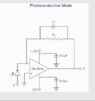
What bandwidth do you want to achieve? Optical diode detectors are not usually operated at zero bias; reverse bias improves bandwidth and gives you a better detector signal. Often done like this:

nd_Photoconductive_Modes_of_Photodiode_Operation_2.png


https://www.allaboutcircuits.com/te...hotoconductive-modes-of-photodiode-operation/
 

Attachments

  • 1682870732660.png
    1682870732660.png
    9.1 KB · Views: 133
berkeman said:
What bandwidth do you want to achieve? Optical diode detectors are not usually operated at zero bias; reverse bias improves bandwidth and gives you a better detector signal. Often done like this:

View attachment 325698

https://www.allaboutcircuits.com/te...hotoconductive-modes-of-photodiode-operation/
Ah I actually don't know much about this. What do you mean by bandwidth in this case? It is the frequency with which the peaks appear? Also how do I achieve reverse bias in practice (the diode has only one BNC output)?
 
Can you post a link to the datasheet?
 
I've done a lot of this in the past, and, sorry to say, there is no good way to do it with some sort of calibration standard. You have to measure it. That has to include the beam delivery stuff (lenses, apertures, mirrors, filters, diffusers, etc.) and the electronics (at least the 1st stage).
 
I'm getting an error when I click on the link(s):

The resource you are looking for has been removed, had its name changed, or is temporarily unavailable.
 
berkeman said:
I'm getting an error when I click on the link(s):

The resource you are looking for has been removed, had its name changed, or is temporarily unavailable.
Hmmm how about this one: https://www.thorlabs.com/search/thorsearch.cfm?search=DET100A2 This is the model and the documentation is attached to it on the website.
 
DaveE said:
I've done a lot of this in the past, and, sorry to say, there is no good way to do it with some sort of calibration standard. You have to measure it. That has to include the beam delivery stuff (lenses, apertures, mirrors, filters, diffusers, etc.) and the electronics (at least the 1st stage).
I am not sure I understand. In my case I want to know the power after all the optical element (the light coming out of my setup goes directly into the diode). Shouldn't the conversion curve (Power to current) be enough to get that power (without caring about the optics before)?
 
  • #10
This one?
https://www.thorlabs.com/drawings/b...246-86BA-313A130BF3DE4C38/DET100A2-Manual.pdf

I didn't realize it was a detector assembly. You should ask Thor Labs about accuracy/calibration, they may have selected diodes, characterized, or calibrated them somehow. Si diode die responsivity isn't that well controlled, in my experience.

OTOH, I suppose we should have started by asking what sort of accuracy you need.

kelly0303 said:
Shouldn't the conversion curve (Power to current) be enough to get that power
Yes, if you have it, it's accurate, and you realize exactly what light is illuminating the surface (i.e. how much of the beam is being sampled).
 
  • Like
Likes   Reactions: hutchphd
  • #11
How accurate do you need to be? If you really want accuracy I would choose photoconductive mode rtaher than photovoltaic
What you have done should get you within a factor of 2 for sure. Be aware that the slope on the silicon photodiode spectral response falls off pretty fast above 900nm (you are at 45% at 1064 ) and that is Temp dependent.
If you are not rapidlly passing through the peak signal (>kHz) then the bandwidth should not matter.
 
  • Like
Likes   Reactions: DaveE
  • #13
This is a detector for 1064 nm. The DET100A2 sensitivity specs are ; [mA/mW]
1060​
0.415​
1080​
0.295​
Vo = 0.391 mA*Rf/mW​
 

Similar threads

  • · Replies 32 ·
2
Replies
32
Views
3K
  • · Replies 5 ·
Replies
5
Views
2K
  • · Replies 32 ·
2
Replies
32
Views
4K
  • · Replies 78 ·
3
Replies
78
Views
6K
  • · Replies 3 ·
Replies
3
Views
2K
  • · Replies 4 ·
Replies
4
Views
1K
  • · Replies 9 ·
Replies
9
Views
4K
  • · Replies 7 ·
Replies
7
Views
2K
Replies
4
Views
3K
  • · Replies 13 ·
Replies
13
Views
4K