Why Does Coriolis Force Deflect Freely Falling Rocks?

Click For Summary
SUMMARY

The Coriolis force causes freely falling rocks to deflect slightly to the east due to the Earth's rotation. When a rock falls from a height, it retains its initial tangential velocity, which results in it traveling further east than the ground below as it descends. This phenomenon occurs because the rock is initially stationary in the rotating frame of reference, leading to a discrepancy in its position relative to the Earth's surface. Understanding this effect requires a grasp of the virtual nature of the Coriolis force and its implications in a rotating system.

PREREQUISITES
  • Understanding of Coriolis force and its implications in physics
  • Familiarity with rotational dynamics and inertial frames
  • Basic knowledge of mechanics and free fall motion
  • Ability to visualize motion in a rotating reference frame
NEXT STEPS
  • Study the mathematical formulation of the Coriolis force in physics
  • Explore the effects of the Coriolis force on large-scale weather patterns
  • Learn about inertial frames and their significance in classical mechanics
  • Investigate real-world applications of the Coriolis effect in engineering and geophysics
USEFUL FOR

Students of physics, educators teaching mechanics, meteorologists analyzing weather systems, and engineers involved in projects affected by rotational dynamics.

daniel_i_l
Gold Member
Messages
864
Reaction score
0
My mechanics book says that if a rock falls freely to Earth from a certain height than it will be deflected slightly to the east due to the Coriolis force. But I don't understand why. Consider the following Wikipedia picture:
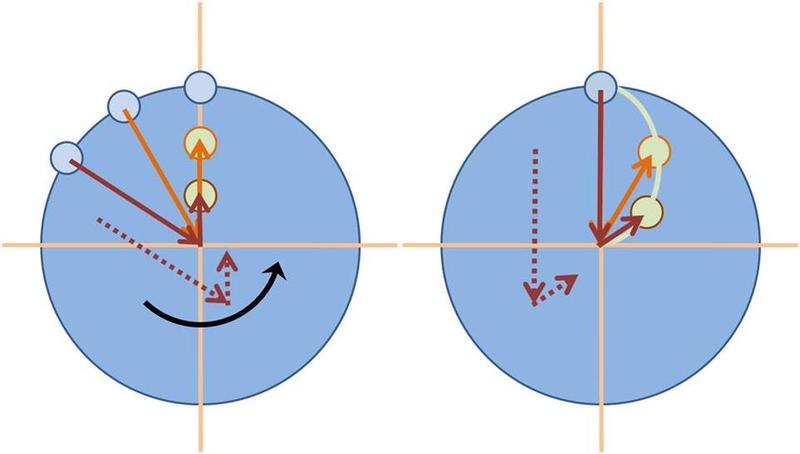
Coriolis_construction.JPG

If we imagine that we're looking at the nothern hemisphere from above, than wouldn't this imply that the rock would fall to the west? The Coriolis force would be directed east but that's just the centripetal force that causes the rock to spin.
What am I misunderstanding?
Thanks.
 
Physics news on Phys.org
I think the picture is showing the (linear) motion of a ball across a rotating surface, as viewed from either frame, and presumably this ball did not start out stationary in the rotating frame.

For the book's scenario, the rock moves closer to the rotational axis, but was initially stationary in the rotational frame. Thus, since no tangential inertial force acts on it, it will have excessive tangential velocity for its new radius, which is to say that (in the time elapsed falling) it will have traveled further east than the ground has.

(Note that I've made some first order approximations here, you should do the exact full 3D calculation yourself, for each frame. Your bit about causing "the rock to spin" sounds like a misunderstanding.)...how long has this forum had physorg spam?
 
Last edited:
No ideea what that drawing is.

The Coriolis force is "virtual" but has it's applications.

Imagine a stone falling from a 10 km height. At t=0 the stone is above Point A but as the Earth rotates without being able to impart any rotation to the stone then the stone will fall in point B slightly west ( or east :D). There is no true force acting upon either stone or Earth but in a assembly the force can have consequences. Again the above stone in a 10 km tube. As the stone falls it will constantly hit (or push) the west side of the tube because of the "virtual" Coriolis force.
 

Similar threads

  • · Replies 11 ·
Replies
11
Views
3K
  • · Replies 7 ·
Replies
7
Views
5K
  • · Replies 14 ·
Replies
14
Views
4K
  • · Replies 24 ·
Replies
24
Views
5K
  • · Replies 6 ·
Replies
6
Views
3K
Replies
26
Views
3K
Replies
40
Views
8K
  • · Replies 9 ·
Replies
9
Views
2K
  • · Replies 18 ·
Replies
18
Views
3K
  • · Replies 9 ·
Replies
9
Views
8K