Correlation between Tire Pressure and Acceleration of a Motorbike

Click For Summary
SUMMARY

The correlation between tire pressure and acceleration of a motorbike is influenced by several factors, including loadout and friction. Tire pressure recommendations typically balance durability, gas mileage, and comfort, with optimal pressures being 29 psi for the front and 33 psi for the rear. The acceleration of a motorbike is primarily determined by the engine torque and total mass, including passengers, which affects inertia. Additionally, the rear wheel loading can increase traction, potentially improving acceleration under certain conditions, despite the added weight of a passenger.

PREREQUISITES
  • Understanding of basic physics principles, particularly force and acceleration
  • Familiarity with tire pressure specifications and their impact on performance
  • Knowledge of motorcycle dynamics, including swingarm geometry and center of gravity
  • Awareness of friction forces and their role in vehicle acceleration
NEXT STEPS
  • Research the effects of tire pressure on motorcycle handling and performance
  • Study the relationship between load distribution and traction in motorcycles
  • Explore the physics of motorcycle acceleration and the role of engine torque
  • Investigate the impact of different surfaces on motorcycle grip and acceleration
USEFUL FOR

Motorcycle enthusiasts, engineers, and performance tuners looking to optimize bike acceleration and handling based on tire pressure and loadout considerations.

bagasme
Messages
79
Reaction score
9
I have asked this question on Stack Exchange: SE question.

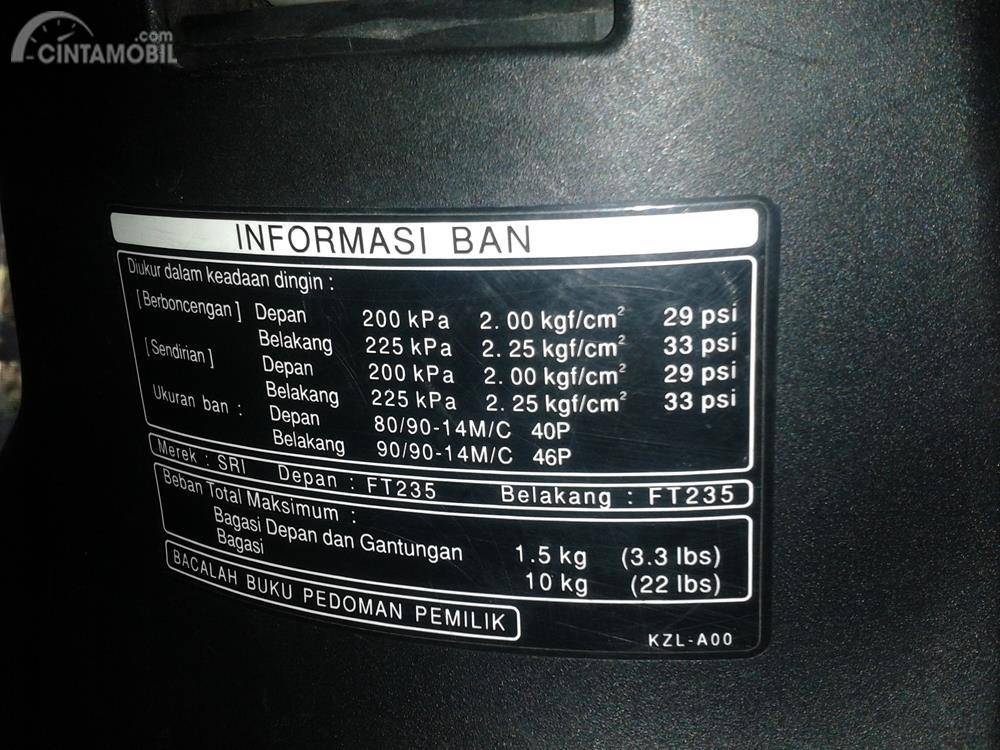
I often encountered this sticker on most motorbikes (especially matic ones) [credit: cintamobil.com]:
245804


There, when the tire pressure was measured from cold condition, the tire pressure are same regardless of loadout (29 psi and 33 psi for front and rear tire respectively).

According to SE:
The acceleration of the bike is given by the torque of the engine and the mass of the bike plus passengers - so when you have a passenger, there is greater inertia to overcome and your acceleration will be less
The force of friction is typically (naively) modeled by Ff∝μN
, whether static or kinetic (while both of these forces are vectors, the normal force acts perpendicular to the surface while friction acts in some direction parallel to the surface). If engine/gearbox can put enough torque on the axle to spin the wheels out, then the acceleration is capped not by the drive-train, but by the friction between the drive wheel(s) and the road.

Most tire manufacturers recommend a tire pressure which balances the durability of the tire's sidewall and the increased gas mileage of an over-inflated tire with the added comfort, acceleration and braking of a slightly less inflated tire (see rolling resistance). Obviously, tires either too flat or too full are a safety hazard.
If the engine/gearbox are powerful enough, the center mass hasn't moved too high and the connection between the road and the wheels exceptionally tight, one could see greater acceleration with a passenger.

Is it true that tire pressure and loadout (e.g. riders) correlate with acceleration of motorbike? Are there any papers that explain about it?

Regards, Bagas
 
Physics news on Phys.org
bagasme said:
Is it true that tire pressure and loadout (e.g. riders) correlate with acceleration of motorbike? Are there any papers that explain about it?
Tire pressure will figure into load sensitivity.

As indicated above, for power-limited acceleration, total rider mass is crucially important.

The passenger will be toward the rear of the bike. Adding the passenger could thereby increase rear wheel loading proportionally more than front wheel loading, gaining more through traction than is lost due to the extra mass. On some surfaces, (snow, slush, water sufficient to hydroplane), the weight of the passenger could help the wheels "cut through" and get some purchase on the road beneath.
 
For most motorcycles, acceleration isn't grip limited anyways, so all of those factors are irrelevant. Acceleration is limited by rear swingarm geometry, suspension, and CG location, since the limiting factor is the acceleration at which the bike will wheelie and flip over backwards.
 
  • Like
Likes   Reactions: jbriggs444

Similar threads

  • · Replies 10 ·
Replies
10
Views
2K
  • · Replies 18 ·
Replies
18
Views
2K
  • · Replies 52 ·
2
Replies
52
Views
7K
  • · Replies 8 ·
Replies
8
Views
14K
  • · Replies 8 ·
Replies
8
Views
6K
  • · Replies 7 ·
Replies
7
Views
4K
  • · Replies 9 ·
Replies
9
Views
12K
  • · Replies 6 ·
Replies
6
Views
2K
  • · Replies 1 ·
Replies
1
Views
2K
  • · Replies 2 ·
Replies
2
Views
4K