SUMMARY
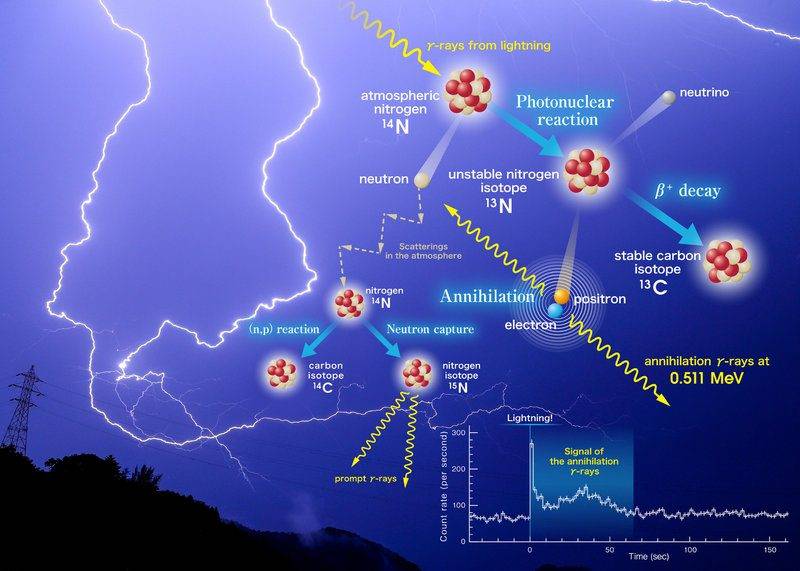
A Japanese team of scientists has confirmed that lightning strikes generate gamma rays that interact with atmospheric nitrogen, resulting in the production of positrons. This groundbreaking finding highlights the complex interactions between natural phenomena and particle physics. The research is documented in an article on phys.org, which provides further insights into the implications of these gamma-ray emissions.
PREREQUISITES
- Understanding of gamma-ray physics
- Familiarity with atmospheric chemistry
- Knowledge of particle physics, specifically antimatter
- Basic comprehension of lightning formation and behavior
NEXT STEPS
- Research the mechanisms of gamma-ray production in terrestrial environments
- Explore the implications of positron production in atmospheric science
- Investigate the relationship between lightning and atmospheric nitrogen
- Study the effects of terrestrial gamma-ray flashes on climate and weather patterns
USEFUL FOR
Physicists, atmospheric scientists, and researchers interested in the intersection of natural phenomena and particle physics will benefit from this discussion.