Couldn't understand the way the problem is solved regarding resistivit

  • Thread starter Thread starter Ein Krieger
  • Start date Start date
Click For Summary
SUMMARY

The discussion centers on the relationship between the cross-sectional area and length of a wire during the process of wire drawing. It is established that reducing the cross-sectional area of a wire results in an increase in its length, assuming constant volume. The formula for mass, expressed as Mass = ρAL, where ρ is density, A is cross-sectional area, and L is length, supports this conclusion. The confusion arises from the interpretation of the area reduction and its direct impact on the wire's dimensions.

PREREQUISITES
  • Understanding of wire drawing techniques
  • Familiarity with the concepts of volume and mass in physics
  • Knowledge of the relationship between cross-sectional area and radius
  • Basic grasp of density calculations
NEXT STEPS
  • Research the physics of wire drawing and its effects on material properties
  • Study the mathematical relationships between area, length, and volume in solid materials
  • Explore the implications of density changes during deformation processes
  • Learn about the mechanical properties of materials under tensile stress
USEFUL FOR

Students and professionals in materials science, physics educators, and engineers involved in manufacturing processes related to wire and material deformation.

Ein Krieger
Messages
32
Reaction score
0
Hello,

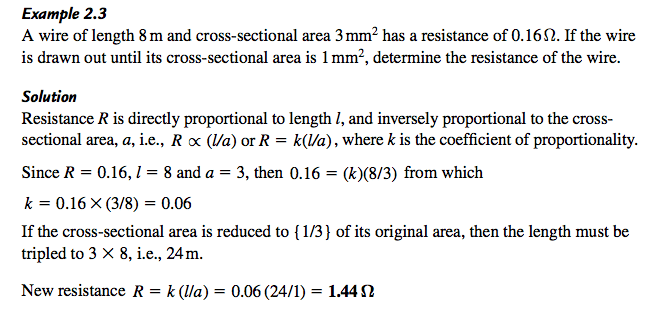
I was observing the solution of the following problem below:
765fa3055a66.png


Below it says that reducing the cross-sectional area of the wire triples its length. However, according to cross-sectional area equation A=pi*r^2 we observe that reduction of area only leads to reduction of radius .

Is there a mistake or I have some gaps in knowledge regarding above mentioned relationship?
 
Engineering news on Phys.org
It says the wire is drawn out to reduce it cross section area. See http://en.wikipedia.org/wiki/Wire_drawing if you don't know what "wire drawing" means.

Assume the volume of the wire is constant. As you reduce the cross section area, you increase the length.
 
In the original configuration there is some fixed mass of wire. After stretching will there not be the same mass of wire? You need to make the wire longer to compensate for the loss in radius.

The wires mass before+
mass= ρ*Volume. the volume = A*L
so
Mass = ρAL

I will now let you find the length after stretching.
 

Similar threads

Replies
2
Views
1K
  • · Replies 5 ·
Replies
5
Views
2K
  • · Replies 2 ·
Replies
2
Views
2K
  • · Replies 3 ·
Replies
3
Views
2K
  • · Replies 30 ·
2
Replies
30
Views
10K
  • · Replies 4 ·
Replies
4
Views
980
  • · Replies 24 ·
Replies
24
Views
4K
  • · Replies 5 ·
Replies
5
Views
2K
  • · Replies 10 ·
Replies
10
Views
2K
Replies
6
Views
3K