Coulomb's law in its vector form?

Join the discussion
Ask a follow-up here, or get your own question answered by working scientists, mathematicians and engineers — people, not an autocomplete.
Real named experts · corrections over time · the nuance an AI answer skips
8 replies · 7K views
ConfusedRookie
Messages
11
Reaction score
0
sorry I have use the image I made. Since I don't know how to perform the formula on forum :(
This is the problem I am having.
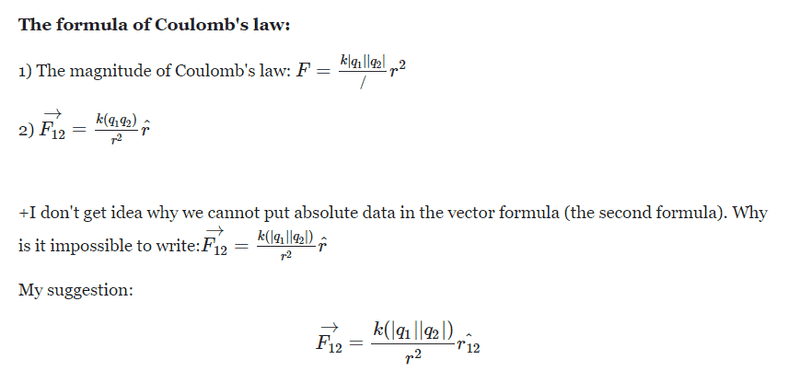
wtf12345.png
 
Last edited:
Physics news on Phys.org
Hello Rookie, :welcome:

You would miss the direction of ##\vec F## if one of the two charges has a charge opposite to the other...
In other words: ##\vec F## can be in the same direction as ##\vec r## or it can be in the opposite direction.
 
BvU said:
Hello Rookie, :welcome:

You would miss the direction of ##\vec F## if one of the two charges has a charge opposite to the other...
In other words: ##\vec F## can be in the same direction as ##\vec r## or it can be in the opposite direction.
Oh my god. I've just realized without the absolute symbols. It would be more easier to express the direction. Oh my oh my thank you very much teacher :)
 
BvU said:
My pleasure
Teacher. There's one more thing I would like to ask. I see there are many formula using "charge density". Is charge density able to be negative !?

ae544e.gif


If a charge density can be negative, it is very much easy to express its direction. I didn't find any vector form E that use the unit vector to express direction. They mainly focus on the magnitude.
 
With ##\vec F = q\vec E\ ## you can use (almost) the same expression

Charge density can be negative, yes: negative charge leads to negative charge density :smile:

Your picture in post #6 comes through as a lot of letters/numbers :nb)
