Current Dividing in an Electrical Circuit

Click For Summary
SUMMARY

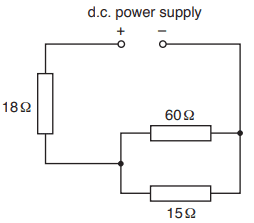
The discussion centers on current division in an electrical circuit containing a 7.5V DC power supply and three resistors: 18 ohms, 15 ohms, and 60 ohms. The largest current flows through the 18 ohm resistor due to its position in the circuit, as all current from the power supply must pass through it before branching to the other resistors. The 60 ohm resistor experiences the smallest current because it has the highest resistance, confirming that current divides inversely with resistance in parallel circuits.

PREREQUISITES
  • Understanding of Ohm's Law
  • Knowledge of series and parallel resistor configurations
  • Familiarity with electrical circuit terminology
  • Basic principles of voltage and current flow
NEXT STEPS
  • Study the concept of current division in parallel circuits
  • Learn about calculating total resistance in series and parallel circuits
  • Explore the application of Ohm's Law in circuit analysis
  • Investigate the effects of resistor values on current flow
USEFUL FOR

Electrical engineering students, hobbyists building circuits, and anyone interested in understanding current flow and resistance in electrical systems.
Muhammad Danish
Messages
70
Reaction score
7
Member advised to use the formatting template for all homework help requests
A circuit contains a 7.5V d.c power supply and three resistors. The total resistance of the circuit is 30 ohms. Why will the largest current in the 18 ohm resistor? As far as I know is that the smallest current will be in 60 ohm resistor because it has the maximum resistance. Please explain.
Thanks.
(regards)
upload_2018-4-15_14-14-13.png
 

Attachments

  • upload_2018-4-15_14-14-13.png
    upload_2018-4-15_14-14-13.png
    2.1 KB · Views: 502
Physics news on Phys.org
Hi,

I don't see a contradiction in your statements: All the current that the supply delivers to the circuit will have to go through the 18 ##\Omega## resistor. And yes, the 60 ##\Omega## resistor will have a smaller amount of current than the 15 ##\Omega## resistor.
 
BvU said:
Hi,

I don't see a contradiction in your statements: All the current that the supply delivers to the circuit will have to go through the 18 ##\Omega## resistor. And yes, the 60 ##\Omega## resistor will have a smaller amount of current than the 15 ##\Omega## resistor.
Why won't the largest amount of current pass through 15 ohm resistor? Because lower the resistance, higher will be the current..
 
Current flows from high potential (voltage) -- the + of the power supply -- to low potential -- the ##-## of the power supply. On its path it has to go through resistor 18 ##\Omega## and after that it can and will branch over the other two. From the power supply + to the other end of the 18 ##\Omega## resistor there is a potential drop.

The left sides of the 60 ##\Omega## and the 15 ##\Omega## resistors are connected by a wire. So are the right sides.
In other words: the potential difference over the 60 ##\Omega## and the 15 ##\Omega## resistors is the same.
 
BvU said:
Current flows from high potential (voltage) -- the + of the power supply -- to low potential -- the ##-## of the power supply. On its path it has to go through resistor 18 ##\Omega## and after that it can and will branch over the other two. From the power supply + to the other end of the 18 ##\Omega## resistor there is a potential drop.

The left sides of the 60 ##\Omega## and the 15 ##\Omega## resistors are connected by a wire. So are the right sides.
In other words: the potential difference over the 60 ##\Omega## and the 15 ##\Omega## resistors is the same.
Can we say that current divides as it flows into the resistors connected in parallel?
 
Yes. I used the word branching. All the current that comes into a connection point has to go out again (or else it would build up a huge potential in no time)
 

Similar threads

  • · Replies 42 ·
2
Replies
42
Views
5K
  • · Replies 14 ·
Replies
14
Views
1K
Replies
4
Views
2K
  • · Replies 3 ·
Replies
3
Views
2K
  • · Replies 6 ·
Replies
6
Views
2K
  • · Replies 21 ·
Replies
21
Views
2K
Replies
3
Views
2K
  • · Replies 3 ·
Replies
3
Views
2K
  • · Replies 7 ·
Replies
7
Views
2K
  • · Replies 8 ·
Replies
8
Views
2K