Curve ball problem, the spin axis will change?

Click For Summary

Discussion Overview

The discussion revolves around the behavior of a spinning table tennis ball in flight, specifically focusing on the changes to its spin axis due to aerodynamic forces. Participants explore the implications of air drag, gravity, and Magnus force on the trajectory and spin axis of the ball, considering both theoretical and practical aspects of the problem.

Discussion Character

  • Exploratory
  • Technical explanation
  • Debate/contested
  • Mathematical reasoning

Main Points Raised

  • Some participants propose that the spin axis will remain unchanged despite the forces acting on the ball, suggesting that drag and lift do not affect the spin torque.
  • Others argue that the spin axis may precess under certain conditions, particularly when the spin axis is at an acute angle to the velocity vector.
  • One participant questions the role of profile drag and its interaction with the lift force, indicating uncertainty about how these forces affect the ball's motion.
  • There is a discussion about the conditions under which precession occurs, with some suggesting that precession requires a force couple that is not aligned with the spin axis.
  • Some participants express doubt about the influence of gravity on the spin axis, arguing that it does not contribute to precession if the initial angular momentum is aligned with the initial velocity.
  • One participant mentions that in the absence of gravity, the ball may follow a corkscrew path if the spin axis is neither parallel nor perpendicular to the velocity.

Areas of Agreement / Disagreement

Participants have differing views on whether the spin axis will change or precess due to aerodynamic forces. While some believe it remains fixed, others contend that precession is possible under specific conditions. The discussion does not reach a consensus on the behavior of the spin axis.

Contextual Notes

Participants express uncertainty regarding the definitions and implications of various forces acting on the ball, including the nature of drag and lift. There are also unresolved mathematical considerations related to the forces and their effects on the spin axis.

zyh
Messages
135
Reaction score
0
curve ball problem, the spin axis will change?image updated!

HI, I encountered a problem about the curve ball (table tennis ball) flying in the air. See the pictures below.
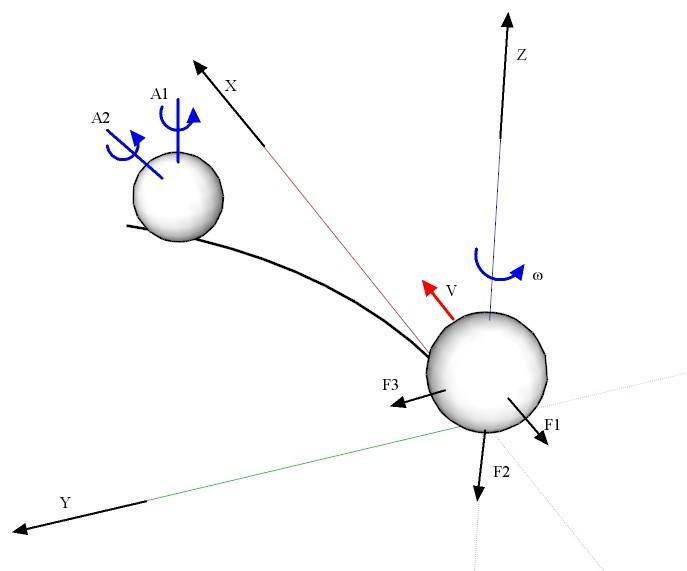
attachment.php?attachmentid=16110&stc=1&d=1225157791.jpg


A ball with an initial velocity V along X axis, and has a spin along Z axis. As far As I know ( see my previous post in The air drag problem... ) .
F1 is the air drag.
F2 is the gravity.
F3 is the magnus force( sometimes we call it lift force).

So, the ball will not travel directly through X axis, it will curve to left.

My question is : What about the spin axis? Will it shift from A1 to A2? ( A1 is the axis parallel to Z axis as the initial state )? If Yes, How can I estimate the angle between A1 and A2?

Any suggestion is appreciated. Thank you very much.
 

Attachments

  • ball_force2.jpg
    ball_force2.jpg
    15.1 KB · Views: 858
Last edited:
Physics news on Phys.org
I'm sorry that the attachment image is destroyed(I upload the jpg file as an attachment, but it doesn't appeared). I will upload it soon!

Image added!
 
Last edited:
The way you have it drawn, the ball will curve to the right, and also lift from gravitational effects.
 
Last edited:
Thanks Phark.
To my knowledge, I think the revolution axis(or spin axis) will remain its original direction( in the picture, it is A1), because, the drag, life and gravity force all have no effects on the spin Torque.
 
My mistake about the directions of deflection. I got everything inverted.

The question is, what happens when the spin axis is at some accute angle to the velocity, like when the ball starts dropping, right?

The lift and the induced drag, for instance, will act somewhere toward the 'leading edge'. But where is the profile drag--the viscous and eddy current drag?
 
Hi, Phrak, I received your message. In my case: the revolution axis is transverse with Velocity, which is more simple than your question" spin axis is some accute angle to the velocity".

I think the lift force ( magnus force ) is defined by:
\overrightarrow{F_{lifg}}=k1\overrightarrow{\omega}\times\overrightarrow{V}
Through I'm not sure this formula is right.
The profile drag(Let me guess its meaning) is defined by:
\overrightarrow{F_{drag}}=-k2\parallel\overrightarrow{V}\parallel\overrightarrow{V}
where K1 and k2 are all drag coefficients.
 
Let me make sure I have this right. You want to know if the spin axis will precess, right?

For something with little angular mass, such as a ping pong ball, it seems, it precession could be substancial at the right angle of attack. What's required for it to precess is force couple whos axis isn't parallel with the spin axis.

I'd have to get out my crayons to see how the distributed forces would do this. It's probably more intuitive to draw the spin axis as horizontal, where the axis is oriented in the airflow like the span of a wing, then give it a little yaw.
 
Last edited:
Thanks, Yes, I'm try to find whether the spin axis will precess.
Do you mean "Angular mass" is the same as "Angular momentum" ? see in
http://en.wikipedia.org/wiki/Angular_momentum
I'm my picture, I think the torque given by "distributed forces" is symmetric on the spin axis. So, the precess may not happen.:wink:
 
First of all, let me say that your direction of curve in the original illustration is correct. The ball will curve in the same direction it is spinning. The curve in the opposite direction would be true on Mars (or maybe at extremely high altitudes), but not on Earth.

Secondly, I can see no force that would cause the axis to tilt. As I understand it, precession is a phenominon that takes place when the axis of rotation is already tilted. Maybe I'm not using the right frame of reference?
 
Last edited:
  • #10
Thanks LURCH for your reply.
First of all, let me say that your direction of curve in the original illustration is correct. The ball will curve ni the same direction it is spinning. The curve in the opposite direction would be true on Mars Or maybe at extremely high altitudes), but not on Earth.
Yes, I have seem an article talking about that it will curve right in Mars.

Secondly, I can see no force that would cause the axis to tilt. As I understand it, precession is a phenominon that takes place when the axis of rotation is already tilted. Maybe I'm not using the right frame of reference?
Yes, In my opinion, I think the spin axis will never tilted from it's any original condition.
 
  • #11
LURCH said:
First of all, let me say that your direction of curve in the original illustration is correct. The ball will curve in the same direction it is spinning. The curve in the opposite direction would be true on Mars (or maybe at extremely high altitudes), but not on Earth.

Secondly, I can see no force that would cause the axis to tilt. As I understand it, precession is a phenominon that takes place when the axis of rotation is already tilted. Maybe I'm not using the right frame of reference?

Lurch. At the initial position of the ball, the spin axis and velocity are perpendicular. But after a while gravity will give the ball a downward velocity component so that the velocity and spin axis are no longer perpendicular. So I wonder what the forces on the ball then.
 
  • #12
It's almost a given that there will be precessional forces on the ball for the spin axis no at 0 or 90 degrees to the velocity. This would be false if there is some symmetry condition or the distributed forces somehow conspired against it.


The forces on the ball in this general condtion can be resolved into a force acting through the center of the ball (gravity included) and a force couple whos axis is not likely aligned with the spin axis. Any misalignment results in a pair of precessional forces.

After breaking a few crayons trying some picturorial solutions, I've concluded wind tunnel simulation software might be better.


In another senario, in the absense of gravity, and the spin axis not parallel nor perpendicular with the initial velocity, I think the ball will follow a corkscrew path; no precession required.
 
Last edited:
  • #13
HI, Phark.
Firstly, I think the gravity will not give any precession effort on the initial Angular momentum.

Secondly, If the initial angular momentum is parallel or perpendicular to the initial velocity(consider the absence of gravity condition), after a while, the axis will not change it's direction.

I don't think it will get a "corkscrew path" ( the angular momentum is not parallel nor perpendicular to the velocity), though I can't test it in wind tunnel equipment.
 

Similar threads

Replies
2
Views
3K
  • · Replies 5 ·
Replies
5
Views
4K
  • · Replies 1 ·
Replies
1
Views
3K
  • · Replies 4 ·
Replies
4
Views
1K
  • · Replies 25 ·
Replies
25
Views
4K
  • · Replies 10 ·
Replies
10
Views
4K
  • · Replies 11 ·
Replies
11
Views
2K
Replies
22
Views
3K
Replies
14
Views
3K
  • · Replies 2 ·
Replies
2
Views
2K