How to Find Linear Acceleration Without Cylinder Radius?

Click For Summary
To find linear acceleration without knowing the cylinder radius, the relationship between the linear acceleration of the center of mass and the point on the cylinder must be understood. The linear acceleration can be derived using the forces and masses involved, specifically through the equations of motion and torque. The radius cancels out in the calculations, simplifying the process. By applying the given values, the expected acceleration of 2.19 m/s² can be confirmed. This approach demonstrates that the problem can be solved without the radius by focusing on the dynamics involved.
ricles
Messages
10
Reaction score
5
Homework Statement
A solid cylinder A of uniform mass given ##m_1## can rotate freely along an axis fixed to a support B of given mass ##m_2##, also given. A constant force ##F## is applied at the extremity (point ##k##) of a light thread firmly rolled in the cylinder. The friction between the support and the horizontal place is negligible. Find the acceleration at point ##k##.
Relevant Equations
Equations of linear and rotational motion.
This comes from a list of exercises, and setting ##m_1 = 5.4kg##, ##m_2 = 9.3kg## and ##F=5N##, the answer should yield ##2.19m/s^2## (of course, supposing the answer is right).

If I knew the radius ##R## of the cylinder, I could find its momentum and use it to find the linear acceleration. I'm really mystified on how to go about this problem without the radius 🤔
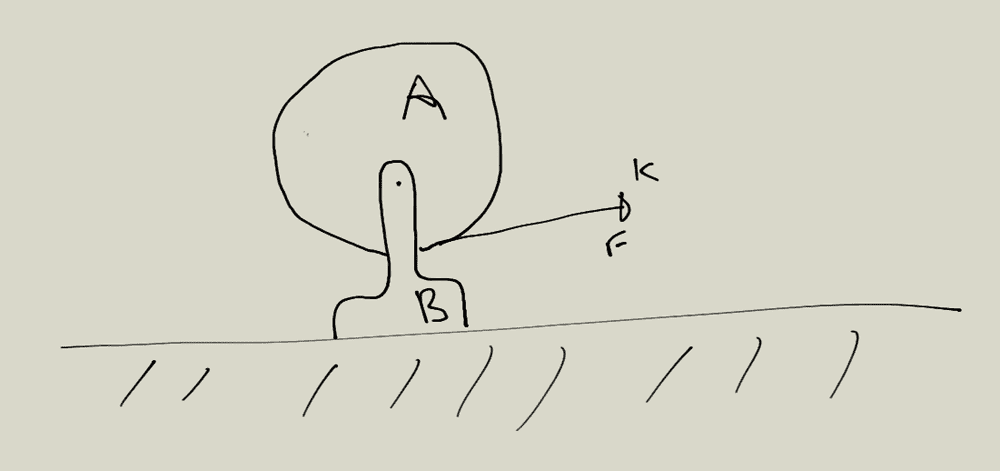
cylinder_on_support.png

(sorry for the poor drawing :p)
 
Physics news on Phys.org
ricles said:
If I knew the radius ##R## of the cylinder, I could find its momentum and use it to find the linear acceleration.
It's not clear how you would get from momentum to acceleration.

I'm really mystified on how to go about this problem without the radius 🤔
It could be that ##R## cancels out in the calculations so that the answer doesn't depend on ##R##.

You will probably need to think about the relation between the linear acceleration of ##k## and the linear acceleration of the center of the cylinder.
 
  • Like
Likes Lnewqban
Yes, that's right. It's actually not complicated after thinking a little, we have (##a_k## denoting the acceleration at the point k):
$$
\begin{align}
a_{cm} & = \frac{f}{m_1 + m_2} \\
\tau &= f\cdot R = I\cdot \alpha = \left(\frac12 m_1 R^2 \right) \alpha \therefore \alpha = \frac{2f}{m_1R} \\
a_R &= R\cdot \alpha = \frac{2f}{m_1} \text{ (and this is where the R cancels)}\\
a_k &= a_{cm} + a_R = \frac{2f}{m_1} + \frac{f}{m_1 + m_2}
\end{align}
$$
and plugging the values yields the expected result. It was a simple problem - it's just I was "blocked" from seeing it, so to speak. Anyway, thanks for the encouragement 👍
 
  • Like
Likes Lnewqban and TSny
The book claims the answer is that all the magnitudes are the same because "the gravitational force on the penguin is the same". I'm having trouble understanding this. I thought the buoyant force was equal to the weight of the fluid displaced. Weight depends on mass which depends on density. Therefore, due to the differing densities the buoyant force will be different in each case? Is this incorrect?

Similar threads

  • · Replies 17 ·
Replies
17
Views
8K
  • · Replies 7 ·
Replies
7
Views
4K
  • · Replies 8 ·
Replies
8
Views
2K
  • · Replies 2 ·
Replies
2
Views
3K
  • · Replies 3 ·
Replies
3
Views
2K
Replies
2
Views
3K
Replies
1
Views
2K
  • · Replies 7 ·
Replies
7
Views
6K
Replies
1
Views
2K
  • · Replies 9 ·
Replies
9
Views
2K