Damage by tire blowing up at 203 mph

  • Context: High School 
  • Thread starter Thread starter Tachyon son
  • Start date Start date
  • Tags Tags
    Damage Tire
Join the discussion
Ask a follow-up here, or get your own question answered by working scientists, mathematicians and engineers — people, not an autocomplete.
Real named experts · corrections over time · the nuance an AI answer skips
2 replies · 1K views
Tachyon son
Messages
38
Reaction score
2
Hi all,

We have a discussion among friends after this video:


For sure the energy involved in a tire spinning at those speeds is massive enough to create these damage:
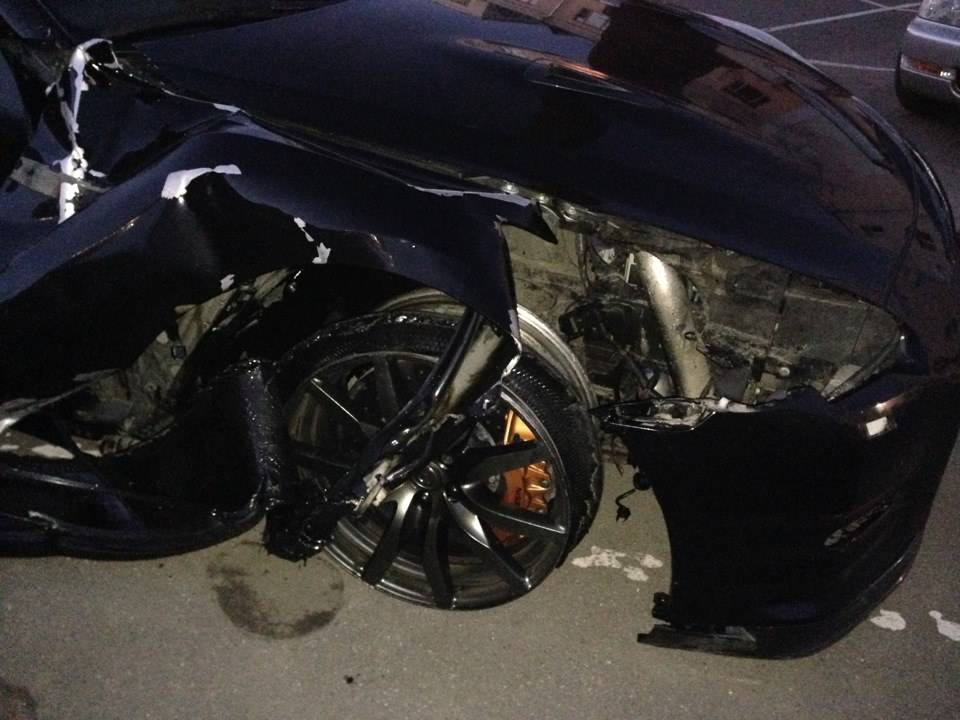
7a2e792s-960.jpg

87c0e52s-480.jpg


But what kind of energy is exactly the one which directly produces that body rip?
Rotational kinetic energy?
Centrifugal?
Thanks a lot.PS: That tire is spinning circa 40 revolutions per second at that speed.
 
Physics news on Phys.org
Tachyon son said:
But what kind of energy is exactly the one which directly produces that body rip?
Rotational kinetic energy?
Centrifugal?
Once the tire comes apart, it seems most convenient to treat its pieces as individually having kinetic energy due to their motion. Since we are talking about damage to the [much more massive] car, one would use their kinetic energy in the car's rest frame.

On the other hand, if the fragments retain coherence, they will individually be spinning. If for instance, a large portion of the tire carcass is spinning, detached from the wheel, I would agree that rotational kinetic energy seems a more appropriate notion.

Of course, both are the same number.

Centrifugal force is not a form of energy.
 
  • Like
Likes   Reactions: Lnewqban
That kind of damage seems to be produced by the whipping effect of lenghts of fabric-rubber long pieces that remain attached to the rim (via steel ring in bead of tire) while it is still able to rotate supplying some torque.
Note the interior side of the tire's ring still attached to the rim, although it moved to the exterior side.

This is also an all-wheel-drive car, which may have had power being supplied to that right front tire at time of rupture.
If so, being suddenly unloaded, the rpm's of that rim could have reached a higher value via the differential.
That engine is able to provide more than 450 HP, while the body material close to that tire is light but not very strong against impact.

Please, see:
https://en.m.wikipedia.org/wiki/Nissan_GT-R

:cool:
 
Last edited:
  • Like
Likes   Reactions: russ_watters