SUMMARY
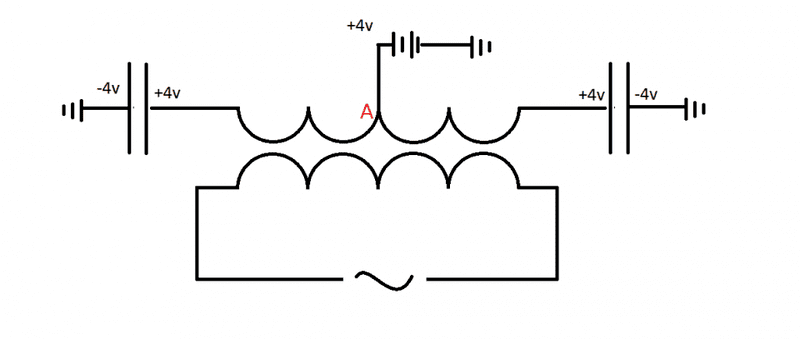
The discussion centers on the feasibility of a circuit designed to maintain a DC bias on capacitors, specifically with a +4V bias at point A. Participants confirm that while the circuit appears functional, the "-4V" notes should be removed since the capacitor outsides connect to ground (0V). The center tap is confirmed to be biased at 4V, with the capacitor windings experiencing both 4V DC and an AC component due to transformer action.
PREREQUISITES
- Understanding of capacitor biasing techniques
- Knowledge of transformer action and AC components
- Familiarity with circuit analysis involving DC and AC voltages
- Basic electronics terminology, including voltage levels and grounding
NEXT STEPS
- Research capacitor biasing methods in electronic circuits
- Learn about transformer action and its effects on voltage levels
- Study the implications of grounding in circuit design
- Explore AC and DC voltage interactions in capacitive circuits
USEFUL FOR
Electronics engineers, hobbyists designing circuits with capacitors, and students studying circuit theory will benefit from this discussion.