loginorsinup
- 54
- 2
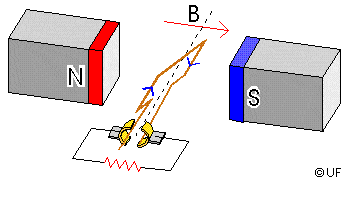
Given a simple DC generator with a single loop in the presence of a magnetic field such as the one below, typically, the analysis involves how each rectangular loop's terminal ends up on opposite sides of an armature housing each of the coils.
 The analysis is fairly straightforward to then extend to a second loop positioned perpendicular to the first loop. The result is also a rectified / pulsed DC waveform at the brushes, except there will be a more regular supply of pulses than in the case with one loop. The two coils are connected to a commutator such that opposite ends of each loop's terminals go to opposite ends of the commutator. This is conceptually straightforward as well.
All of this is fine, but in real life, generators with many such armature windings / loops are wired such that the opposite ends of a loop are connected as follows.
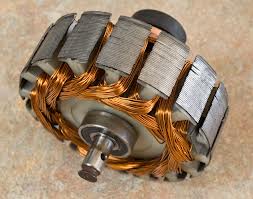 In other words, given 6 loops, instead of the first loop having one end at 12 o'clock on a clock and the other end at 6 o'clock on a clock, the ends are at 12 o'clock and 1 o'clock. Can someone help me understand why? How does the analysis change, if at all at that point, as far as how much voltage is generated?
Thanks in advanced.
All of this is fine, but in real life, generators with many such armature windings / loops are wired such that the opposite ends of a loop are connected as follows.
Thanks in advanced.