Deducing the volume of an elliptical cone

  • Thread starter Thread starter yaakob7
  • Start date Start date
  • Tags Tags
    Cone Volume
Click For Summary
SUMMARY

The volume of a right elliptical cone with an elliptic base defined by semi-axes a and b and height h is calculated using the formula V = (1/3)abhπ. The discussion highlights the importance of understanding the area of an ellipse, given by A = πab, and suggests using elliptical cross-sections for easier volume calculation. Participants emphasize the necessity of mastering change of variables in double integrals to simplify the problem-solving process.

PREREQUISITES
  • Understanding of right elliptical cones and their properties
  • Familiarity with the area formula for ellipses, A = πab
  • Knowledge of double integrals and change of variables
  • Basic calculus concepts, including integration
NEXT STEPS
  • Study the derivation of the volume formula for elliptical cones
  • Learn about change of variables in double integrals
  • Explore applications of elliptical cross-sections in volume calculations
  • Practice problems involving integration of elliptical areas
USEFUL FOR

Students studying calculus, particularly those focused on geometry and integration techniques, as well as educators seeking to enhance their teaching of volume calculations involving elliptical shapes.

yaakob7
Messages
4
Reaction score
0
Here again

Homework Statement


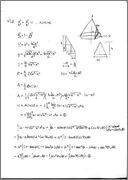
Find the volume of a right elliptical cone with an elliptic base with semi-axes a and b and heigh h

Homework Equations


So: \frac{x^2}{a^2}+\frac{y^2}{b^2}=1
The Attempt at a Solution


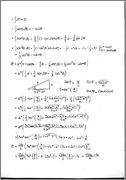
image.jpg


image.jpg


That's what I have, but answer should be:

V=\frac{1}{3}abh\pi

I've checked it all over again like 10 times, but I can't find the mistake. If you can see it I'd be grateful
 
Physics news on Phys.org
To tell you the truth, I can 't bring myself to slog through all your steps. But I have a question for you. Have you had change of variables in double integrals yet? For example, do you know how to show the area of the ellipse $$\frac {x^2}{a^2}+\frac{y^2}{b^2}=1$$ is ##\pi a b## by mapping the ellipse to a circle? The reason for my asking is that if you have studied that, a much easier way to do the problem is to use the elliptical cross-sections. You can figure out the equation of the ellipse cross section at height ##z## for ##0\le z \le h## and either use the above formula or develop it with the appropriate change of variables.
 
LCKurtz said:
To tell you the truth, I can 't bring myself to slog through all your steps. But I have a question for you. Have you had change of variables in double integrals yet? For example, do you know how to show the area of the ellipse $$\frac {x^2}{a^2}+\frac{y^2}{b^2}=1$$ is ##\pi a b## by mapping the ellipse to a circle? The reason for my asking is that if you have studied that, a much easier way to do the problem is to use the elliptical cross-sections. You can figure out the equation of the ellipse cross section at height ##z## for ##0\le z \le h## and either use the above formula or develop it with the appropriate change of variables.

I know how to make an implicit differentation but, I can't do that to an intregal expression.
 
LCKurtz said:
To tell you the truth, I can 't bring myself to slog through all your steps. But I have a question for you. Have you had change of variables in double integrals yet? For example, do you know how to show the area of the ellipse $$\frac {x^2}{a^2}+\frac{y^2}{b^2}=1$$ is ##\pi a b## by mapping the ellipse to a circle? The reason for my asking is that if you have studied that, a much easier way to do the problem is to use the elliptical cross-sections. You can figure out the equation of the ellipse cross section at height ##z## for ##0\le z \le h## and either use the above formula or develop it with the appropriate change of variables.

yaakob7 said:
I know how to make an implicit differentation but, I can't do that to an intregal expression.

What I asked you has nothing to do with implicit differentiation. Just tell me this: Are you allowed to use the area formula ##\pi ab## for your standard xy ellipse area as a given? If the answer to that is yes, then figure out the equation of the elliptical cross section of your cone at height ##z## for ##0\le z \le h## and use that formula for its area. Then you can integrate the elliptical cross section area as a function of z to get the volume.
 

Similar threads

Replies
9
Views
5K
  • · Replies 10 ·
Replies
10
Views
2K
Replies
3
Views
2K
  • · Replies 9 ·
Replies
9
Views
2K
  • · Replies 4 ·
Replies
4
Views
2K
  • · Replies 3 ·
Replies
3
Views
2K
  • · Replies 9 ·
Replies
9
Views
2K
  • · Replies 3 ·
Replies
3
Views
2K
  • · Replies 1 ·
Replies
1
Views
4K
  • · Replies 17 ·
Replies
17
Views
5K