Define the polarization in TE/TM modes

Click For Summary
The discussion revolves around the confusion regarding the polarization direction of electric (E) and magnetic (H) fields in transverse electric (TE) and transverse magnetic (TM) modes. It emphasizes the importance of using the right-hand rule to determine the correct orientations of E and H fields in relation to the wave's propagation direction. The initial misunderstanding is clarified by applying the cross product method to find the correct directions of the fields, leading to the conclusion that the depictions in the referenced pictures are incorrect. Ultimately, the correct relationships between the fields are established, reinforcing that electromagnetic waves propagate in the direction defined by the cross product of E and H. The thread concludes with a reaffirmation of the right-hand rule's application in these scenarios.
Dimani4
Messages
50
Reaction score
0
Hello people,

I'm a little bit confused about how to define the polarization direction for TM/TE mode.
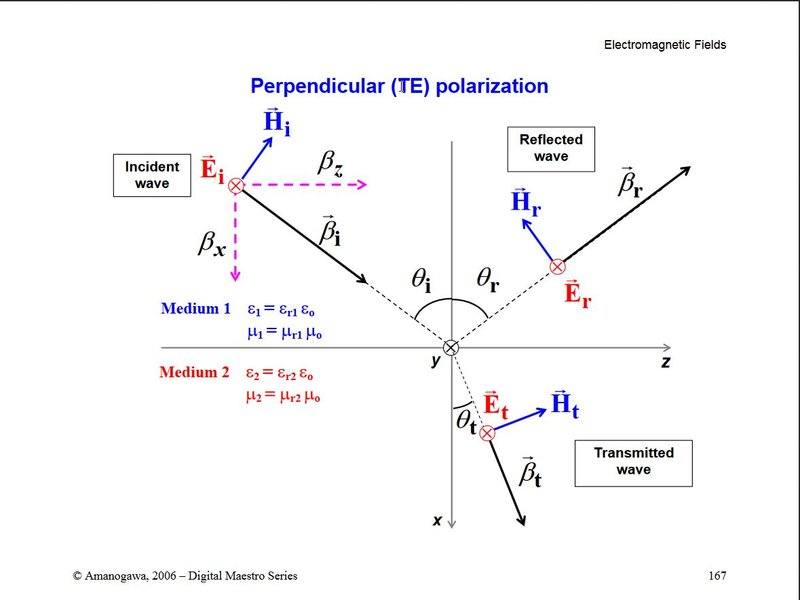
Take a look at the TE mode picture I found in some place.
TE polarization.jpg


Picture1

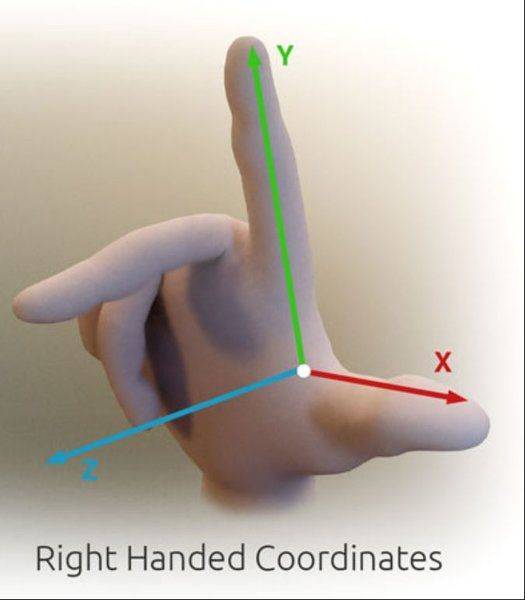
The Cartesian system of coordinate (XYZ) here is chosen by the right hand rule.
rhr.jpg

Picture2

But how we chose the direction of magnetic field (H) and electric field (E)? If I chose it according the right hand coordinate the direction of electric field E (TE- E field perpendicular to the incidence plane i.e. in the Y direction)should be out of the plate and not into the plate (as described here in the Picture1) and the direction of the magnetic field should be exactly the opposite to the one that signed in Picture1.

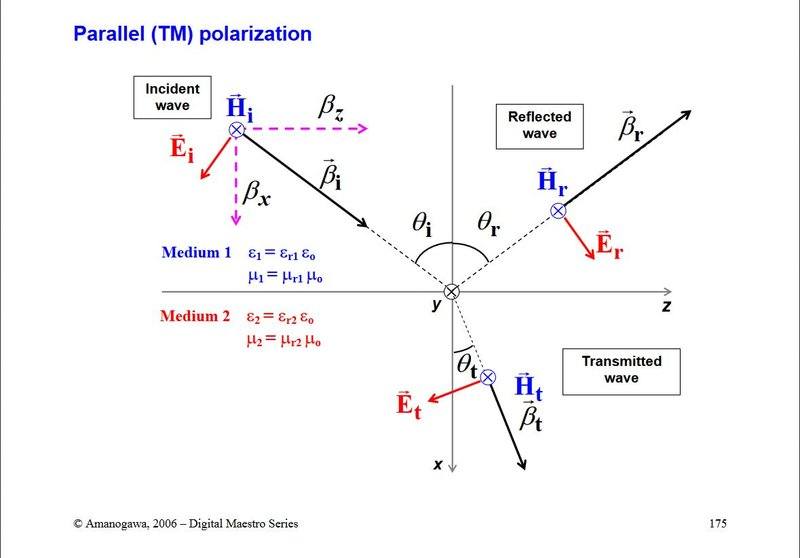
Here the TM case.
TM polarization.jpg


Picture3

Here the situation for the E field is right (if we choose the right hand rule) but the H field again should be out of the plane and not into the plane as depicted in Picture3. And why for TE (magnetic field Hi) and TM (electric filed Ei) have the opposite directions?
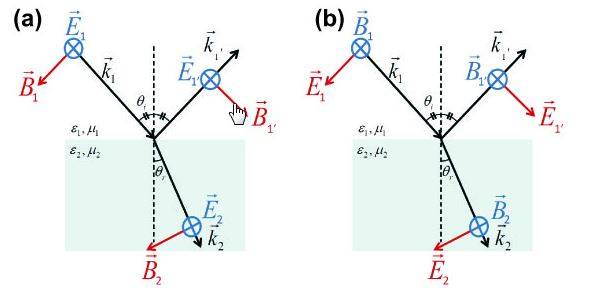
Here I found another picture (Picture4) where for the TE (magnetic field B) and electric field E for TM have the same directions.
TE TM polarization.jpg


Picture 4

Please help to understand this confusion.

Thank you.
 

Attachments

  • TE polarization.jpg
    TE polarization.jpg
    28.5 KB · Views: 7,047
  • TE polarization.jpg
    TE polarization.jpg
    28.5 KB · Views: 7,194
  • rhr.jpg
    rhr.jpg
    22 KB · Views: 4,458
  • TM polarization.jpg
    TM polarization.jpg
    26.7 KB · Views: 6,931
  • TE TM polarization.jpg
    TE TM polarization.jpg
    16.4 KB · Views: 6,621
Science news on Phys.org
Sorry for erratum, but for TM case the right hand rule works as it depicted in the Picture3. If we assume the magnetic field enters to incidence plane (X) then the electric field E should be directed as it shown in Picture3. But again the question remains for the TE case (Picture1). If we choose electric field enters to the incidence plane like (X) then the magnetic field should be directed exactly as electric field for the TM case and not as described in Picture1. Isn't it?

Thank you.
 
Dimani4 said:
Sorry for erratum, but for TM case the right hand rule works as it depicted in the Picture3. If we assume the magnetic field enters to incidence plane (X) then the electric field E should be directed as it shown in Picture3. But again the question remains for the TE case (Picture1). If we choose electric field enters to the incidence plane like (X) then the magnetic field should be directed exactly as electric field for the TM case and not as described in Picture1. Isn't it?

Thank you.
I think I got my mistake.
When I define the coordinates system according right hand rule to find the exact directions of the Electric and Magnetic field I should use again the right hand rule to find out the direction of the magnetic field according the formula (H=βi*Ei/ωμ) where β is the direction of propagation of our wave in the incident plane (as depicted for instance in Picture1). Then, to find out the direction of magnetic field which presenting in Picture1 we should just do cross product between the vector of the electric field Ei which as we supposed enters the incident plane (X) and direction of propagating wave. And if you do this you get the right result of the direction of the magnetic field as depicted in Picture1.
About the Picture3 (TM) the conclusions are the same. If we suppose that the magnetic field enters the incident plane the direction of electric field should be as depicted in Picture3 (if you do cross product between the β and the electric field you get the direction of the magnetic field vector should enter into the incident field).

After these conclusions I guess that the directions depicted in the Pictures4 are not right. The right directions depicted on Picture1 and Picture3.

Thank you.
 
EM waves propagate in the direction corresponding to E cross H. Hold the fingers of your right hand straight along E. Curl your fingers to align with H. The direction of your thumb will be the direction of propagation (k direction).
 
bstpeter said:
EM waves propagate in the direction corresponding to E cross H. Hold the fingers of your right hand straight along E. Curl your fingers to align with H. The direction of your thumb will be the direction of propagation (k direction).
Welcome to PF.

This thread that you are replying to is 5 years old, but your reply is okay. :smile:
 

Similar threads

  • · Replies 12 ·
Replies
12
Views
6K
  • · Replies 1 ·
Replies
1
Views
1K
Replies
5
Views
6K
  • · Replies 2 ·
Replies
2
Views
11K
  • · Replies 2 ·
Replies
2
Views
1K
  • · Replies 0 ·
Replies
0
Views
1K
Replies
2
Views
5K
  • · Replies 2 ·
Replies
2
Views
3K
  • · Replies 4 ·
Replies
4
Views
9K
  • · Replies 15 ·
Replies
15
Views
30K