Deflection of Prismatic Beam With Fixed Ends and Single Load

Click For Summary
SUMMARY

The discussion centers on the deflection of a prismatic beam with fixed ends subjected to a single load. The user attempted to apply standard equations to a modified scenario where the load is applied at the midpoint, expecting to derive reactions Ay and By as P/2. However, the results yielded By = P and Ay = 0, indicating a misunderstanding of the application of the equations. The user seeks validation of their approach to ensure confidence in their engineering solutions.

PREREQUISITES
  • Understanding of statically indeterminate beam theory
  • Familiarity with beam deflection equations
  • Knowledge of reaction forces in fixed beam systems
  • Basic skills in structural analysis
NEXT STEPS
  • Review the derivation of beam deflection equations for fixed supports
  • Study the principles of static equilibrium in structural analysis
  • Explore software tools for beam analysis, such as SAP2000 or ANSYS
  • Learn about validation techniques for engineering solutions in practice
USEFUL FOR

This discussion is beneficial for civil engineers, structural analysts, and students studying mechanics of materials who are looking to deepen their understanding of beam deflection and reaction forces in fixed-end scenarios.

Satonam
Messages
38
Reaction score
1
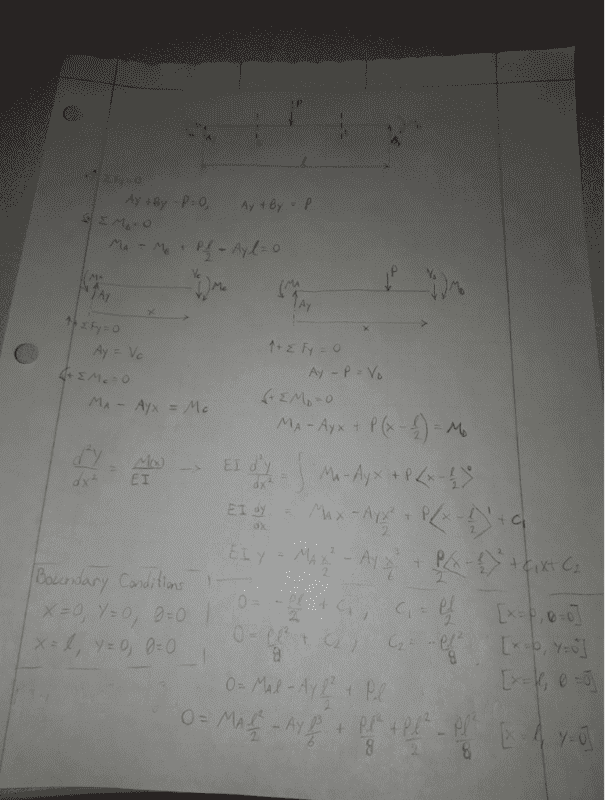
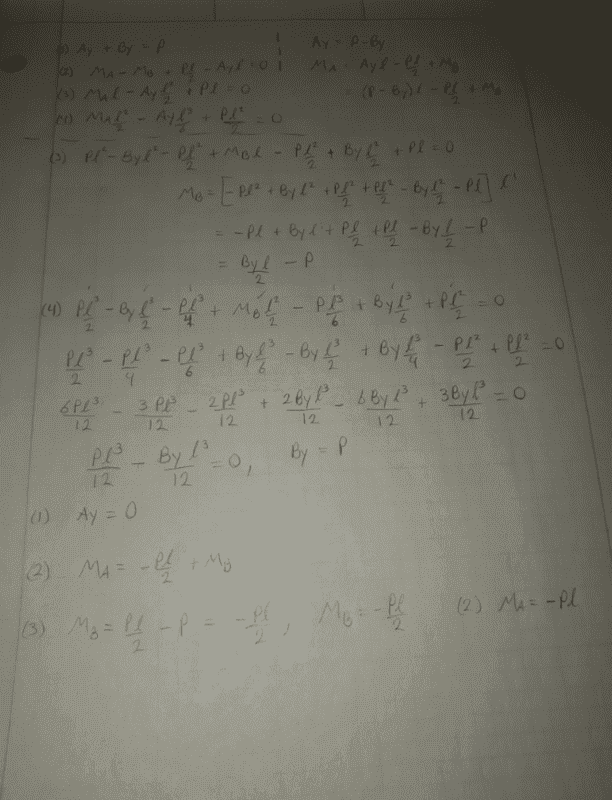
I've been refreshing my mind with regards to solving statically indeterminate beam deflection problems. In an effort to achieve confidence over my solutions, I attempted to recreate the standard equations in Figure 1. In my problem, I changed it so that:
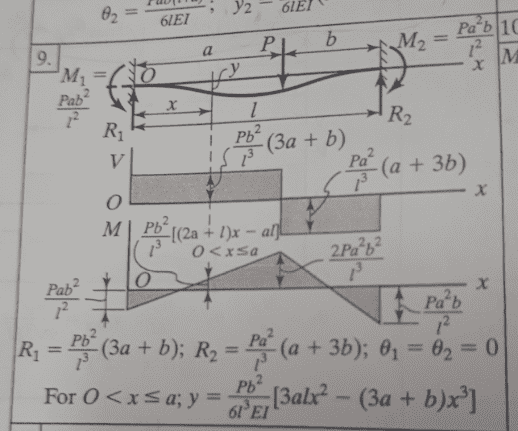
  • a = b = L/2
  • Ay = R1
  • By = R2
  • etc.
However, while I expected the equations to naturally spit out Ay = By = P/2 as one would expect, I got By = P and Ay = 0. Can you find Waldo in Figure 2 and 3?

upload_2019-3-15_15-37-23.png
Figure 1

upload_2019-3-15_15-34-57.png
Figure 2

upload_2019-3-15_15-36-2.png
Figure 3
 

Attachments

  • upload_2019-3-15_15-34-57.png
    upload_2019-3-15_15-34-57.png
    70.8 KB · Views: 620
  • upload_2019-3-15_15-36-2.png
    upload_2019-3-15_15-36-2.png
    69.2 KB · Views: 608
  • upload_2019-3-15_15-37-23.png
    upload_2019-3-15_15-37-23.png
    38.1 KB · Views: 591
Engineering news on Phys.org
Why not use the equations as written with your numbers rather than try to refactor it?
 
Due to my inexperience in a real engineering environment, I don't feel confident using an equation I can't even derive. Since I won't have a professor to tell me I'm right after graduation, I'm trying to figure out how to create that validation on my own so that I can provide my employer with a solution I know will work.
 

Similar threads

Replies
6
Views
4K
Replies
3
Views
3K
  • · Replies 13 ·
Replies
13
Views
5K
  • · Replies 10 ·
Replies
10
Views
2K
  • · Replies 8 ·
Replies
8
Views
3K
  • · Replies 5 ·
Replies
5
Views
6K
Replies
33
Views
5K
  • · Replies 1 ·
Replies
1
Views
2K
Replies
5
Views
2K
  • · Replies 3 ·
Replies
3
Views
2K