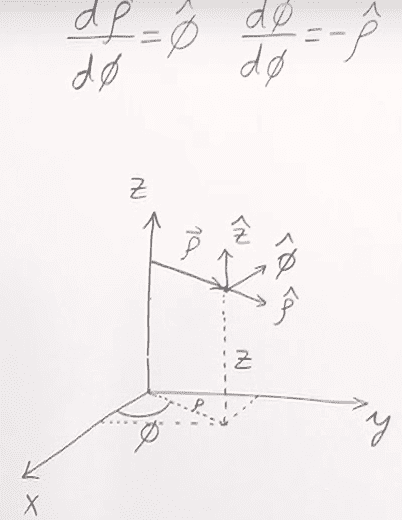
Del operator in a Cylindrical vector fucntion

Click For Summary
SUMMARY

The discussion centers on the properties of the del operator in cylindrical coordinates, specifically the derivatives ∂r^/∂Φ = Φ^ and ∂Φ/∂Φ = -r^. These derivatives are essential for deriving the divergence of a vector function in cylindrical coordinates. Participants emphasize that applying the definition of the derivative to the unit vector r^, expressed as (cos Φ, sin Φ), clarifies these relationships. A reference to a related discussion on Physics Forums is provided for further understanding.

PREREQUISITES
  • Understanding of cylindrical coordinates and their unit vectors
  • Familiarity with vector calculus concepts, particularly divergence
  • Knowledge of the definition of derivatives in multivariable calculus
  • Basic proficiency in LaTeX for mathematical formatting
NEXT STEPS
  • Study the derivation of divergence in cylindrical coordinates
  • Learn about the properties of unit vectors in polar and cylindrical systems
  • Explore the application of the del operator in various coordinate systems
  • Review the LaTeX tutorial for formatting mathematical expressions
USEFUL FOR

Students and professionals in mathematics, physics, and engineering who are working with vector calculus and cylindrical coordinate systems.

TheColector
Messages
29
Reaction score
0
Hi there
  1. I'm having a hard time trying to understand how come ∂r^/∂Φ = Φ^ ,∂Φ/∂Φ = -r^ -> these 2 are properties that lead to general formula.
  2. I've been thinking about it and I couldn't explain it. I understand every step of "how to get Divergence of a vector function in Cylindrical Coordinates" except for these formulas below.
upload_2018-6-12_1-7-36.png
A picture attached for visualization.
3.

DC-1504v1.png
General formula
Thanks for any help.
 

Attachments

  • upload_2018-6-12_1-7-36.png
    upload_2018-6-12_1-7-36.png
    28.5 KB · Views: 996
  • DC-1504v1.png
    DC-1504v1.png
    1.7 KB · Views: 826
Physics news on Phys.org
TheColector said:
Hi there
  1. I'm having a hard time trying to understand how come ∂r^/∂Φ = Φ^ ,∂Φ/∂Φ = -r^ -> these 2 are properties that lead to general formula.
  2. I've been thinking about it and I couldn't explain it. I understand every step of "how to get Divergence of a vector function in Cylindrical Coordinates" except for these formulas below.
View attachment 226837 A picture attached for visualization.
3.
View attachment 226838 General formula
Thanks for any help.
If you apply the definition of derivative, these formulas will fall right out. For ##\frac {\partial \hat r} {\partial \theta}##, start with ##\hat r = (cos \theta, sin \theta)##.
By the way, you can easily write ##\hat r## as ##\#\#\backslash hat~r\#\###. For more cool formatting tricks, see the LaTex tutorial.
 

Similar threads

  • · Replies 2 ·
Replies
2
Views
2K
  • · Replies 3 ·
Replies
3
Views
2K
  • · Replies 6 ·
Replies
6
Views
5K
  • · Replies 1 ·
Replies
1
Views
1K
Replies
5
Views
5K
  • · Replies 1 ·
Replies
1
Views
2K
  • · Replies 3 ·
Replies
3
Views
3K
  • · Replies 8 ·
Replies
8
Views
3K
  • · Replies 7 ·
Replies
7
Views
3K
  • · Replies 4 ·
Replies
4
Views
3K