Depth of NPT Holes: How to Fully Screw in Fittings Roy's Q&A

Click For Summary
SUMMARY

The discussion focuses on the proper design and tapping of 1/8" NPT (National Pipe Thread) holes for fittings. Key insights include the importance of achieving adequate thread engagement for leak-tight joints, with a minimum engagement length of 0.25 inches as per ANSI Standard B2.1-1968. Users noted that deeper taps allow for more threads but may leave excess unused threads, which can complicate assembly. Recommendations include consulting professional plumbing resources for standards and utilizing tapered reamers for precise hole depth.

PREREQUISITES
  • Understanding of NPT thread specifications and standards
  • Familiarity with ANSI Standard B2.1-1968
  • Knowledge of tapping techniques and tools
  • Experience with Autodesk Inventor for CAD design
NEXT STEPS
  • Research ANSI Standard B2.1-1968 for detailed NPT specifications
  • Learn about tapered reamers and their application in NPT hole preparation
  • Explore best practices for using thread sealants in NPT fittings
  • Study Autodesk Inventor's capabilities for customizing threaded hole depths
USEFUL FOR

Manufacturers, mechanical engineers, and designers involved in creating threaded fittings and ensuring leak-tight connections in piping systems.

Roy S Ramirez
Messages
24
Reaction score
4
TL;DR
I have no idea how to properly size an NPT hole.
Hello everybody!

I've notice that when using NPT fittings, the female fittings usually doesn't take all of the male threads:
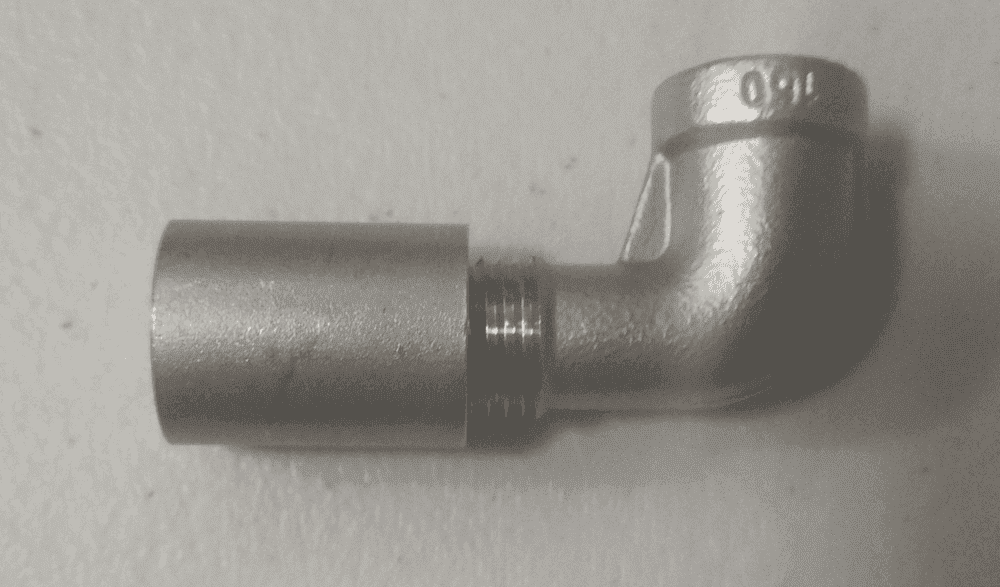
246121

This has never bothered me since these are commercial fittings and the engineers who designed them know what they are doing. But now, I need to make NPT holes in a metallic plate, and I'm concerned about this. Since the hole should be tapered, I noticed that the deeper I get the tap, the more threads the hole takes. For example, for a 1/8" NPT fitting, I drilled and tapped a hole in a 24 mm thick piece of wood and was able to screw it all in:
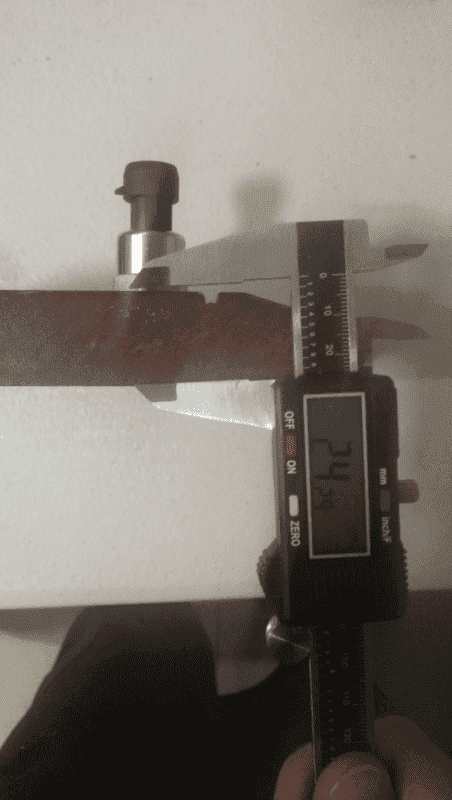
246124

But if I drill and tap a less deeper hole (closer to the actual length of the fitting), I get less threads in like in image 1. So it seems like the deeper I go the better, but this means making lots of threads that don't get use. In the second picture the fitting has a length of 10 mm while the hole is about 24 mm; that leaves 14 mm of unused threads!

Moreover, Autodesk Inventor makes me more confused. Whenever I try to add an NPT hole, it doesn't let me change the threaded section's depth:
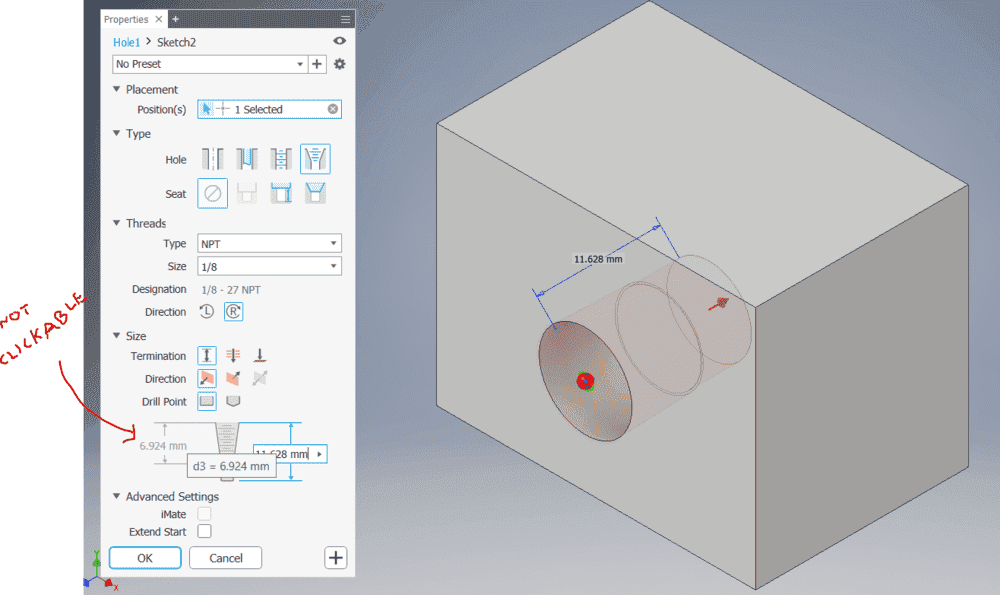
246125

So my question is how do I design 1/8" NPT holes?
This is the part I'm manufacturing, I have three fittings like the one in image 2, and I would like to be able to fully screw them in in these three holes:
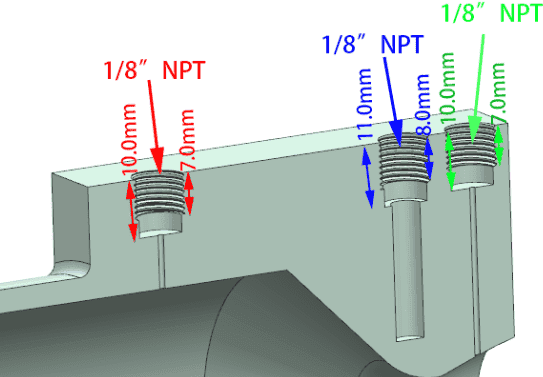
246126


Thank you for your help!

Roy
 
Engineering news on Phys.org
I don't get why you are concerned how many threads DON'T to in. I think what matters is how many threads DO go in and if you have enough for a good solid fit, who cares if there are more left over?
 
There is a standard for the depth of the tapped thread. It affects how leak tight the joint will be. If you can’t find it online, ask a professional plumbing supply house (not a retail outfit like Home Depot) or a commercial plumber.

BTW, NPT threads are spec’d in inches, not mm.
 
marcusl said:
There is a standard for the depth of the tapped thread. It affects how leak tight the joint will be. If you can’t find it online, ask a professional plumbing supply house (not a retail outfit like Home Depot) or a commercial plumber.

BTW, NPT threads are spec’d in inches, not mm.
Hello @marcusl , thanks! I think that 6.924 mm suggested by Inventor might be that standard depth
 
Extracted from ANSI Standard B2.1-1968, as printed in MACHINERY'S HANDBOOK, 23rd Edition. ISBN 0-8311-1200-X pgs. 1612-1614, 2383. Different dimensions apply for mechanical joints. Same ANSI Standard, succesive pgs., in Handbook.

Here are the standards for pressure-tight 1/8in. male pipe thread:
The taper allows the the large-diameter of the male threads to be partial depth thds. for 3.47 thds., or 0.1285in.

Outside Diameter: 0.405in.
Taper Inches per Foot: nominal 3/4; max 7/8; min 11/16
Pitch dia. at small end: 0.36351in.
Handtight engagement length: 0.1615in.
Minimum thd. engagement length for a tight joint: 0.25in.
Wrench engagement length (total): 0.2726

For female thds:
Minor dia.: 0.342in.
Pitch dia., straight part of thd.: min 0.3701in., max 0.3771in.

I suggest you get a copy.

Cheers,
Tom
 
Roy S Ramirez said:
So it seems like the deeper I go the better
As I recall the length should be just adequate for the sealant in use, but not longer since that makes assembly and disassembly problematic.

Also there was a trick in the old days to wrap the teflon tape (and, before that: hemp) in a way that it is thin at the beginning at the thread and it gets thicker later on: so the threads on the fitting were never (!) used in full length - that meant not enough sealant were used in this cone-like way.
Other advantage of this method was that leaks could be handled simply by tightening - you can't tighten an already fully screwed joint.
 
Roy S Ramirez said:
Summary: I have no idea how to properly size an NPT hole.

Since the hole should be tapered, I noticed that the deeper I get the tap, the more threads the hole takes
If you are the assembly person, turning and turning the fittings will just confuse you from what you expect.
You may have to report the fitting as being ? and reject it, just for that reason.
Stick to NPT guidelines, where I believe only a turn over or below is allowed,
See wiki for its chart and discussion.
https://en.wikipedia.org/wiki/National_pipe_thread
 
For obvious reasons I don't like pipe threads when the assembly is tightened and there are no threads left but it didn't take much torque to get it there. It certainly implies that it will not seal. Conversely, I don't like a lot of threads left over after the assembly is tightened especially with galvanized steel pipe. The reason is that the threads are not galvanized and are prone to oxidation. Thread sealant will help prevent this but it is not as desirable as being farther threaded together.
 
A set of tapered reamers corresponding to the NPT taps is useful. IIRC, the shoulder at the wide end will come flush with the surface when the ream is to correct depth, and the tap is then turned as deep as it will go in the tapered hole.
 
  • Informative
Likes   Reactions: Tom.G

Similar threads

Replies
3
Views
2K
  • · Replies 21 ·
Replies
21
Views
44K
  • · Replies 7 ·
Replies
7
Views
8K
  • · Replies 15 ·
Replies
15
Views
10K
  • · Replies 52 ·
2
Replies
52
Views
7K
  • · Replies 1 ·
Replies
1
Views
4K
  • · Replies 2 ·
Replies
2
Views
5K
  • · Replies 42 ·
2
Replies
42
Views
7K
  • · Replies 4 ·
Replies
4
Views
3K