Derivation of an Equivalent Spring Constant

3 replies · 28K views · last reply
Saladsamurai
Messages
3,009
Reaction score
7
Okay. I have been at this for two nights now. I want to derive, step by step, the equivalent spring constant of a Beam cantilevered at both ends with a loading at its center.

Here is a schematic with A=B=L/2
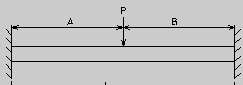
Schematic of a horizontal beam fixed at both ends, with a downward point load P at its centre; the two half-spans are labelled A on the left and B on the right.
Now I would like to use superposition to find the deflection at L/2 due to the loading. I know there are tables out there, but I want to "derive" this. (I know that I am not really deriving it since I am using superposition and tables...but bear with me).
Here are the equations I have at my disposal. Calling them from top to bottom 1-6,
I think that 1, 2, and 4 will prove the most useful, but I could be wrong.
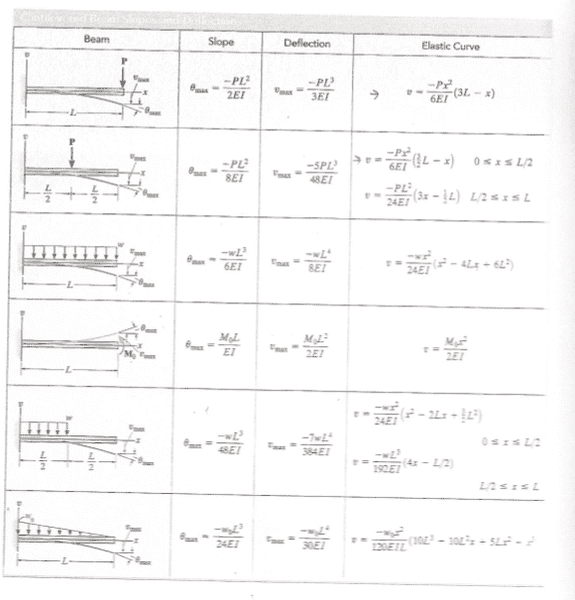
Table of beam deflection formulas with columns for beam diagram, slope, deflection and elastic curve, covering six cantilever and fixed-end loading cases.

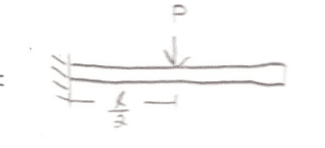
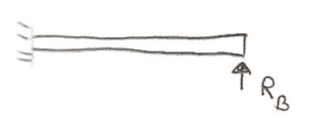
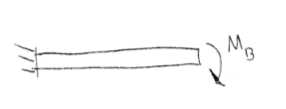
Now, if I replace the fixed end at the right with its reaction force and moment I have:
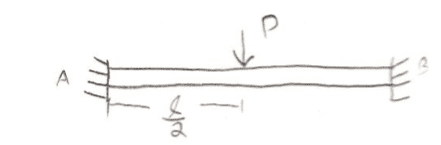
Hand-drawn schematic of a horizontal beam fixed at both ends, labeled A on the left and B on the right, with a downward point load P at the center and a span dimension of L/2 marked below the left half.


=

1
Hand-drawn schematic of a horizontal beam fixed at the left end by hatched support, with a downward point load P applied at the center. A dimension line below the left portion is labeled L/2.


+

2
Hand-drawn sketch of a horizontal beam fixed with hatching at the left end, with a vertical upward reaction arrow labeled R_B at the right end.


+

3
Hand-drawn sketch of a horizontal beam fixed at its left end, with a curved arrow labeled M_B at its right end indicating a moment.
 
Last edited:
From inspection we can see automatically that the reaction forces at both ends are given by:

RA=RB=P/2

The moments are giving me trouble though. I believe M=(1/12)*PL according to my mechanics book. But I could be wrong.

Can someone confirm that? And that the direction of MB is indeed clockwise?
 
See if this helps...it's from the bible according to Roark's. I have done this problem a long time ago but I'd have to dig it up. This should be quicker by giving you something to shoot for. Notice the max deflection values at x=a.
 
Attachments
  • Table of beam formulas from Roark's, case 14d: left end fixed, right end fixed, with a point load W at distance a. Lists reactions R_A, R_B, moments M_A, M_B, slopes and deflections, and maximum moment and deflection expressions.
    double-cantillever.JPG
    11.9 KB · Views: 916
This problem difficult because you can't determine the reaction moments through equilibrium alone (statically indeterminate). Therefore you need to use information about the deflection to solve the problem.

With the symmetry of the problem you know:

[tex]y(0) = y(L) = 0[/tex]

[tex]\frac{dy}{dx}_{x = 0} = \frac{dy}{dx}_{x = L/2} = \frac{dy}{dx}_{x = L} = 0[/tex]

Split the problem into two parts. Integrate the equation to get y' and y. Use the 3 relevant boundary conditions to solve for the two integration constants and the reaction moment Ma.

[tex]M(x) = EI \frac{d^2y}{dx^2} = -M_{A} + \frac{P}{2}(x)[/tex]

Good luck
 
Attachments
  • Diagram of a beam fixed at both ends with end moments Ma and Mb and vertical reactions, carrying two downward point loads labelled P/2 at its midspan.
    temp.PNG
    2.4 KB · Views: 865