Derivation of an Equivalent Spring Constant

Click For Summary

Discussion Overview

The discussion focuses on deriving the equivalent spring constant of a cantilever beam loaded at its center. Participants are exploring the theoretical aspects of beam deflection and the application of superposition in this context.

Discussion Character

  • Exploratory
  • Technical explanation
  • Mathematical reasoning

Main Points Raised

  • One participant expresses a desire to derive the equivalent spring constant using superposition and available equations, acknowledging the reliance on existing tables.
  • Another participant confirms the reaction forces at both ends as RA=RB=P/2 but expresses uncertainty regarding the moments, suggesting a moment value of M=(1/12)*PL and questions its direction.
  • A third participant references a source (Roark's) to provide guidance on maximum deflection values, indicating prior experience with the problem.
  • A fourth participant notes the difficulty in determining reaction moments through equilibrium alone due to the statically indeterminate nature of the problem and suggests using deflection information and boundary conditions to solve it.

Areas of Agreement / Disagreement

Participants generally agree on the need to use superposition and boundary conditions, but there is uncertainty regarding the calculation of moments and the specific approach to derive the equivalent spring constant. Multiple competing views and methods remain present in the discussion.

Contextual Notes

The discussion highlights limitations in determining reaction moments solely through equilibrium, emphasizing the need for additional information about deflection. There are also unresolved mathematical steps related to the integration of equations and the application of boundary conditions.

Saladsamurai
Messages
3,009
Reaction score
7
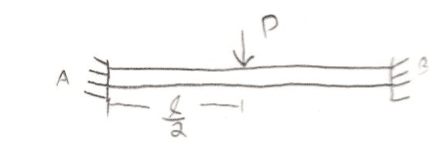
Okay. I have been at this for two nights now. I want to derive, step by step, the equivalent spring constant of a Beam cantilevered at both ends with a loading at its center.

Here is a schematic with A=B=L/2
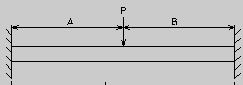
Picture3-12.png
Now I would like to use superposition to find the deflection at L/2 due to the loading. I know there are tables out there, but I want to "derive" this. (I know that I am not really deriving it since I am using superposition and tables...but bear with me).
Here are the equations I have at my disposal. Calling them from top to bottom 1-6,
I think that 1, 2, and 4 will prove the most useful, but I could be wrong.
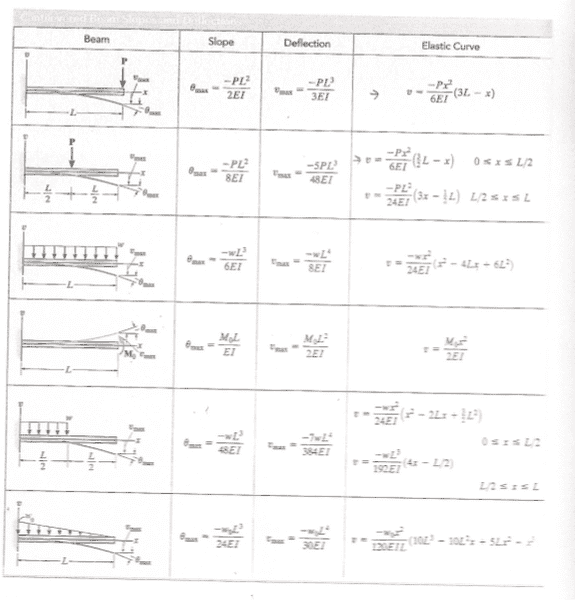
Picture4-5.png

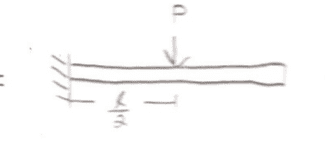
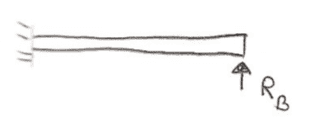
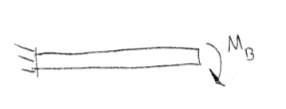
Now, if I replace the fixed end at the right with its reaction force and moment I have:
Picture5-4.png


=

1
Picture6-2.png


+

2
Picture7-1.png


+

3
Picture8.png
 
Last edited:
Engineering news on Phys.org
From inspection we can see automatically that the reaction forces at both ends are given by:

RA=RB=P/2

The moments are giving me trouble though. I believe M=(1/12)*PL according to my mechanics book. But I could be wrong.

Can someone confirm that? And that the direction of MB is indeed clockwise?
 
See if this helps...it's from the bible according to Roark's. I have done this problem a long time ago but I'd have to dig it up. This should be quicker by giving you something to shoot for. Notice the max deflection values at x=a.
 

Attachments

  • double-cantillever.JPG
    double-cantillever.JPG
    11.9 KB · Views: 886
This problem difficult because you can't determine the reaction moments through equilibrium alone (statically indeterminate). Therefore you need to use information about the deflection to solve the problem.

With the symmetry of the problem you know:

y(0) = y(L) = 0

\frac{dy}{dx}_{x = 0} = \frac{dy}{dx}_{x = L/2} = \frac{dy}{dx}_{x = L} = 0

Split the problem into two parts. Integrate the equation to get y' and y. Use the 3 relevant boundary conditions to solve for the two integration constants and the reaction moment Ma.

M(x) = EI \frac{d^2y}{dx^2} = -M_{A} + \frac{P}{2}(x)

Good luck
 

Attachments

  • temp.PNG
    temp.PNG
    2.4 KB · Views: 835

Similar threads

  • · Replies 13 ·
Replies
13
Views
6K
Replies
6
Views
4K
Replies
4
Views
2K
  • · Replies 2 ·
Replies
2
Views
1K
Replies
3
Views
3K
  • · Replies 4 ·
Replies
4
Views
5K
  • · Replies 15 ·
Replies
15
Views
3K
  • · Replies 4 ·
Replies
4
Views
4K
Replies
33
Views
5K
Replies
52
Views
13K