Derivative of a Function: Understanding Slope and Continuity

grace77
Messages
43
Reaction score
0
Problem statement

ImageUploadedByPhysics Forums1394018429.382539.jpg

My question is for number 27.
Revelant equation
None

Attempt at a solution

I'm not sure where to start.
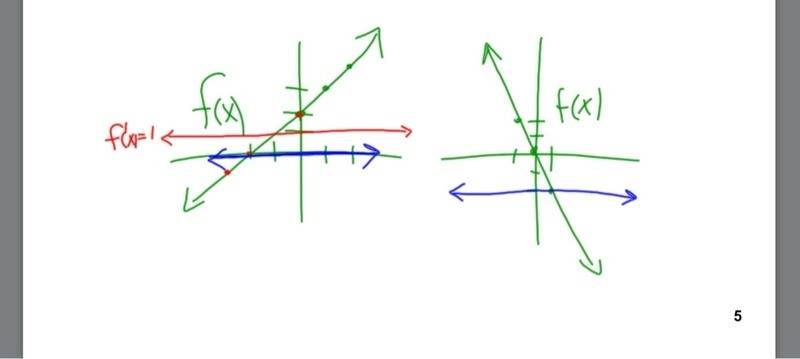
ImageUploadedByPhysics Forums1394018545.381550.jpg
ImageUploadedByPhysics Forums1394018553.886597.jpg


This is my teachers answer. I understand how the slope is 1 for x greater than -1 and that it is -2 at x greater than -1 and that there is a point at (0,-1) but I don't understand how they connect to form that final pic. I think I'm missing something ,can someone help me?
 
on Phys.org
Never mind I think I understand it now. I think I was just confused by the previous picture leading up to the answer.
 
grace77 said:
Never mind I think I understand it now. I think I was just confused by the previous picture leading up to the answer.
Maybe someone could elaborate on this for me? Thanks
 
grace77 said:
Maybe someone could elaborate on this for me? Thanks

What does it mean for a function to be continuous ?
 
SammyS said:
What does it mean for a function to be continuous ?

That there are no breaks or holes
 
If f'(x)= 1, for x< -1, then f(x)= x+ C1 for some constant C1, for x< -1, so the graph is a straight line with slope 1.

If f'(x)= -2, for x> -1, then f(x)= -2x+ C2 for some constant C2, for x> -1, so the graph is a straight line with slope -2.

Since f is continuous, the two lines must meet at x= -1. That means that -1+ C1= -2(-1)+ C2.

That, together with f(0)= C2= -1 is sufficient to determine both C2 and C1.
 

Similar threads

  • · Replies 11 ·
Replies
11
Views
2K
Replies
7
Views
2K
  • · Replies 11 ·
Replies
11
Views
2K
  • · Replies 4 ·
Replies
4
Views
2K
Replies
2
Views
2K
  • · Replies 8 ·
Replies
8
Views
4K
Replies
6
Views
2K
Replies
23
Views
2K
  • · Replies 20 ·
Replies
20
Views
4K
  • · Replies 1 ·
Replies
1
Views
1K