Derive The Transfer Function from First Principles

Join the discussion
Ask a follow-up here, or get your own question answered by working scientists, mathematicians and engineers — people, not an autocomplete.
Real named experts · corrections over time · the nuance an AI answer skips
7 replies · 4K views
optically challenged
Messages
4
Reaction score
0
All,

I need help deriving the Transfer Function of this circuit from first principles.
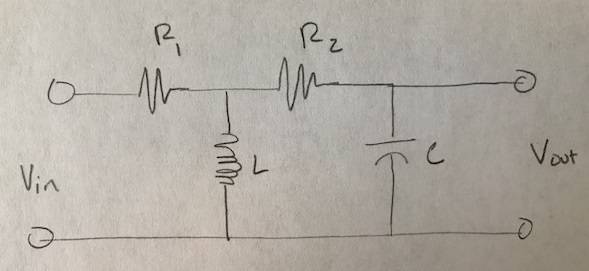
24v3z9s.jpg

http://i66.tinypic.com/24v3z9s.jpg
 
Engineering news on Phys.org
anorlunda said:
Do you consider Ohm's Law first principle ?
Yes
 
In short, No. No intro of circuit analysis and parallel/series combinations. Basically given this with one previous example and told to go figure it out. This is for a course in Signal Analysis.

Thanks Anorlunda, I will post it there.
 
Simplest way to attack this (i.e. how I would attack a similar problem at work).

1. Replace all devices with a general impedance (call it, for example, Z, so R1 = Z1, R2 = Z2, L = Z3, C = Z4.)
2. Solve the now trivial three-node voltage divider problem using KCL.
3. Replace all the Zs with their actual impedences (e.g. Z1 = R1, Z2 = R2, Z3 = sL, Z4 = 1/sC)
4. Simplify the expression and you're done!
 
That's not nice for the teacher to give you that problem without the proper background.

If you are only interested in this problem, use @analogdesign 's advice in post #6. But basic circuits is something you'll surely need in your career. It is worth your time to learn it. A very effective and fast way to learn is using Khan Academy. It takes less than 5 hours there to learn a whole basic circuits course.

https://www.khanacademy.org/science/physics/circuits-topic#circuits-resistance