Deriving Bernoulli's Equation Using Euler's Law of Motion

Click For Summary
SUMMARY

This discussion focuses on deriving Bernoulli's Equation using Euler's Law of Motion, specifically addressing the pressure differences acting on a particle in motion. The participants clarify that the pressure at the top of the particle is higher than at the bottom, leading to a net force that opposes the motion. The expression (P + dP) indicates a change in pressure, but does not inherently imply that dP is positive. This nuanced understanding is crucial for accurately applying Bernoulli's principles in fluid dynamics.

PREREQUISITES
  • Understanding of Bernoulli's Equation
  • Familiarity with Euler's Law of Motion
  • Basic knowledge of fluid dynamics concepts
  • Ability to interpret pressure diagrams in fluid mechanics
NEXT STEPS
  • Study the derivation of Bernoulli's Equation in detail
  • Explore applications of Euler's Law of Motion in fluid dynamics
  • Learn about pressure distribution in fluid flow
  • Investigate the implications of pressure differences on particle motion
USEFUL FOR

Students and professionals in physics, engineering, and fluid dynamics who seek to deepen their understanding of fluid behavior and the mathematical principles governing it.

yjl
Messages
8
Reaction score
0
Hi all,

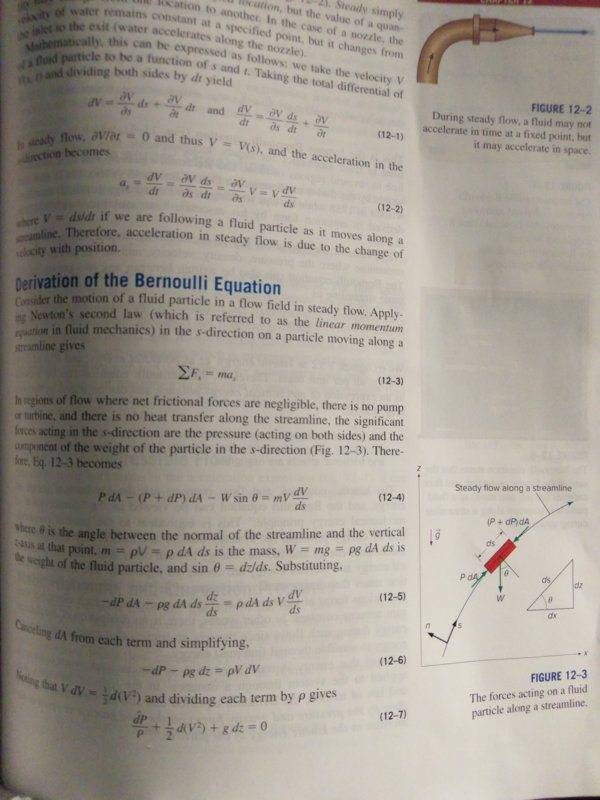
I have attached an image of a page out of the book I am using for context. The blue arrow in Figure 12-3 describes the motion of the particle. I figured the net force would need to be in the same direction, but apparently the net force opposes the motion. So, in Figure 12-3 the pressure at the top of the particle is higher than the pressure at the bottom (P + dP versus P). I am wondering why this is the case.
245740
 
Last edited:
Physics news on Phys.org
Hello yjl, :welcome: !

Where does it say ##dp > 0 ## ?
 
  • Like
Likes   Reactions: yjl
BvU said:
Hello yjl, :welcome: !

Where does it say ##dp > 0 ## ?

Thank you :-)

Nowhere explicitly. But surely there must be a good reason for assuming the top part of the particle to have a greater pressure.

Is it not true that the net force in Figure 12-3 would make the particle accelerate towards the x-axis?
 
What net force ?
 
  • Like
Likes   Reactions: yjl
BvU said:
What net force ?

The net force due to the pressure difference when dP > 0.
 
The expression ##(P+dP)## does not mean that dP is positive. It only means that pressure changes from one end of the free body to the other. But dP can also be negative.
 
  • Like
Likes   Reactions: yjl
Chestermiller said:
The expression ##(P+dP)## does not mean that dP is positive. It only means that pressure changes from one end of the free body to the other. But dP can also be negative.

Ah.
Well, thank you :-).
I see now that that was what BvU was hinting at.
 

Similar threads

  • · Replies 1 ·
Replies
1
Views
2K
  • · Replies 4 ·
Replies
4
Views
2K
  • · Replies 20 ·
Replies
20
Views
3K
  • · Replies 23 ·
Replies
23
Views
4K
  • · Replies 13 ·
Replies
13
Views
3K
  • · Replies 30 ·
2
Replies
30
Views
4K
  • · Replies 35 ·
2
Replies
35
Views
4K
  • · Replies 14 ·
Replies
14
Views
2K
  • · Replies 4 ·
Replies
4
Views
2K
  • · Replies 7 ·
Replies
7
Views
2K
