crick
- 39
- 4
Consider a waveguide with axis parallel to axis ##z##. Using cartesian coordinates the fields inside the waveguide can be written as

Where ##\alpha## is the wavenumber and ##k=\frac{\omega}{c}## .
The maxwell equations ##\nabla \times E=-\frac{\partial B}{\partial t}## and ##\nabla \times B=\epsilon \mu \frac{\partial E}{\partial t}## are written in components as
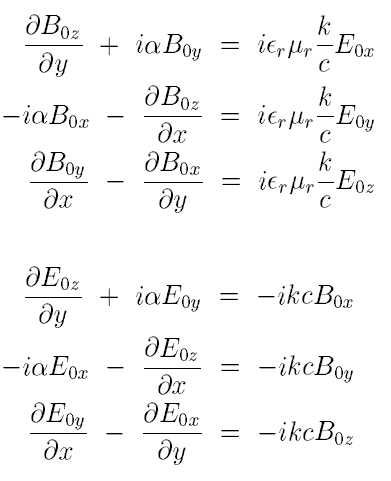 ##\tag{(A)}##While the maxwell equations ##\nabla \cdot E=-\frac{\partial B}{\partial t}## and ##\nabla \cdot B=\epsilon \mu \frac{\partial E}{\partial t}## are written in components as
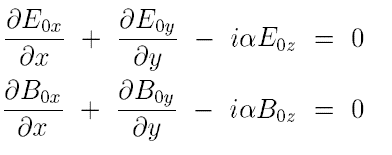
##\tag{(B)}##
On textboox it is claimed that equations ##B## are not useful, since they can obtained from equations ##A##. So how to obtain equations ##B## using equations ##A##?
Where ##\alpha## is the wavenumber and ##k=\frac{\omega}{c}## .
The maxwell equations ##\nabla \times E=-\frac{\partial B}{\partial t}## and ##\nabla \times B=\epsilon \mu \frac{\partial E}{\partial t}## are written in components as
##\tag{(B)}##
On textboox it is claimed that equations ##B## are not useful, since they can obtained from equations ##A##. So how to obtain equations ##B## using equations ##A##?