Deriving the electromagnetic field strength tensor

Click For Summary
SUMMARY

The discussion focuses on deriving the electromagnetic field strength tensor, specifically the relationship between the components of the tensor and the use of identities such as the Levi-Civita symbol and Kronecker delta. Participants clarify the derivation steps involving the identity ##\varepsilon_{ijk}\varepsilon_{ilm} = \delta_{jl}\delta_{km} - \delta_{jm}\delta_{kl}## and the implications of summation over indices. The conversation emphasizes the importance of understanding the notation and identities used in tensor calculus, particularly in the context of electromagnetism.

PREREQUISITES
  • Understanding of tensor calculus and notation
  • Familiarity with the Levi-Civita symbol and Kronecker delta
  • Basic knowledge of electromagnetism and field theory
  • Proficiency in vector calculus, particularly curl operations
NEXT STEPS
  • Study the derivation of the electromagnetic field strength tensor in detail
  • Learn about the properties and applications of the Levi-Civita symbol
  • Explore the relationship between vector potentials and magnetic fields using curl operations
  • Investigate tensor identities and their implications in theoretical physics
USEFUL FOR

This discussion is beneficial for physics students, researchers in theoretical physics, and anyone interested in understanding the mathematical foundations of electromagnetism and tensor analysis.

rwooduk
Messages
757
Reaction score
59
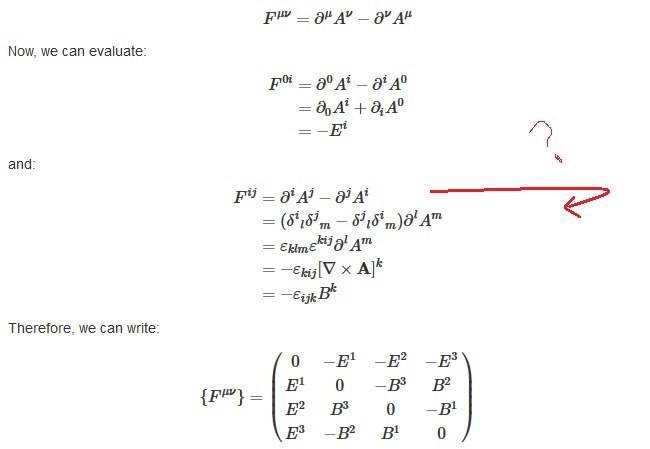
Just one last question today if someone can help. I'm trying to derive the electromagnetic field strength tensor and having a little trouble with (i think) the use of identities, please see below:
YWH2xbX.jpg


I understand the first part to get -Ei, but it's the second line of the next bit I don't understand. I see he wants to get line one to the form he has done so he can use the following identity:

##\varepsilon _{ijk}\varepsilon _{ilm} = \delta _{jl}\delta _{km} - \delta _{jm}\delta _{kl}##

But I'm unsure how he has got there and line 2 to 3 looks a little iffy. I've tried using ##\delta _{ij}\delta _{jk} = \delta _{ik}## but that didn't go very well, and also I've always thought something of the form ##\delta_{i}^{l} ## was the kroneka delta function, so I'm unsure how it would come in here.

If someone can help by putting a couple of inbetween stages in the derivation it would really help my understanding of what is going on and the notation / identities he's used.
 
Physics news on Phys.org
## \delta^{i}{}_l\delta^{j}{}_m \partial^lA^m= \partial^iA^j##

etc.
 
  • Like
Likes   Reactions: rwooduk
Thanks for the reply, I can see that relation by looking at the difference between the lines, but how did he get the ## \partial^iA^j## term to equal that?
thanks again
 
The sum over ##m## when there is a ##\delta_i^m## is non-zero only when ##i = m## and you can replace the ##m## sum by simply replacing the other ##m## by the ##i## and removing the delta.
 
  • Like
Likes   Reactions: rwooduk
Orodruin said:
The sum over ##m## when there is a ##\delta_i^m## is non-zero only when ##i = m## and you can replace the ##m## sum by simply replacing the other ##m## by the ##i## and removing the delta.

ahh ok i see so j must = m and i must = m so it goes to Am. And likewise i must = l and j must = l therefore it goes to delta l. This is probably a stupid question, but wouldn't you then get zero in the bracket? i.e. (1-1)
 
rwooduk said:
This is probably a stupid question, but wouldn't you then get zero in the bracket? i.e. (1-1)
No. In one of the terms the i replaces the l and in the other it replaces the m. This gives different terms.
 
  • Like
Likes   Reactions: rwooduk
Orodruin said:
No. In one of the terms the i replaces the l and in the other it replaces the m. This gives different terms.

hmm, kind of got that, ok thanks, will work on this some more.

Thanks for all the replies.
 
Isn't this way too complicated? I usually write
$$F^{ij}=\partial^{i} A^{j} - \partial^{j} A^i=-(\partial_i A^j-\partial_{j} A^{i})=-\epsilon^{ijk} B^{k},$$
where one has to keep in mind that
$$\partial^i=-\partial_i=\frac{\partial}{\partial x^i}$$
and then use that
$$\vec{B}=\vec{\nabla} \times \vec{A}.$$
 
  • Like
Likes   Reactions: rwooduk
vanhees71 said:
-(\partial_i A^j-\partial_{j} A^{i})=-\epsilon^{ijk} B^{k},$$

do you go from LHS to RHS from memory, or are you saying you used the things you say below it? It's the steps inbetween I'm interested in.

would welcome a simpler 'derivation' of this step though
 
  • #10
This is simply the definition of the curl operation and the vector potential by ##\vec{B}=\vec{\nabla} \times \vec{A}##.
 
  • Like
Likes   Reactions: rwooduk

Similar threads

  • · Replies 2 ·
Replies
2
Views
1K
  • · Replies 43 ·
2
Replies
43
Views
7K
  • · Replies 2 ·
Replies
2
Views
2K
  • · Replies 4 ·
Replies
4
Views
3K
  • · Replies 51 ·
2
Replies
51
Views
9K
  • · Replies 7 ·
Replies
7
Views
3K
  • · Replies 4 ·
Replies
4
Views
2K
  • · Replies 10 ·
Replies
10
Views
3K
  • · Replies 3 ·
Replies
3
Views
1K
  • · Replies 4 ·
Replies
4
Views
4K