Deriving the kinetic energy equation?

Click For Summary
SUMMARY

The discussion focuses on deriving the kinetic energy equation using calculus, specifically through the Work-Energy Theorem. The steps include rewriting work as an integral, expressing force in terms of velocity, and integrating over the change in velocity. A key point of inquiry is the interchangeability of the differentials "dv" and "dr," which is explained through the concept of dot products commuting and the parametrization of the path as a function of time.

PREREQUISITES
  • Understanding of the Work-Energy Theorem
  • Familiarity with calculus, particularly integration and differentiation
  • Knowledge of vector calculus and dot products
  • Concept of parametrization in line integrals
NEXT STEPS
  • Study the Work-Energy Theorem in classical mechanics
  • Learn about vector calculus and the properties of dot products
  • Explore line integrals and their applications in physics
  • Investigate the relationship between velocity and acceleration in calculus
USEFUL FOR

Students of physics, educators teaching mechanics, and anyone interested in the mathematical foundations of kinetic energy derivation.

EchoRush
Messages
9
Reaction score
1
Hello, I just have a quick question on deriving the kinetic energy formula using calculus. I understand most of it, I just have a question about one of the steps. here are the steps.

  • Begin with the Work-Energy Theorem.The work that is done on an object is related to the change in its kinetic energy.
    • \Delta K=W
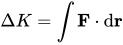
  • Rewrite work as an integral.The end goal is to rewrite the integral in terms of a velocity differential.
    \Delta K=\int {\mathbf  {F}}\cdot {\mathrm  {d}}{\mathbf  {r}}
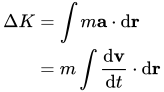
  • Rewrite force in terms of velocity.Note that mass is a scalar and can therefore be factored out.
    {\begin{aligned}\Delta K&=\int m{\mathbf  {a}}\cdot {\mathrm  {d}}{\mathbf  {r}}\\&=m\int {\frac  {{\mathrm  {d}}{\mathbf  {v}}}{{\mathrm  {d}}t}}\cdot {\mathrm  {d}}{\mathbf  {r}}\end{aligned}}
  • Rewrite the integral in terms of a velocity differential.Here, it is trivial, because dot products commute. Recall the definition of velocity as well.
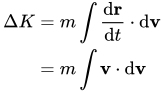
    {\begin{aligned}\Delta K&=m\int {\frac  {{\mathrm  {d}}{\mathbf  {r}}}{{\mathrm  {d}}t}}\cdot {\mathrm  {d}}{\mathbf  {v}}\\&=m\int {\mathbf  {v}}\cdot {\mathrm  {d}}{\mathbf  {v}}\end{aligned}}


  • Integrate over change in velocity. Typically, initial velocity is set to 0.
    {\begin{aligned}\Delta K&={\frac  {1}{2}}mv^{{2}}-{\frac  {1}{2}}mv_{{0}}^{{2}}\\&={\frac  {1}{2}}mv^{{2}}\end{aligned}}


    My question is about step number 4. Why were we just able to flip the "dv" and the "dr" like that? What do they mean when they say "dot products commute"? Why can we just switch around the 'dv" and the "dr"?
 
Physics news on Phys.org
EchoRush said:
My question is about step number 4. Why were we just able to flip the "dv" and the "dr" like that? What do they mean when they say "dot products commute"? Why can we just switch around the 'dv" and the "dr"?

One way to look at it is to start with a small but finite increment:

##\Delta \vec r \approx \vec v \Delta t##

## \Delta \vec v \cdot \Delta \vec r \approx (\Delta \vec v \cdot \vec v) \Delta t ##

## \frac{\Delta \vec v}{\Delta t} \cdot \Delta \vec r \approx \Delta \vec v \cdot \vec v##

And, in the limit we have:

## \frac{d \vec v}{dt} \cdot d \vec r = \vec v \cdot d\vec v##
 
  • Informative
Likes   Reactions: Dale
EchoRush said:
My question is about step number 4. Why were we just able to flip the "dv" and the "dr" like that? What do they mean when they say "dot products commute"? Why can we just switch around the 'dv" and the "dr"?
Here's a slighty more formal approach. We parametrise the path ##\vec r(t)## by time (*). I.e. we define the path as a function of time. This gives ##d \vec r = \frac{d \vec r}{dt} dt = \vec v dt##, hence:

##\int_{r_0}^{r_1} \frac{d \vec v}{dt} \cdot d \vec r = \int_{t_0}^{t_1} \frac{d \vec v}{dt} \cdot \vec v dt = \frac 1 2 \int_{t_0}^{t_1} \frac{d}{dt}(v^2) dt = \frac 1 2 (v^2(t_1) - v^2(t_0))##

(*) Note that a parameterisation of some sort is actually the definition of a line integral That's how you define what is meant by a line integral in the first place.
 
  • Informative
  • Like
Likes   Reactions: vanhees71 and Dale

Similar threads

  • · Replies 11 ·
Replies
11
Views
2K
  • · Replies 3 ·
Replies
3
Views
1K
  • · Replies 8 ·
Replies
8
Views
6K
  • · Replies 2 ·
Replies
2
Views
1K
  • · Replies 16 ·
Replies
16
Views
3K
  • · Replies 4 ·
Replies
4
Views
12K
  • · Replies 21 ·
Replies
21
Views
3K
  • · Replies 41 ·
2
Replies
41
Views
4K
  • · Replies 2 ·
Replies
2
Views
2K
  • · Replies 77 ·
3
Replies
77
Views
6K