Help with deriving the formula for kinetic energy (using calculus)

Join the discussion
Ask a follow-up here, or get your own question answered by working scientists, mathematicians and engineers — people, not an autocomplete.
Real named experts · corrections over time · the nuance an AI answer skips
8 replies · 6K views
EchoRush
Messages
9
Reaction score
1
Hello, I am learning how to use calculus to derive the formula for kinetic energy

now, I understandthe majority of the steps in how to do this, however, there is one step where I get totally lost, I will post a picture of the steps and I will circle the part where I get lost. If you see the part circled in BLUE, Why can we just “re-write” those variables? Why can we just switch the positions of the “v” and the “r”?
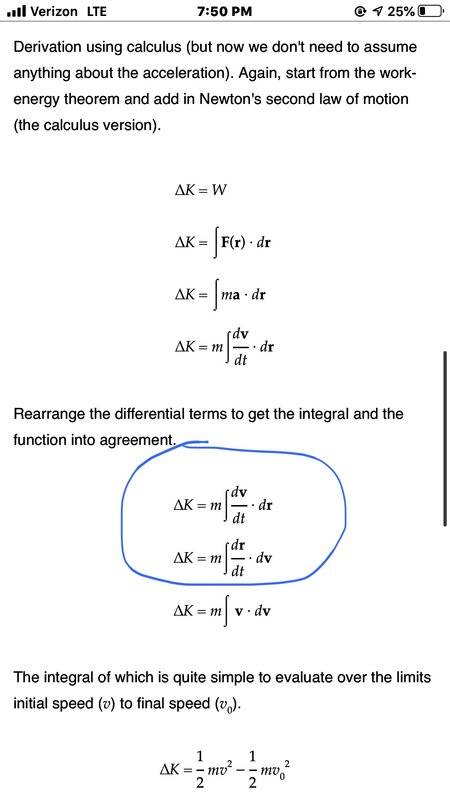
35FE6FA7-AFCC-4E58-8CE9-D4807278455E.jpeg
 
Physics news on Phys.org
It might help to write ##\frac{d \mathbf v}{dt}\cdot d\mathbf r## in terms of cartesian components as $$\frac{d v_x}{dt}dx + \frac{d v_y}{dt} dy+\frac{d v_z}{dt}dz$$

Using the chain rule, $$\frac{d v_x}{dt}dx = \left(\frac{d v_x}{dx}\frac{dx}{dt}\right)dx = \frac{dx}{dt}\left(\frac{d v_x}{dx}dx\right) $$

Note $$\frac{d v_x}{dx}dx = dv_x $$

So we end up with $$\frac{d v_x}{dt}dx = \frac{dx}{dt} dv_x = v_x \, dv_x$$

Similarly for the other cartesian components.
 
  • Like
Likes   Reactions: etotheipi, EchoRush and mpresic3
TSny said:
It might help to write ##\frac{d \mathbf v}{dt}\cdot d\mathbf r## in terms of cartesian components as $$\frac{d v_x}{dt}dx + \frac{d v_y}{dt} dy+\frac{d v_z}{dt}dz$$

Using the chain rule, $$\frac{d v_x}{dt}dx = \left(\frac{d v_x}{dx}\frac{dx}{dt}\right)dx = \frac{dx}{dt}\left(\frac{d v_x}{dx}dx\right) $$

Note $$\frac{d v_x}{dx}dx = dv_x $$

So we end up with $$\frac{d v_x}{dt}dx = \frac{dx}{dt} dv_x = v_x \, dv_x$$

Similarly for the other cartesian components.
Can you please explain what you mean when you say rewrite it in terms of Cartesian coordinates? How do you actually take (dv/dt) dr and rewrite it into Cartesian coordinates?
 
EchoRush said:
Can you please explain what you mean when you say rewrite it in terms of Cartesian coordinates? How do you actually take (dv/dt) dr and rewrite it into Cartesian coordinates?

The expression ##\large \frac{d \mathbf{v}}{dt} \cdot \normalsize d\mathbf{r}## represents the dot product of two vectors.

In unit vector notation (using cartesian basis vectors ##\hat i, \hat j,## and ##\hat k##), we can write

$$ \frac{d \mathbf{v}}{dt} = \frac{d{v_x}}{dt} \hat i + \frac{d{v_y}}{dt} \hat j + \frac{d{v_z}}{dt} \hat k $$
$$ d \mathbf {r} = dx \hat i + dy \hat j+ dz \hat k$$

The dot product can then be expressed as
$$ \frac{d \mathbf{v}}{dt} \cdot d\mathbf{r} = \frac{d{v_x}}{dt} dx + \frac{d{v_y}}{dt}dy+ \frac{d{v_z}}{dt} dz$$
 
##\mathbf{r}## is a vector pointing to the location in space of the location of ##\mathbf{v}## (where ##\mathbf{v}## is also a vector with the components of velocity). At this point you haven't decided whether you take ##\mathbf{r}## in Cartesian coordinates, meaning ##\mathbf{r} = [x, y, z]^T## or in cylindrical coordinates, meaning ##\mathbf{r} = [x, r, \theta]^T##, or spherical coordinates: ##\mathbf{r} = [r, \theta, \phi]^T##. So that is what it means to "rewrite ##\frac{d\mathbf{v}}{dt} \cdot \mathbf{dr}## into Cartesian components". It is deciding that ##\mathbf{r} = [x, y, z]^T##.

Don't forget that ##\mathbf{v}## must be described in the same coordinate system of course: ##\mathbf{v} = [v_x, v_y, v_z]^T##.
 
Looking back at my post #2, I don't like what I did. I said you could use the chain rule to write ##\large \frac{dv_x}{dt} = \frac{dv_x}{dx} \frac{dx}{dt}##. This doesn't take into account that in three dimensional space ##v_x## would generally depend on all three of the coordinates ##x, y,## and ##z## and not on just ##x##.

Here's another attempt. $$\frac {d \mathbf v}{dt} \cdot d \mathbf {r} = \frac {d \mathbf {v}}{dt} \cdot \frac {d \mathbf {r}}{dt} dt = \frac {d \mathbf {r}}{dt} \cdot \frac {d \mathbf {v}}{dt}dt= \frac {d \mathbf {r}}{dt} \cdot d \mathbf {v} $$

The second step just uses the commutative property ##\mathbf{A} \cdot \mathbf{B} = \mathbf{B} \cdot \mathbf{A}## for any two vectors ##\mathbf A## and ##\mathbf B##.
 
  • Like
Likes   Reactions: vanhees71
Arjan82 said:
At this point you haven't decided whether you take ##\mathbf{r}## in Cartesian coordinates, meaning ##\mathbf{r} = [x, y, z]^T## or in cylindrical coordinates, meaning ##\mathbf{r} = [x, r, \theta]^T##, or spherical coordinates: ##\mathbf{r} = [r, \theta, \phi]^T##.

This is not correct - only in a Cartesian coordinate system are the components of the position vector with respect to the basis also the coordinates.

In a spherical coordinate system, the position vector is ##\mathbf{r} = r \mathbf{e}_r##, i.e. the representation of ##\mathbf{r}## w.r.t. the spherical tangent basis is ##[r,0,0]^T##. This is not the same as the tuple ##(r, \theta, \phi)## of spherical coordinates identifying that point in the space.

In a cylindrical coordinate system, the position vector is ##\mathbf{r} = \rho \mathbf{e}_{\rho} + z\mathbf{e}_z##, i.e. the representation of ##\mathbf{r}## w.r.t. the cylindrical tangent basis is ##[\rho, 0, z]^T##. This is not the same as the tuple ##(\rho, \phi, z)## of cylindrical coordinates identifying that point in the space.

Really, it is best to only express position vectors with respect to a constant basis in the frame, e.g. a Cartesian basis.
 
  • Like
Likes   Reactions: Arjan82
I try to explain as the way keeping the terms in integral along any but fixed path.
[tex]\int \frac{d}{dt}v\cdot dr[/tex]
Changing integral variable from r to t
[tex]\int \frac{d}{dt}v\cdot \frac{dr}{dt}dt=\int \frac{d}{dt}v\cdot v dt[/tex]
Changing integral variable from t to v
[tex]\int dv \cdot v[/tex]
Often variables r and v are not monotonous along the path ,e.g. around top ends of pendulum, we should consider it in integration.
 
Last edited:
It's much simpler. The work is defined as the line integral of the forces along the trajectory of the particle in motion given these forces, i.e.,
$$W=\int_{t_1}^{t_2} \mathrm{d} t \dot{\vec{x}} \cdot \vec{F}[\vec{x}(t)].$$
Now along this trajectory Newton's Law of motion holds:
$$m \ddot{\vec{x}}=\vec{F}(\vec{x}).$$
Thus the work is also given by
$$W=\int_{t_1}^{t_2} \mathrm{d} t \dot{\vec{x}} \cdot m \ddot{\vec{x}}=\int_{t_1}^{t_2} \mathrm{d} t \frac{m}{2} \mathrm{d}_t (\dot{\vec{x}}^2) = \frac{m}{2} \dot{\vec{x}}^2(t_2)-\frac{m}{2} \dot{\vec{x}}(t_1).$$
That's why it is convenient to define a new quantity called "kinetic energy",
$$E_{\text{kin}}=\frac{m}{2} \dot{\vec{x}}^2=\frac{m}{2} \vec{v}^2.$$
Then we have just derived the "work-energy theorem",
$$W=E_{\text{kin}}(t_2)-E_{\text{kin}}(t_1).$$
 
  • Like
Likes   Reactions: TSny, Arjan82 and etotheipi