Describing Rolling Constraint for Rolling Disk With No Slipping

Join the discussion
Registration is free. Ask a follow-up in this thread, or start your own.
6 replies · 5K views
theshape89
Messages
5
Reaction score
2
Homework Statement
A disk rolls without slipping across a horizontal plane. The plane of the disk remains vertical, but it is free to rotate about a vertical axis. What generalized coordinates may be used to describe the motion? Write a differential equation describing the rolling constraint. I've attached a picture below.
Relevant Equations
Let ##\omega## be the angular velocity of a point on the edge of the disk and ##r## the radius of the disk. Then ##v_{tangential}=\omega r##.
Let ##R=\sqrt{x^{2} + y^{2}}##. Then
\begin{align}v_{tangential}&=\frac{dR}{dt} \nonumber\\
&=\frac{dR}{dx}\frac{dy}{dt} + \frac{dR}{dy}\frac{dy}{dt} \nonumber\\
&=\frac{x}{R}\frac{dx}{dt} + \frac{y}{R}\frac{dy}{dt} \nonumber\\
&= cos\phi \frac{dx}{dt} + sin\phi \frac{dy}{dt}.\nonumber \end{align}
Using ##v_{tangential}=\omega r##
##cos\phi \frac{dx}{dt} + sin\phi \frac{dy}{dt} = \frac{d\theta}{dt}r##​
or
##cos\phi dx+ sin\phi dy= d\theta r##​

I'm supposed to end up with
\begin{align}cos\phi dx+ sin\phi dy &= d\theta r\end{align}
and
\begin{align}\frac{dy}{dx}=tan\phi\end{align}.
But I'm not sure how to get (2). If I differentiate (1) w.r.t. ##x## and if the terms with ##\frac{d\phi}{dx}## disappear, I'm still left with ##cos\phi + sin\phi \frac{dy}{dx}=0##, which won't get me to (2).
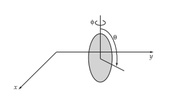
 

Attachments

  • Capture.PNG
    Capture.PNG
    1.3 KB · Views: 209
Physics news on Phys.org
Your working should have partial derivatives in a few places.
Looking at the diagram, it seems self-evident that the angle φ is the current direction of rolling, i.e. tan φ=dy/dx. But I don't understand how in your working you substituted cos φ for x/R and sin φ for y/R. That would imply y/x=tan φ.
 
haruspex said:
Your working should have partial derivatives in a few places.
Looking at the diagram, it seems self-evident that the angle φ is the current direction of rolling, i.e. tan φ=dy/dx. But I don't understand how in your working you substituted cos φ for x/R and sin φ for y/R. That would imply y/x=tan φ.
Thanks for the reply - looks like I completely messed this one up!

If I start from the start and now say that ##R## is the distance from the origin to the center of the disk, I see what you're saying about ##\frac{dy}{dx}=tan\phi##. Then, expanding ##dR##, I get (remembering to put in the partial derivatives this time!)
$$dR=\frac{\partial R}{\partial x}dx + \frac{\partial R}{\partial y} dy.$$
Where I now get confused is that it seems evident that
$$cos\phi=\frac{\partial x}{\partial R}$$
and
$$sin\phi=\frac{\partial y}{\partial R}.$$
Which then gives me
$$dR=\frac{1}{cos\phi}dx + \frac{1}{sin\phi} dy.$$
Where am I going wrong? I need to be getting
$$dR=cos\phi dx + sin\phi dy.$$
 
theshape89 said:
it seems evident that
$$cos\phi=\frac{\partial x}{\partial R}$$
No. If we introduce ##\psi## s.t. ##(R,\psi)## is ##(x,y)## in polar coordinates then $$cos\psi=\frac{\partial x}{\partial R}$$ But that is very different from ##\phi##.
Anyway, when using partial derivatives, it helps to bear in mind that strictly speaking one should always identify what variables are being kept constant. Much of the time it is obvious, but when you wrote ##\frac{\partial}{\partial R}##, what was being kept constant?
 
haruspex said:
No. If we introduce ##\psi## s.t. ##(R,\psi)## is ##(x,y)## in polar coordinates then $$cos\psi=\frac{\partial x}{\partial R}$$ But that is very different from ##\phi##.
Anyway, when using partial derivatives, it helps to bear in mind that strictly speaking one should always identify what variables are being kept constant. Much of the time it is obvious, but when you wrote ##\frac{\partial}{\partial R}##, what was being kept constant?
I believe we are keeping ##\phi## constant, since ##R## is constrained to move along the angle ##\phi##. I think I know what you're getting at; I'm not calculating the differential correctly. I can't in general vary ##x## without varying ##y## since ##R## is constrained to move along ##\phi##. I'll go away and return when I have more...
 
@theshape89 :

The disk moves along some curve in the x-y plane:
1670349665012.png


Consider a small element ##ds## of the curve. Let ##\phi## be the orientation of ##ds## relative to the x-axis.

1670348915519.png

You should be able to get equations (1) and (2) of your first post directly from this triangle and how ##ds## is related to the radius of the disk ##r##, and the amount ##d\theta## the disk rotates as it travels along ##ds##.