Design of a window opener mechanism -- problems

Click For Summary

Discussion Overview

The discussion revolves around the design of a window opener mechanism intended to facilitate easier operation of a window, particularly one situated on a roof angled at 45 degrees. Participants explore various mechanical designs and the challenges associated with them, including energy storage and potential energy considerations.

Discussion Character

  • Technical explanation
  • Debate/contested
  • Homework-related

Main Points Raised

  • One participant proposes using a spiral torsional spring to store energy as the window closes, which would then assist in opening the window.
  • Another participant requests clarification on the design, specifically the relationship between the wire and spring mechanism and the window, suggesting a need for more detailed drawings.
  • A participant mentions that the axle for the window will be geared 1:2, allowing for a 90-degree rotation of the pulley system.
  • Concerns are raised about the complexity of the proposed design, with suggestions to consider simpler alternatives, such as repositioning the window hinges or using counterbalances.
  • One participant suggests rotating the window about a vertical axis to eliminate potential energy changes, but this is countered by the original poster, who notes the specific requirement of the roof angle.
  • Another participant reiterates the vertical axis rotation idea but is met with the constraint of the roof's angle, leading to further discussion on the feasibility of the design.
  • There is a mention of the need for a good weather seal if the window is to be designed to open in a specific manner.
  • A participant points out a potential error in the original poster's formula, indicating a missing factor.

Areas of Agreement / Disagreement

Participants express differing opinions on the complexity and feasibility of the proposed designs, with no consensus reached on the best approach. Some suggest simpler alternatives while others defend the original design concept.

Contextual Notes

Participants highlight limitations in the design process, including the requirement for a novel mechanism that does not replicate existing solutions, as well as unresolved details regarding the mechanical setup and potential energy considerations.

Frederik
Messages
6
Reaction score
2
I have been struggling with this problem for a long time now, and are hoping you can help me. The assignment was to design a mechanism for opening a window with less effort. My way of solving this is to store energy in a spiral torsional spring as the window closes, which would be released when opening the window. I have tried to explain the resulting challenge in the picture below.
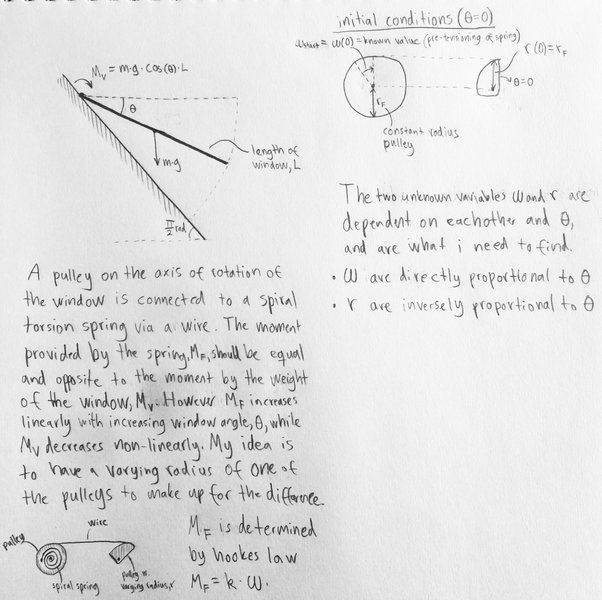
IMG_5547.jpg
 

Attachments

  • IMG_5547.jpg
    IMG_5547.jpg
    48.3 KB · Views: 614
Engineering news on Phys.org
Welcome to the PF.

Normally, schoolwork problems go in the Homework Help forums, but for projects like this where you show lots of work, we can sometimes allow them in the technical forums. I'll leave the thread here in ME for now.

I'm not seeing where the wire and spring mechanism are in relation to the window in your diagram in the upper left. Do you have more of a perspective drawing of the setup available? Or a drawing like in the upper left that shows where the wire is?
 
I hope these sketches illustrate the concept better:
IMG_5549.jpg
 

Attachments

  • IMG_5549.jpg
    IMG_5549.jpg
    38 KB · Views: 576
  • Like
Likes   Reactions: Tom.G and berkeman
The axle which the window rotates about will actually be geared 1:2, meaning the pulley with varying radius will turn 90 degrees, from a fully open to fylly closed position of the window (window opens 45 degrees).
 
Note that in your very first formula in post #1 a factor ##1\over 2## is missing.

Question: why such a complicated design if you could simply let the window hinges be halfway the window (ie where mg acts) instead of at the top ?

Or counterbalance above the hinges in your design with something as heavy as the window but smaller
 
  • Like
Likes   Reactions: Frederik
BvU said:
Note that in your very first formula in post #1 a factor ##1\over 2## is missing.

Question: why such a complicated design if you could simply let the window hinges be halfway the window (ie where mg acts) instead of at the top ?

Or counterbalance above the hinges in your design with something as heavy as the window but smaller
Such a window has already been produced by the company. Our lecturers want us to come up with a completely new design, not currently used by the company, therefore leaving out the simpler or more obvious mechanisms.
 
Why not rotate the window about a vertical axis, with the result that there is no change in potential energy required?
 
  • Like
Likes   Reactions: berkeman
Dr.D said:
Why not rotate the window about a vertical axis, with the result that there is no change in potential energy required?
That's not an option unfortunately, i should have mentioned that it's a window ment for a roof angled 45 degrees.
 
Frederik said:
That's not an option unfortunately, i should have mentioned that it's a window ment for a roof angled 45 degrees.
Seems like it would work fine. Put the axle down the middle of the window matching the slope of the roof. Turn the window 90 degrees (half in and half out of the roof) to open it. The main challenge will be to design a good weather seal that can work with such a window opening scheme & motion...
 
  • #10
Frederik said:
roof angled 45 degrees
The drawing in post # 1 says ##\pi/2## :rolleyes:
 
  • Like
Likes   Reactions: Frederik

Similar threads

  • · Replies 11 ·
Replies
11
Views
6K
Replies
3
Views
2K
  • · Replies 9 ·
Replies
9
Views
3K
  • · Replies 4 ·
Replies
4
Views
4K
Replies
4
Views
2K
  • · Replies 22 ·
Replies
22
Views
3K
  • · Replies 6 ·
Replies
6
Views
9K
Replies
7
Views
4K
  • · Replies 7 ·
Replies
7
Views
3K
Replies
4
Views
2K